Water & Steam
Court-Bouillon Poaching
Gently poaching fish or vegetables in an aromatic, acidulated broth.
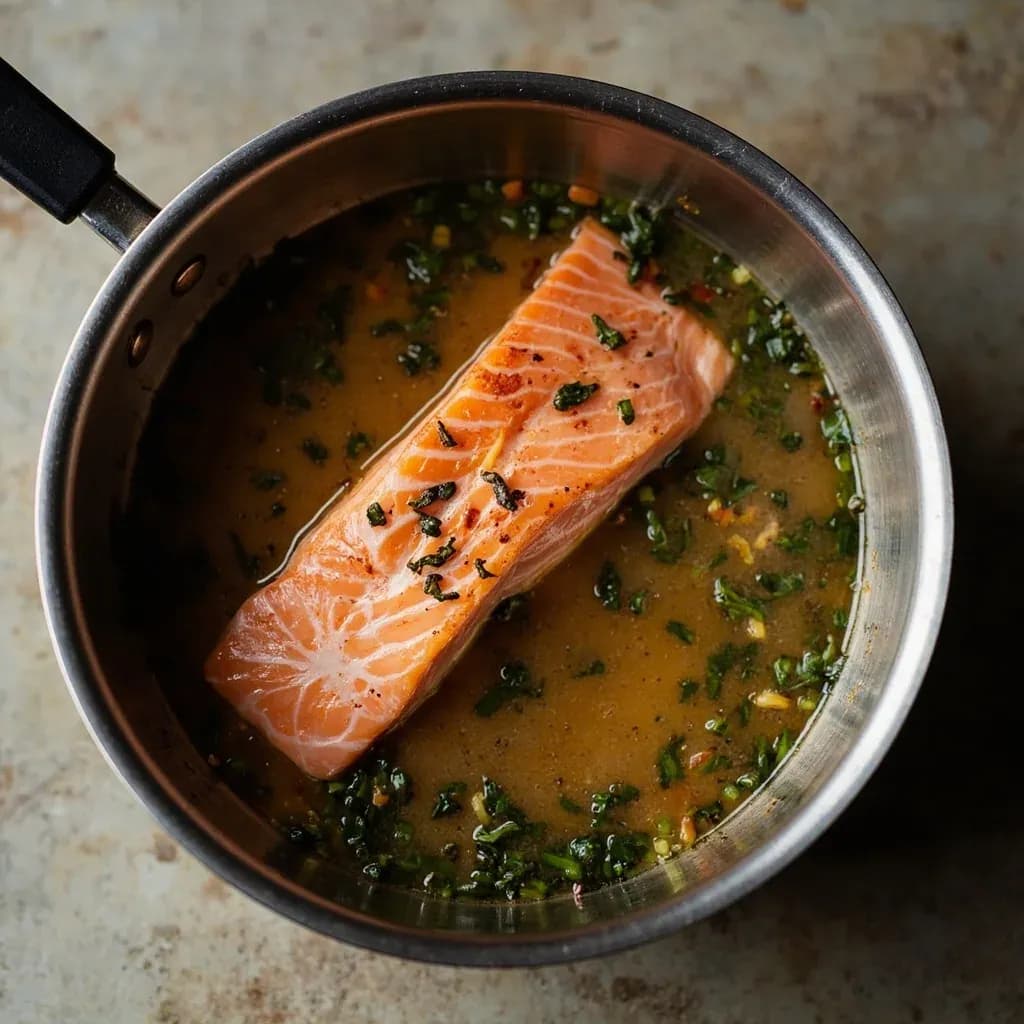
Court-bouillon poaching cooks delicate foods in a quick aromatic broth of water, wine or vinegar, vegetables, and herbs held just below a simmer. The acidic, flavorful liquid seasons the food while the gentle heat keeps fish, shellfish, or vegetables tender and intact. It's a classic French method for poaching salmon, eggs, and artichokes.
Court-bouillon poaching is the practice of cooking delicate proteins and vegetables in a briefly infused, acidulated aromatic liquid — a "short broth" in the literal French sense, built and ready in well under an hour. The liquid carries wine or vinegar, a handful of aromatics (onion, leek, celery, parsley stems, bay, thyme, peppercorns), and just enough acid to firm the proteins, brighten the color, and keep muddy or oceanic aromas in check. It is not a stock and it is not a consommé; it is a working bath, strained before the food ever touches it, then held at the gentlest possible heat.
The reason cooks return to it is the texture. Submerging fish, shellfish, or vegetables in a barely trembling liquid — 160 to 180 °F, with no bubbles breaking the surface — lets the flesh cook through without contracting violently, so the muscle stays moist and slides apart in clean flakes instead of shredding. The acid is doing real chemical work alongside the herbs: it helps surface proteins set, keeps the flesh whiter, and tames muddy aromas in freshwater fish. Anything hotter would either toughen the food or drive albumin out in white clouds; anything cooler would stretch the cook unevenly. Master the temperature, and the rest is largely a matter of which aromatics you reach for.
The other quiet virtue is what is left in the pot. A strained cup of the cooking court-bouillon, reduced by half, is a ready-made base for a beurre blanc, a cream-and-herb finish, or a chilled aspic glaze — saving you from rebuilding the same flavor profile in a separate saucepan. The technique is forgiving in ingredients and unforgiving in heat, which is the whole of the skill.
- Difficulty
- Easy
Types & varieties
The classic version: water plus dry white wine, lemon, mushroom trimmings, onion, parsley stems, bay, thyme, peppercorns. The standard poaching medium for white-fleshed fish, sole, and salmon.
Built on red wine, often with tomato and sometimes fennel; less common, used for richer fish or for braises in the coq au vin spirit.
The oldest and simplest form: plain water acidulated with a generous measure of wine or cider vinegar and aromatics. Favored for freshwater fish like carp and trout, whose muddy notes the acid tames.
Poaching in milk, often with a little lemon or butter, for very delicate flatfish like sole; yields tender flesh and an emulsion that becomes a quick pan sauce.
A lighter infusion of leek, fennel, bay, peppercorns, and a splash of vinegar or lemon; the standard bath for asparagus, artichokes, and leeks.
Heavier on the aromatics, with more wine and a generous handful of sea salt; the standard medium for lobster, crab, langoustines, and large shrimp.
How to do it
- 1
Assemble the aromatics
Roughly chop 1 onion, 1 leek (white and pale green parts), 1 stalk of celery, and a small bunch of parsley stems. Have ready 2 bay leaves, a sprig of thyme, and 6–8 whole black peppercorns.
- 2
Build the liquid
In a wide, heavy pot or a fish poacher, combine 4 cups cold water, 2 cups dry white wine (a 1-to-2 wine-to-water ratio, the classic au blanc), the juice of 1 lemon or 2 tablespoons wine vinegar, the chopped aromatics, the herbs, and the peppercorns. Do not add salt yet.
- 3
Infuse the court-bouillon
Bring slowly to a bare simmer over medium heat, then reduce to low and cook gently for 20–30 minutes so the aromatics give up their flavor. The liquid should smell distinctly of wine, herbs, and lemon.
- 4
Strain and adjust
Strain through a fine sieve into a clean pot, or lift the solids out with a spider. Stir in a small amount of salt — a light hand is wise if the fish will be finished with a seasoned sauce, since you can always adjust seasoning at the end. Squeeze in more lemon if the liquid tastes flat.
- 5
Bring to poaching temperature
Return the strained liquid to the stove and bring it to 160–180 °F (70–82 °C). The surface should show just a whisper of movement, no bubbles. A poaching thermometer is worth having; a rolling boil is far too hot.
- 6
Lower in the food
For a whole fish or large piece: wrap it in cheesecloth or a long strip of parchment for easy lifting, then gently submerge. For fillets: arrange skin-side down in a single layer, just covered by the liquid.
- 7
Poach gently
Maintain the bare-shiver temperature throughout. A 1-inch-thick salmon portion poaches in about 8–10 minutes; thin fillets in 3–5 minutes; a 2–3 lb whole fish in 12–18 minutes. The fish is done when a paring knife slides into the thickest part with no resistance and the flesh flakes just at the edges.
- 8
Rest and serve (or chill)
Lift the fish out on the cheesecloth or with a slotted spatula. For hot service, rest 2–3 minutes, then serve with a butter or sauce made from a cup of the reduced court-bouillon. For cold service, leave the fish in the liquid off the heat for 5–10 minutes, then refrigerate in a portion of the strained court-bouillon.
- 9
Optional: reduce for a sauce
Strain 1 cup of the cooking liquid, simmer it down by half, then mount with cold butter cubes (3–4 tablespoons) for a quick beurre blanc, or finish with cream and herbs.
Reading the Temperature
A poaching thermometer is worth the drawer space. The target is a band, not a single number: 160 °F at the low end, where the surface barely trembles and a bubble releases only every few seconds; 180 °F at the high end, where the liquid shivers visibly but never breaks into a true simmer. Below 160 °F, fish proteins set slowly and unevenly, the cook time stretches, and the flesh can take on a raw, translucent core that lingers under the surface. Above 180 °F, the muscle fibers contract hard, albumin leaches out in white ribbons, and the texture turns rubbery. Hold the band, and the fish emerges clean, moist, and ready to flake on its own.
Matching the Variant to the Food
Choosing among the variants is mostly about the fat content of the protein and the strength of its flavor. Lean, delicate fish want a court-bouillon that will not bully them; oily or ocean-strong fish can carry — and benefit from — a more assertive base.
- Sole, flounder, turbot, and other flatfish: milk court-bouillon or a very gentle au blanc.
- Salmon, trout, sea bass, halibut: standard au blanc with white wine and lemon.
- Carp, catfish, and other freshwater fish with muddy notes: a vinegar court-bouillon, whose acid neutralizes the off-aromas.
- Lobster, crab, large shrimp, langoustines: a heavily aromatic au blanc with extra wine and a generous salt load.
- Asparagus, artichokes, leeks, salsify, cardoons: a light vegetable court-bouillon, just enough acid to keep the vegetables bright and green.
Common uses
Tips & pitfalls
- Keep the court-bouillon at a bare shiver — 160–180 °F — once the food is in. A true simmer roughs up delicate flesh and drives albumin out in white clouds; a rolling boil will shred it.
- Acidulate the liquid: the lemon juice or vinegar is functional, not optional. It helps fish proteins set, keeps the flesh whiter, and knocks back muddy aromas in freshwater fish like carp or trout.
- Strain the court-bouillon before using. Floating peppercorns and bay leaves will cling to fillets and pepper the surface of any sauce you build from the liquid.
- Bring the liquid up to temperature before lowering the fish in. Plunging cold fish into hot court-bouillon cooks it unevenly, leaving a band of overdone flesh at the edges.
- Salt sparingly in the court-bouillon if the fish will be finished with a seasoned sauce. You can always adjust salt at the end; you cannot un-salt a broth that has poached the fish.
- Reuse the court-bouillon once for vegetables or a second batch of shellfish, but not after a strongly flavored fish like salmon or mackerel. The fat and aroma will dominate anything subtle that follows.
- For cold service, leave the cooked fish in the strained court-bouillon off the heat for 5–10 minutes, then refrigerate it in a portion of the liquid. Pulling it out hot dries the surface.
- A common mistake is treating court-bouillon like a consommé or a light soup. It is a working bath, not a dish — it is not normally ladled into a bowl and eaten with a spoon.
Good to know
- French term
- "Court-bouillon" literally means "short broth," distinguishing it from long-simmered stocks and fonds.
- Origin
- Classical French cuisine; the term appears in cookbooks from the 17th–18th centuries as the standard poaching medium for freshwater and saltwater fish.
- Core components
- Water (often with dry white wine), an acid (lemon juice, vinegar, or wine), mirepoix or leek-onion-celery, parsley stems, bay leaf, thyme, and whole peppercorns.
- Target temperature
- 160–180 °F (70–82 °C) — a bare shiver, never a simmer or boil, once the food is in.
- Infusion time
- 20–30 minutes of gentle simmer to extract the aromatics, then strained, before the food goes in.
- Acid ratio
- Roughly 1 tablespoon of vinegar or lemon juice per quart of liquid; for an au blanc court-bouillon, up to 1 part dry white wine to 2 parts water.
- Yield
- Enough liquid to fully submerge the food — typically 1–2 quarts for a whole small fish or a single layer of fillets.
- Reuse
- Strained, the liquid keeps 3–4 days refrigerated and can be reused once for vegetables or shellfish; discard after a strongly flavored fish like salmon or mackerel.
- Difficulty
- Beginner-friendly; the ingredients are forgiving as long as the temperature is held steady.
Also called
court-bouillon · aromatic poaching
Related

Boil
Cook in vigorously bubbling liquid at full rolling heat

Simmer
Hold liquid at a gentle shimmer for tender, unhurried cooking

Poach
Cook gently in barely-trembling liquid for silky, tender results

Steam
Cook in rising vapor to keep color, nutrients, and shape intact

Blanch
Plunge briefly in boiling water, then shock cold to lock color

Braise
Sear, then cook slow in a little liquid until fall-apart tender

Stew
Simmer bite-sized pieces fully submerged into a rich, unified pot

Sous-Vide
Seal and cook in precise warm water for edge-to-edge doneness