Transform & Preserve
Decoction Mashing
Brewing method of boiling part of the mash and returning it to raise temperature.
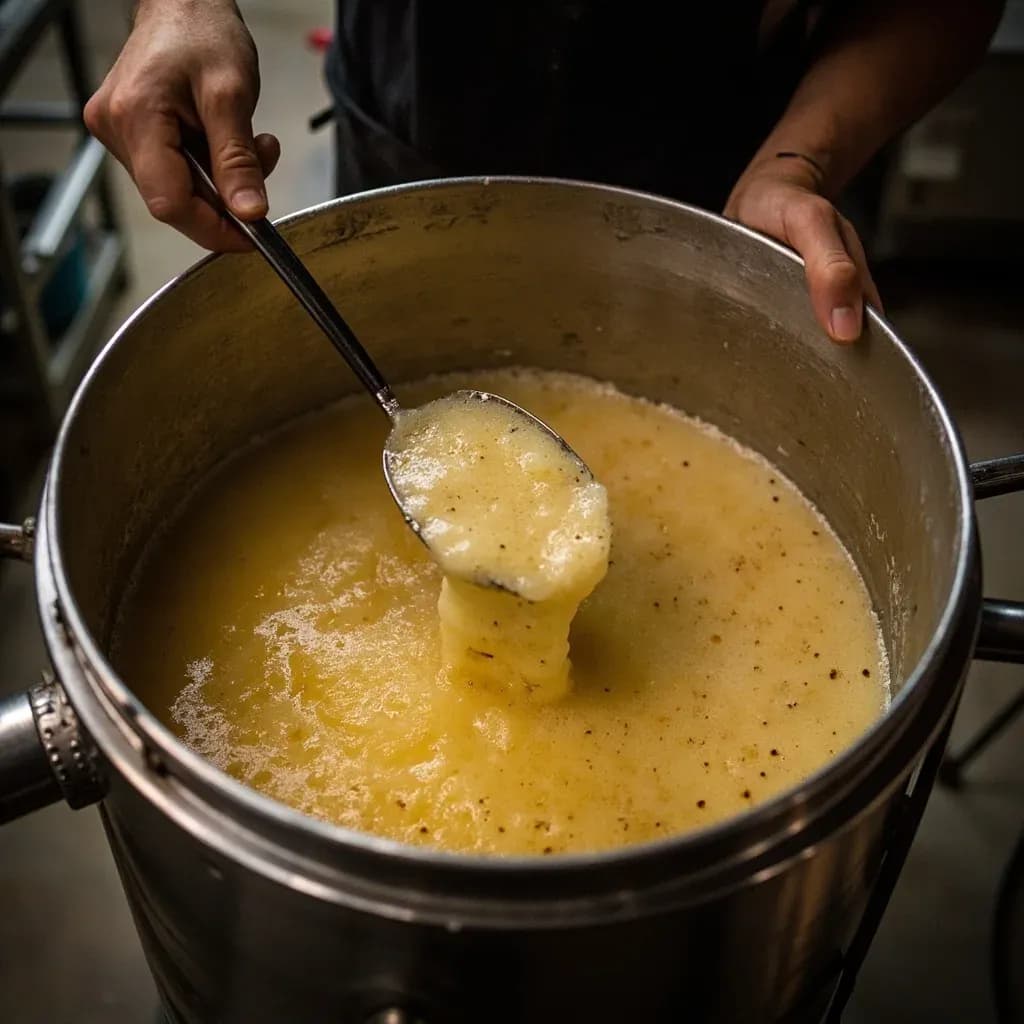
Decoction mashing, used in traditional brewing, removes a portion of the grain mash, boils it, then returns it to the main mash to step up the temperature precisely. The boiling gelatinizes starches and develops malty, toasty flavors prized in many lagers. It predates accurate thermometers and gives a depth of color and flavor hard to get from simple infusion mashing.
Decoction mashing is a traditional lager-brewing technique in which a brewer removes a portion of the mash, brings it to a boil in a separate kettle, and returns it to the main tun to raise the overall mash temperature in discrete steps. The pulled portion is typically about one-third of the total mash by volume and may be drawn thick (grain and liquid together) or thin (liquid runnings only). Boiling the grain drives Maillard reactions and melanoidin formation that simple infusion step mashing cannot match, producing worts with deeper malt complexity, fuller body, and the bready, slightly toasty backbone that defines classic Bavarian and Czech lagers.
The method predates the routine use of thermometers and external heating, when brewers relied on a sequence of drawn-off boils to reach each enzymatic rest and finally mash-out. Today, decoction survives not because it is necessary — modern well-modified malts convert cleanly with simple step infusions — but because it adds flavor. A decoction schedule asks for more time (often 30 to 90 minutes over an infusion program), more equipment, and closer attention to stirring and temperature, but in return it gives the brewer a tool for building richness, color, and mouthfeel directly into the wort before fermentation even begins.
- Difficulty
- Hard
Types & varieties
One pull, typically used to step up to saccharification or to perform mash-out. The common modern shortcut for brewers who still want some decoction character without the full schedule.
Two pulls, classically stepping from acid rest up to protein rest and then to saccharification, or from protein rest up through saccharification to mash-out. The most common traditional schedule.
Three pulls stepping the mash up through the enzymatic rests, with the third pull typically reaching mash-out (76–78 °C). The classic Bavarian and Czech program for Bocks, Märzens, and traditional Pilsners; the most time- and energy-intensive variant.
Pulled portion includes both grain and liquid; richer melanoidin development, but requires more stirring and is more prone to scorching.
Only liquid runnings are pulled; gentler Maillard contribution, easier to handle, and closer in result to a well-run infusion step mash.
How to do it
- 1
Mash in low
Dough in at the lowest target rest, typically 35–45 °C for an acid rest or 45–50 °C for a protein rest, using slightly under-target water to leave room for the rising volume from the decoctions. Stir to a uniform, oatmeal-like consistency and let the mash rest 10–20 minutes.
- 2
Pull the first decoction
Scoop or pump roughly one-third of the mash — grain and liquid together for a thick pull, or clear runnings for a thin pull — into the decoction kettle. If the kettle looks dry and risks scorching on the burner, add a little hot water to keep it pumpable.
- 3
Boil the first decoction
Bring the pulled portion to a gentle, controlled boil while stirring constantly. Hold the boil 5 to 15 minutes depending on how much Maillard character you want; longer boils push deeper, bready melanoidin flavors.
- 4
Return and rest
Pour the boiling decoction back into the main mash tun, stirring continuously. The combined mass should land on the next target rest — for example, about 50–55 °C for a protein rest. Hold 15–20 minutes.
- 5
Pull and boil the second decoction
Pull another one-third of the mash, bring to a boil (typically 5 to 15 minutes), and return it to raise the mash into the saccharification range — around 62–67 °C for a beta-amylase-heavy rest, or 68–72 °C for a more balanced, drier profile.
- 6
Saccharification rest
Hold the main mash at saccharification temperature 30 to 60 minutes. Test with iodine; conversion is complete when the wort tests clear of starch.
- 7
Optional third decoction to mash-out
For a triple decoction, pull a final portion, boil it, and return it to raise the mash to 76–78 °C. This mash-out denatures remaining enzymes, thins the wort, and improves lautering.
- 8
Lauter and sparge
Once at mash-out, transfer to the lauter tun (or drain from the mash tun) and sparge with 76–78 °C water until you reach your target pre-boil volume and gravity.
- 9
Boil, hop, and ferment as usual
Proceed with the standard boil schedule, hop additions, cooling, and pitching. The decoction work is done; everything downstream is conventional brewing.
How a decoction raises temperature
The basic arithmetic: a boiling decoction (~100 °C) added back to a cooler mash raises the combined mass toward the next enzymatic rest. The brewers of old used this to climb the temperature ladder — from an acid rest in the high 30s, through a protein rest in the low 50s, to saccharification in the 60s, and finally to a mash-out in the high 70s — without any external heat source. Modern brewers can step-mash with steam jackets, electric elements, or direct-fired kettles, but the underlying calculation is the same: know the mass of the main mash, know the mass and temperature of the decoction you are adding, and aim the resulting temperature at the rest you need. Account for evaporation in the decoction kettle — typically 10 to 15 percent — so the volume you return actually delivers the temperature rise you intended.
Thick vs. thin — choosing your pull
The choice between thick and thin decoction is really a choice about where you want the flavor-building to happen. Pulling grain along with the liquid puts starch and protein directly into the boiling kettle, where it participates fully in Maillard reactions and adds visible color as well as depth. Pulling only the liquid gives a cleaner, more infusion-like result; the malt character is present but more restrained. Thick decoction is the historical default for German lagers and the right call when chasing Märzen, Bock, or Dunkel richness. Thin decoction is a sensible compromise for hop-forward Pilsners where you want a touch of malt backbone without overwhelming delicate hop aromatics.
Reading the results
A well-executed decoction mash shows up in the glass as a fuller, slightly chewier body, a deeper gold-to-amber color than the grist alone would predict, and a malt profile that reads as bready, toasty, or even faintly crust-like rather than merely sweet. If a lager tastes thin or 'green' despite correct fermentation and proper cold conditioning, a single or double decoction on the next batch is often the missing piece.
- Color deepens as melanoidins form during the decoction boil — a useful visual cue.
- Body and head retention often improve, partly from denatured proteins.
- Flavor leans bread-crust, biscuit, and light toast rather than caramel or roast.
- When the effect is unwanted, shorten the boils or switch to a thin decoction to dial it back.
Equipment you actually need
Beyond a standard mash tun, decoction mashing requires a side kettle large enough to hold roughly one-third of the total mash, a heat source capable of bringing that portion to a rolling boil, and a means of moving thick mash — a pump, a scoop and bucket, or a strong arm with a ladle. Cover the main tun with a lid between pulls to slow heat loss. A calibrated thermometer and a watch are non-negotiable; the original decoction brewers were skilled craftsmen, but their craft is easier to learn with instruments.
Common uses
Tips & pitfalls
- Stir the pulled portion constantly while bringing it to a boil — grain-on-burner scorching is the single most common mistake.
- When pulling a thick decoction, dip from the top of the mash where the grain-to-liquid ratio is highest; if it sits too thick on the burner, add a little hot water to keep it pumpable.
- Account for 10–15% evaporation in the decoction kettle so the volume you return actually delivers the temperature rise you planned.
- Cover the main mash tun with a lid between pulls to minimize heat loss and keep your step targets accurate.
- Longer decoction boils (15–20 min) push melanoidin and bread-crust flavors; shorter pulls (5–10 min) keep the profile cleaner — pick deliberately for the style.
- Don't skip a proper mash-out at the end of a triple decoction — it improves lautering and final fermentability.
- If you are new to the method, run a single decoction first to learn the timing and transfer rhythm, then graduate to double or triple.
- Measure, don't guess: a calibrated thermometer and a watch are non-negotiable; rely on instruments rather than feel.
Good to know
- Origin
- Central European brewing tradition, predominantly German, predating routine thermometers and external heating.
- Primary use
- Traditional lager brewing — German Pilsner, Bock, Märzen, Dunkel, Schwarzbier, and Vienna lager.
- Principle
- Withdraw a portion of the mash, boil it, and return it to the main tun to step the whole mash up through enzymatic rests.
- Typical decoction size
- Roughly one-third of the total mash by volume is pulled per step.
- Step count
- Single, double, or triple decoction, named for the number of pulls.
- Decoction boil time
- Usually 5 to 20 minutes per pull; longer boils deepen melanoidin and malt character.
- Flavor effect
- Boiling grain promotes Maillard reactions and melanoidin formation, yielding richer, bready, fuller-bodied beer.
- Time cost
- Adds roughly 30 to 90 minutes over an infusion schedule, depending on step count.
Also called
decoction mash
Related

Confit
Cook slowly submerged in fat for silky tenderness and keeping

Cure
Draw out moisture with salt and time to preserve and concentrate

Pickle
Steep in acidic brine for bright, tangy, crunchy preservation

Ferment
Let friendly microbes transform food into tangy, complex flavor

Marinate
Soak in a seasoned mix to flavor and tenderize before cooking

Brine
Soak in salt water so meat stays juicy and seasoned throughout

Dehydrate
Slowly dry out moisture to concentrate flavor and extend shelf life

Cold-Smoke
Perfume cured food with smoke without cooking it through