Prep & Assembly
Degassing
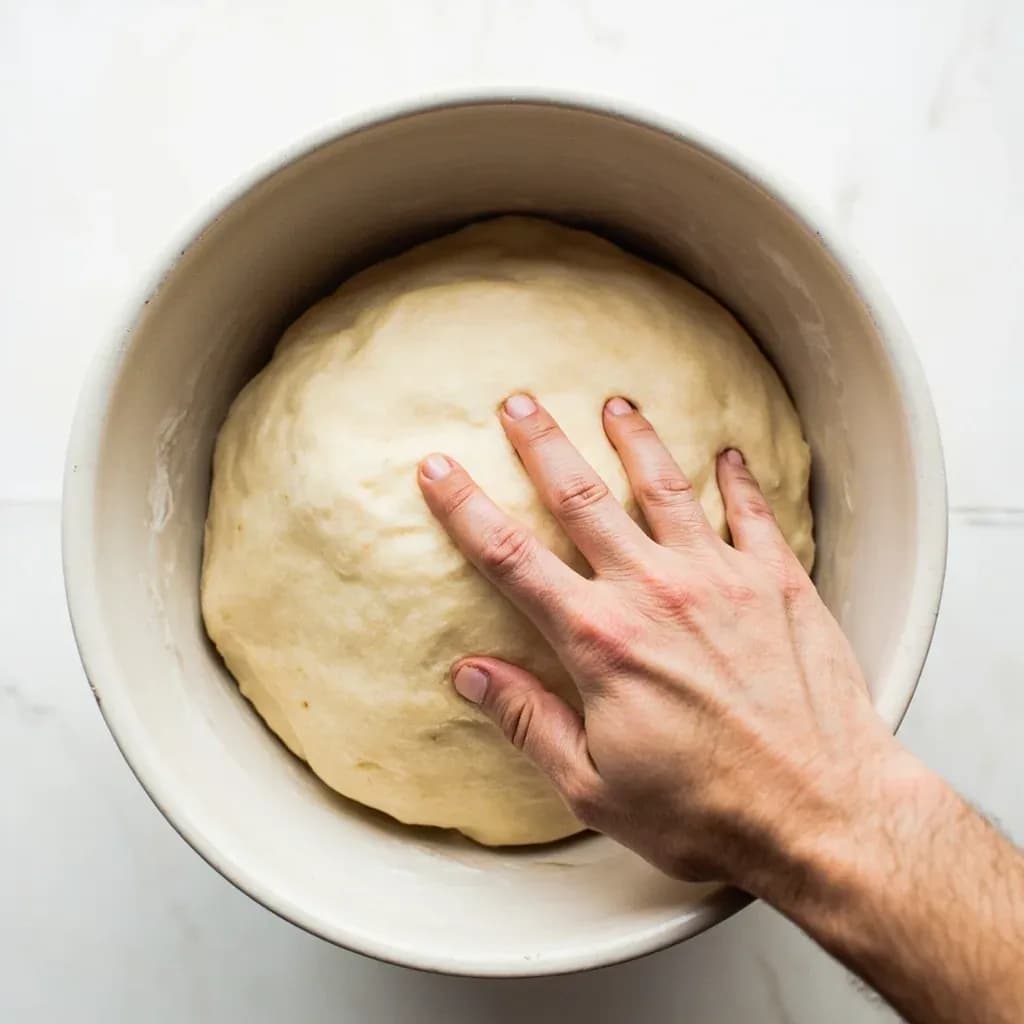
Gently pressing risen dough to expel carbon dioxide and redistribute yeast before shaping.
Degassing, sometimes called punching down or knocking back, presses or folds risen dough to release the carbon dioxide that has accumulated during fermentation. It evens out the temperature, redistributes the yeast and food it feeds on, and refines the crumb structure for a more uniform texture. The dough is then reshaped and given a second rise before baking.
Degassing — also known as punching down or knocking back — is the brief, deliberate deflation of dough that has finished its bulk (first) fermentation. It happens after the dough has roughly doubled and before the baker divides and shapes it, and it is one of the most consequential single actions in a standard loaf. Done well, it sets up the crumb; done roughly, it punishes the dough.
The work is more nuanced than the name suggests. The baker is not trying to squeeze every last bubble from the mass. The point is to release the excess carbon dioxide that has built up, redistribute the yeast cells and dissolved sugars more evenly through the dough, and relieve tension in the gluten network so the loaf can be shaped without tearing. The result is a more cooperative dough and a finished crumb that is finer and more uniform rather than chaotic and holey.
That last point is exactly why some bakers choose not to degas at all. Open-crumb styles such as ciabatta, focaccia, and many country loaves depend on the gas pockets that bulk fermentation produces, and any flattening would undo the texture the baker is after. Degassing is, in other words, a tool to be deployed by intent — not a reflex that belongs in every bread.
- Difficulty
- Easy
Types & varieties
A closed fist pressed straight down into the center of the dough in the bowl — the classic home-baker method, best done with a gentle, controlled press rather than a slam.
The dough is turned out and gently pressed flat with the fingertips or palms on a lightly floured surface.
A bench scraper lifts, folds, and presses the dough, keeping hands clean and preventing tears in wet doughs.
A modern no-knead approach — letter folds, stretch-and-folds, or coil folds are performed without ever pressing the dough flat, preserving more gas for a more open crumb.
Deliberately omitted for open-crumb breads such as ciabatta, focaccia, and some country loaves where large irregular holes are the goal.
How to do it
- 1
Confirm the dough is ready
The dough should have risen by roughly 50–100%, show a domed or rounded top, and jiggle slightly when the bowl is tapped. A poke with a floured finger should leave an indentation that fills in slowly.
- 2
Prepare the surface
Lightly flour the work surface only if the dough is not already sticky; for wetter doughs a bench scraper alone is often enough. Have a plastic or metal bench scraper to hand.
- 3
Release the dough
Tip or scrape the dough out of the bowl onto the surface. If the dough resists, press down gently in the center with floured fingertips to deflate before turning it out.
- 4
Press, don't pound
Using the flat of the palms or the heel of the hand, press the dough outward from the center into an even disc roughly 1 to 1.5 inches (2.5–4 cm) thick. Avoid slamming it flat.
- 5
Fold and tidy
Fold the outer edges into the center like a letter, or stretch the dough slightly and fold it in half. Flip it seam-side down so the surface is smooth and rounded.
- 6
Rest briefly (optional)
Cover with a damp towel or plastic and let the dough relax for 5–15 minutes if it feels tight. This makes the final shaping easier and protects the gluten from tearing.
- 7
Proceed to dividing or shaping
Scale, pre-shape, bench-rest, and final-shape as the recipe directs, then continue to the final proof.
How degassing differs from kneading and folding
Kneading, degassing, and modern fold-and-turn methods are often confused because they all happen to dough that contains gas, but they do fundamentally different work. Kneading generally happens before bulk fermentation and is about building gluten from scratch. Degassing is a short reset, not a development. Stretch-and-fold and coil fold, popular in no-knead and high-hydration baking, are gentler cousins that strengthen and redistribute without deflating the dough.
- Knead early to develop gluten while there is still little gas to disturb.
- Degas in the middle, after the bulk rise, to reset the dough before shaping.
- Fold throughout bulk fermentation to strengthen and redistribute gas without flattening.
- Skip degassing entirely for open-crumb breads such as ciabatta and focaccia.
Common uses
Tips & pitfalls
- Press with the fingertips, the flat of the palm, or a controlled fist — slamming with a fist can tear the gluten and knock out nearly all the gas.
- The dough should retain some air; aim to release about two-thirds of the CO2, not flatten it into a disc.
- Flour your hands or the bench only as much as needed — excess flour at this stage will toughen the final crumb.
- If the dough feels gummy and tears, dust the bench scraper with flour rather than the dough surface itself.
- Test the rise with a floured-finger poke: the dough should spring back slowly and leave a slight indentation.
- Fold the dough onto itself after pressing to build a little tension and a smoother top for shaping.
- Skip degassing for high-hydration artisan breads where an open, irregular crumb is the goal.
- Do not re-knead after degassing — the gluten is relaxed, and overworking will make the final loaf tough.
Good to know
- Also known as
- Punching down, knocking back, deflating
- Stage in bread-making
- After bulk (first) fermentation, before dividing and shaping
- Primary purpose
- Release excess CO2 and redistribute yeast cells and dissolved sugars
- Typical timing
- When dough has roughly doubled and shows a domed, rounded top
- Effect on final crumb
- Finer and more even crumb with smaller, more uniform air cells
- Time required
- 1–2 minutes for a home batch
- Related modern technique
- Stretch-and-fold or coil fold — gentler redistribution without full deflation
Also called
Punching Down · Knocking Back
Related

Whisk
Beat ingredients smooth and aerated with a looping wire motion

Sift
Pass dry ingredients through mesh to aerate and remove lumps

Strain
Pour through mesh to separate solids from liquid for a smooth result

Filter
Pass liquid through fine material to clarify out the smallest particles

Rice
Press cooked potatoes through small holes for fluffy, lump-free texture

Mash
Crush soft cooked food into a rustic, creamy purée

Grind
Crush food into a coarse to fine texture, from spices to meat

Grate
Shred food into fine bits against a sharp-toothed surface