Prep & Assembly
Hand-Stretching Dough
Pulling dough by hand into thin sheets or rounds, as for strudel, phyllo, and pizza.
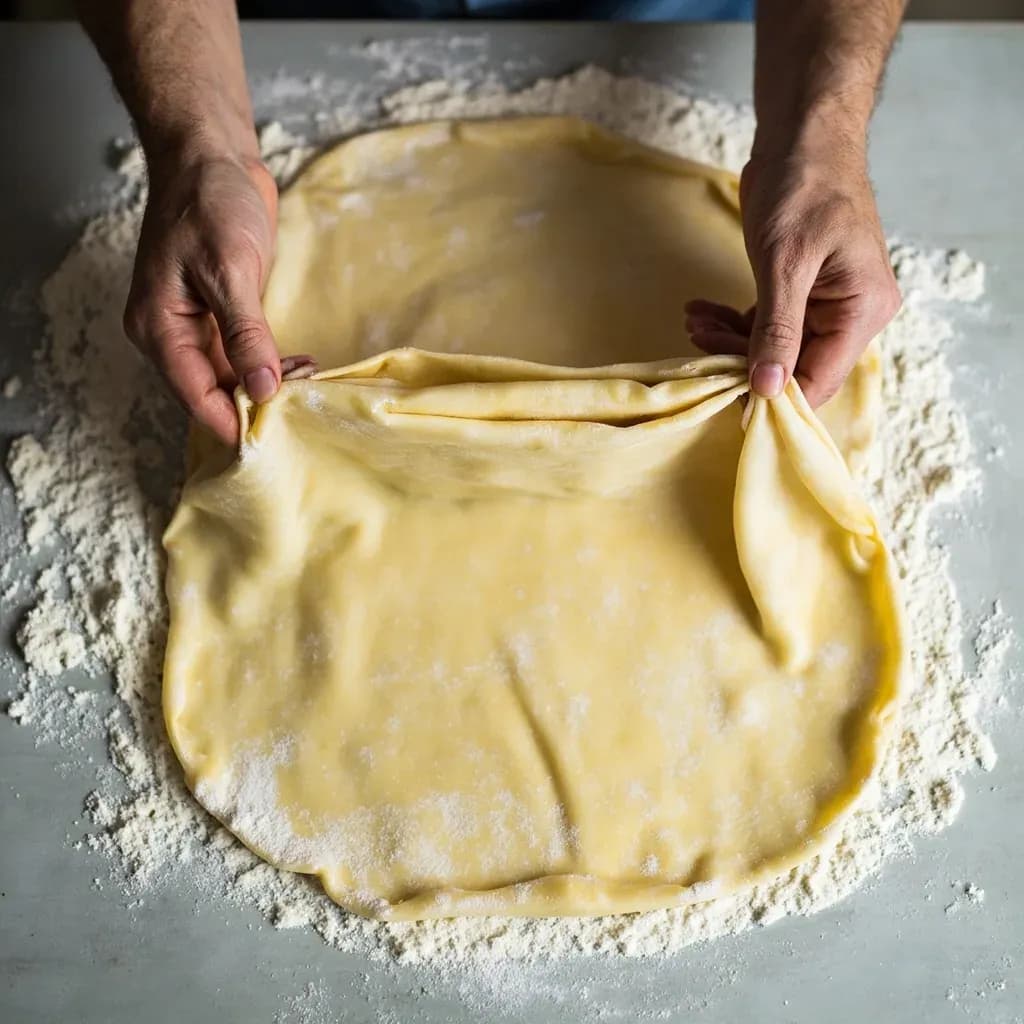
Hand-stretching gently pulls and coaxes a rested dough into a thin sheet or round using the backs of the hands and gravity rather than a rolling pin. It is how bakers achieve the gossamer translucence of strudel and phyllo and the airy, irregular edge of Neapolitan pizza. A well-rested, high-gluten dough is essential so it stretches without tearing, and the work is done over the backs of the knuckles to avoid puncturing it.
Hand-stretching is the practice of shaping wheat-flour doughs by lifting, draping, and pulling them over the backs of the hands and knuckles — never with a rolling pin. It is the canonical shaping method for Neapolitan pizza, strudel, yufka, lavash, naan, and other flatbreads whose identity depends on an open, irregular crumb and a billowing rim.
The technique works because well-developed gluten is elastic but only briefly; once dough has rested and fermented, the strands relax and the trapped fermentation gases can be redistributed rather than crushed. A rolling pin flattens those gas pockets into a dense, even sheet, which is why pizza stretched by pin is noticeably chewier and less airy than pizza stretched by hand. The same principle governs strudel: hand-pulled until translucent, the dough bakes into tissue-thin layers that no rolled sheet can replicate.
Success has very little to do with hand strength. Hydration, fermentation time, and a proper rest do almost all of the work. A rested 60–70% hydration dough will sag obediently across the knuckles; an under-rested or over-tight dough will spring back and tear. The skill lies in reading the dough — knowing when to push, when to let gravity pull, and when to rotate — rather than in force.
- Difficulty
- Hard
Types & varieties
Dough rotated between knuckles and tossed; centrifugal force and gravity extend it while the fist, not a flat surface, supports it.
Dough draped over a floured tablecloth; hands work underneath with the backs of the knuckles to stretch paper-thin until translucent.
Rolled into a thin disc, then worked outward by hand on a floured surface or cushion before cooking on a saj or tava.
Ball of dough slapped between the palms, then spun off the fingertips to finish the thin shape.
Pressed flat, then pulled over the back of the hand or fist — sometimes called "the flying carpet" — to form a teardrop.
Higher-hydration dough pulled gently from the center outward on an oiled tray, preserving large alveoli.
Dough stretched into an oiled sheet pan, then repeatedly pressed with fingertips to create deep dimples that hold olive oil.
How to do it
- 1
Prepare and rest the dough
Mix and bulk-ferment the dough, then divide into individual portions. Pre-shape each into a tight, smooth ball by tucking the underside against the work surface so the top surface is taut. Cover and let rest at room temperature for at least 30 minutes for pizza, or 1–2 hours for strudel. A properly rested ball will hold its round shape without sagging; a finger pressed into it should leave a slow-recovering dent.
- 2
Set up the work surface
Lightly dust a clean countertop, wooden peel, or marble slab with bread flour, semolina, or rice flour. For strudel, drape a large linen cloth over a table and dust it generously. Keep extra flour or a bowl of semolina at hand for re-dusting your knuckles as you work.
- 3
Initial flattening
Press the dough ball gently with the pads of your fingers from the center outward, leaving a small border untouched around the rim. Rotate a quarter turn and repeat until you have a flat disc about 1.5–2 cm thick. Avoid pressing the very edge — the gas trapped there will form the cornicione or the puffy border of your flatbread.
- 4
Drape and stretch over the knuckles
Lift the disc with both hands and drape it over the backs of your curled knuckles (not your palms). The dough should sag between your fists under its own weight. Let gravity pull it downward, then gently open and close your fists to widen the opening. The backs of the knuckles give a gentler, more even pull than the palms.
- 5
Rotate and extend
Rotate the dough roughly 45° between each stretch, keeping it moving so it never sits long enough to stick to the surface or your hands. Work outward from the center and let the rim billow naturally. For pizza, extend to 25–35 cm (10–14 in) with a thick, airy edge; for strudel, keep pulling and walking around the table until you can see the pattern of the cloth through it.
- 6
Final shaping and docking
Lay the stretched dough on a floured peel or parchment. For pizza, dimple only the central area lightly with your fingertips to push out the largest air pockets, leaving the rim puffy. For strudel, lay flat and trim the thicker outer edge with scissors; for flatbreads, dock lightly with a fork to prevent uneven puffing during cooking.
- 7
Top and cook immediately
Hand-stretched dough waits poorly. Once stretched, top and bake within minutes, or the base will sag, stick, or over-proof. For pizza, give the peel a sharp shake before launching to confirm the dough slides freely; sprinkle a little semolina underneath if it sticks. Strudel sheets should be filled, rolled, and shaped as soon as they are stretched.
The science behind the stretch
Two things have to happen for a dough to stretch cleanly: the gluten network must be developed enough to hold together, and it must be relaxed enough to extend without snapping back. Kneading (or time) builds the network; resting lets the strands settle into a less tense state. Fermentation contributes both — enzymatic activity weakens gluten slightly while gas production inflates it. A dough that is under-rested behaves like a rubber band; one that is over-fermented tears at the seams. Hydration lubricates the matrix: wetter doughs (70–80%) stretch farther and trap more gas, which is why Neapolitan pizza and ciabatta-style bases can be pulled thin without tearing. Lower-hydration doughs (45–55%) are stiffer and better suited to strudel and lavash, where extreme thinness is the goal.
- Gluten provides elastic recoil; time at rest reduces it.
- Gas cells (alveoli) are preserved by stretching, destroyed by compression.
- A rolling pin compresses gas pockets flat; hands push them outward.
Choosing hydration and rest
Match hydration to the job. Pizza and ciabatta want 60–75% water; strudel tolerates 45–55% because the dough is meant to dry slightly as it is pulled and needs to hold its shape without sagging. Focaccia sits around 68–72%. Rest times scale with hydration — wet doughs relax faster, drier doughs need longer. As a rule of thumb, a finger press should leave a slow-recovering dent before you stretch; if the dough bounces back immediately, it needs another 15–30 minutes.
- Pizza dough: 60–70% hydration, 1–4 hours at room temperature or 24–72 hours cold.
- Strudel dough: 45–55% hydration, 1–2 hours at room temperature.
- Focaccia: 68–72% hydration, 1–2 hours after preshaping.
- Lavash / yufka: 55–60% hydration, 30–60 minutes.
Common uses
Tips & pitfalls
- Rest the dough until a finger press leaves a slow-recovering indentation; under-rested dough snaps back and tears.
- Dust hands and surface lightly with flour or semolina — excess flour toughens the crust and turns bitter when it scorches.
- For pizza, push from the center outward and leave a 1.5–2 cm cornicione; never press the edge flat, or you lose the airy rim.
- Use the backs of the knuckles rather than the palms — they give a gentler, more even pull and are less likely to tear the dough.
- Let gravity do the work. Drape the dough over both fists and let it sag; rotate frequently to keep extension balanced.
- Keep the dough moving. Once it rests on a surface it sticks and tears — lift and rotate constantly.
- If a small tear appears, patch it with a scrap of dough and pinch closed; dust the seam with flour so it does not seal shut during baking.
- Never reach for a rolling pin if you want an open, airy texture — compression crushes the gas cells that define hand-stretched dough.
- For very wet doughs above 75% hydration, oil hands and surface instead of flouring to prevent tearing and gumminess.
- Stretch only what fits your peel or pan; an oversized base is hard to transfer and shrinks on contact with a hot stone.
Good to know
- Also known as
- Hand-stretching, hand-pulling, stesa a mano (Italian), hand-tossed
- Origin
- Ancient; central to Neapolitan pizza, Central European strudel, and Levantine/Turkish flatbread traditions (yufka, lavash)
- Ideal hydration
- 45–80% (lower for strudel and lavash, higher for Neapolitan pizza and ciabatta-style)
- Resting time
- Minimum 30 minutes; often 1–24 hours at cool temperature to relax gluten
- Primary equipment
- Clean hands and a lightly floured work surface — no rolling pin required
- Maximum thinness
- Strudel can be pulled to ≈0.1 mm (translucent); pizza base typically 0.3–0.5 cm at the base, 0.5–1 cm at the cornicione
- Dough temperature
- Room temperature (20–24 °C / 68–75 °F); cold dough resists stretching and tears
- Effect on texture
- Preserves air bubbles and open crumb; far less gluten damage than the rolling-pin method
Also called
Hand-Stretching Dough · Phyllo Stretching · Strudel Stretching · Pizza Stretching
Dishes that rely on it
Related

Whisk
Beat ingredients smooth and aerated with a looping wire motion

Sift
Pass dry ingredients through mesh to aerate and remove lumps

Strain
Pour through mesh to separate solids from liquid for a smooth result

Filter
Pass liquid through fine material to clarify out the smallest particles

Rice
Press cooked potatoes through small holes for fluffy, lump-free texture

Mash
Crush soft cooked food into a rustic, creamy purée

Grind
Crush food into a coarse to fine texture, from spices to meat

Grate
Shred food into fine bits against a sharp-toothed surface