Heat & Fire
Egg Flipping (Pan Showmanship)
Flipping eggs or omelets in the pan with a wrist toss instead of a spatula.
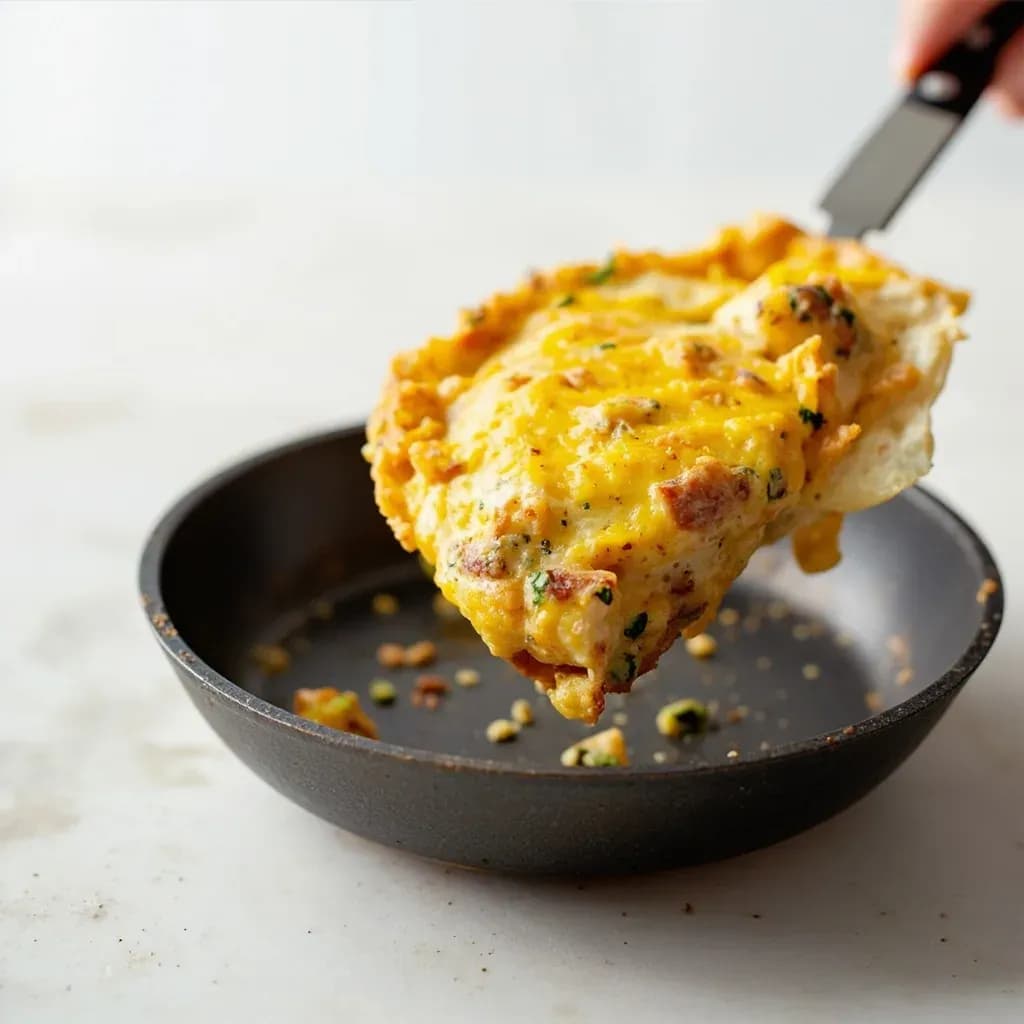
Egg flipping is the cook's technique of jerking the pan so an omelet or fried egg lifts and turns over in the air, landing back cleanly without breaking the yolk or tearing. It demands a well-seasoned non-stick surface and timing on the wrist motion. Beyond showmanship, it lets a cook turn delicate eggs without a spatula touching them.
Egg flipping is a wrist-driven pan toss used to turn an omelet, crepe, or single egg without ever introducing a spatula. A properly cooked French-style omelet has a tender, just-set exterior and a baveuse interior that is soft, glossy, and only loosely held together; a spatula edge dents, tears, or drags that delicate surface, while a clean toss preserves the unblemished, pale skin that defines the style. The flip is also a timing checkpoint — the moment you commit to it tells you everything about how the eggs are set.
The motion is small and economical. A short, sharp push of the pan away from the body, followed by a wrist snap back toward you, uses the far lip of the pan as a ramp. The egg's own weight does most of the work; the pan simply redirects it. Once you understand that the flip is a half-rotation, not a launch, height becomes optional — the low, tidy catch of a bistro French omelet and the high theatrical arc of a teppanyaki performance are mechanically identical, with only the ambition of the wrist snap changing.
Egg flipping sits at the crossroads of technique and showmanship because it is one of the few cookery skills judged by a clean visual outcome visible in a single second. That is why culinary schools use it as a practical benchmark and why it became a signature move of American hibachi-style restaurant service. The cook who can flip an omelet cleanly has demonstrated heat control, timing, and pan discipline — three things that pay off in a hundred other ways in the kitchen.
- Difficulty
- Medium
Types & varieties
Classic rolled-omelet flip taught at culinary schools; the goal is a pale, soft interior with no browning and no spatula marks.
High-arc, audience-facing flip where the egg leaves the pan several inches; often paired with a rice or shrimp toss.
Subtle, low-arc flip performed in front of guests; the priority is polish and clean plating, not height.
Heavier potato-and-egg tortilla turned by inverting a plate over the pan and flipping the whole assembly — a related but distinct move.
Same wrist mechanics applied to thin batters in a crepe or slope-sided pan.
Two-handed grip (handle plus helper hand on the far rim) gives more control; the one-handed version is the showy default.
How to do it
- 1
Choose and heat the right pan
Set an 8-inch (20 cm) omelet pan with sloped or rounded sides over medium heat for about 60 seconds. Add 1 tablespoon of butter and swirl to coat the bottom and lower sides; the foam should be lively but not browned.
- 2
Beat the eggs
Crack 2–3 large eggs into a bowl, add a pinch of salt, and beat with a fork until yolks and whites are fully combined and slightly frothy, about 15–20 seconds. Skip the milk or water — pure eggs set more cleanly and release from the pan more readily.
- 3
Pour and set the base
Pour the eggs in all at once. Working quickly, swirl and stir with the flat of a fork in small circles for 5–8 seconds to break up large curds, then smooth the surface and run the fork once along the far rim to round the edge.
- 4
Read the flip window
The omelet is ready when the bottom is set and pale, the top is mostly set with a thin glossy sheen in the center, and a small shake of the pan sends the omelet sliding freely — proof the butter layer is still working.
- 5
Execute the wrist flip
Grip the handle with your dominant hand, thumb on top. Push the pan sharply forward, then snap the wrist back and slightly up so the far lip throws the egg into a half-rotation. The omelet should clear the rim, travel 6–12 inches, and land back in the pan cooked-side up.
- 6
Catch and form
Lower the handle to meet the omelet as it returns. For a French-style rolled omelet, give the handle a small forward-and-back shake so the omelet rolls over itself once into a neat oval or cylinder with the seam underneath.
- 7
Plate immediately
Tilt the pan over a warmed plate and let the omelet slide out seam-side down. The interior should still tremble — that is the baveuse texture — and carryover heat will finish the center on the plate within seconds.
The mechanics, in plain terms
The flip is a half-rotation, not a toss. The pan's far lip becomes a small ramp, and your wrist provides the redirect. Once the egg leaves the rim it has committed to a flat spin; your only remaining job is to lower the pan to meet it. Watch the far rim of the pan, not the egg in the air, because the egg will land wherever that rim is when you stop the motion. Confidence and a well-buttered surface matter far more than strength — a pan that is too hot, too dry, or too cold will punish a perfect wrist snap with a stuck or torn omelet.
- A short forward push throws momentum into the pan; the wrist snap converts that into rotation.
- A light, well-buttered pan lets the omelet slide freely and rotate without tearing.
- The catch zone is set by where the far rim is at the end of the snap, not by where the egg started.
- Practicing with a folded dish towel in the pan builds the motion without wasting eggs.
Common uses
Tips & pitfalls
- Use an 8-inch (20 cm) pan with sloped sides; a 10- or 12-inch pan requires too much force and a wider catch zone.
- Butter the pan generously (about 1 tablespoon) — fat is what lets the omelet slide and rotate as one piece.
- Cook on medium heat; too hot browns the bottom before the top sets, too cool leaves no skin to flip.
- Season the eggs with salt only — pepper scorches against a hot buttered pan and darkens the surface.
- Commit to the flip when the surface is set at the edges but still glossy in the center; that tackiness is what makes the omelet land as a single piece.
- Motion is forward-and-back, not up-and-up: push away, snap back, and let the far rim do the launching.
- Keep your eyes on the far rim of the pan during the flip, not on the egg in the air — you catch where the rim is, not where the egg started.
- If the omelet folds in mid-air instead of flipping, your pan angle is too vertical; flatten the arc and try again.
Good to know
- Technique type
- Wrist-driven pan toss (no spatula)
- Other names
- Pan flip, omelet toss, French omelet flip, pan showmanship
- Standard pan
- 8-inch (20 cm) omelet pan with sloped or rounded sides
- Typical egg count
- 2–3 large eggs per flip
- Heat level
- Medium (around 325–350°F / 165–175°C)
- Total cook time
- Roughly 60–90 seconds from pour to plate
- Difficulty
- Intermediate; a benchmark skill at culinary schools
- Origin
- Rooted in French omelet tradition; showmanship form spread through American fine dining and Japanese-style teppanyaki/hibachi restaurant service
Also called
pan flip · egg flip
Dishes that rely on it
Related

Sear
Blast the surface hot for a deep-browned, savory crust

Sauté
Cook quickly in a little fat over lively heat, tossing as you go

Stir-Fry
Toss bite-sized pieces over roaring heat for fast, smoky cooking

Pan-Fry
Crisp food in a shallow layer of hot fat, turning once or twice

Deep-Fry
Submerge in hot oil for an all-over crackling crust

Roast
Cook uncovered in dry oven heat for browned edges and tender centers

Bake
Cook with steady, surrounding oven heat — the soul of bread and pastry

Broil
Hit food from directly above with fierce overhead heat