Water & Steam
Tatung Pot Water-Jacket Cooking
Taiwanese electric pot that steam-cooks food via water in an outer jacket until it boils dry.
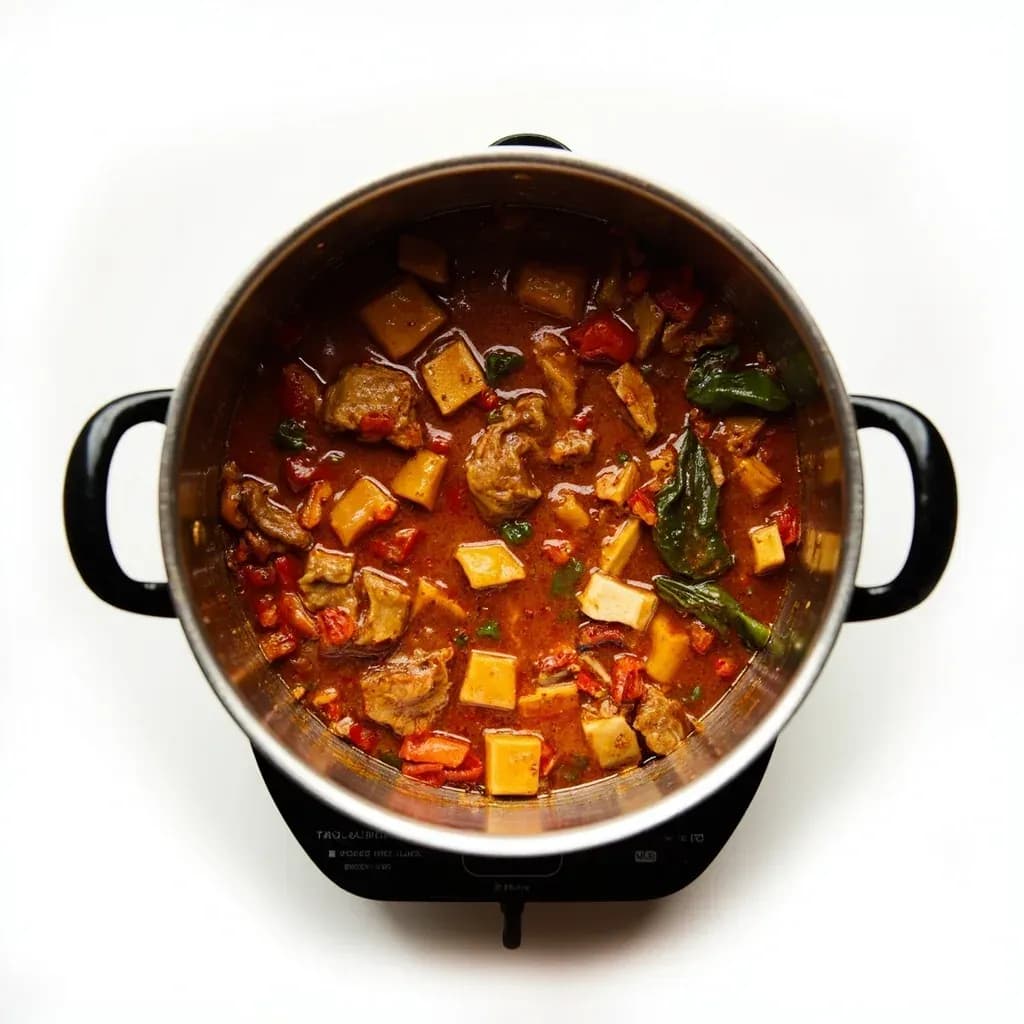
This Taiwanese method uses a Tatung-style electric pot where water poured into an outer chamber heats the inner pot indirectly, steam-cooking the food. The appliance switches off automatically once the outer water boils away, making it a near-hands-off way to steam, braise, or warm rice and stews. Adjusting the outer-water volume controls cooking time precisely.
The Tatung electric pot, designed and continuously manufactured in Taiwan by Tatung Company since 1960, is a two-piece aluminum cooker in which food is heated by steam rising from a water-filled jacket between an outer heating pot and an inner food pot. The water boils against the heating element at the bottom and rises as steam around the inner pot, so the food never sits on a hot plate and almost never scorches. This makes the Tatung behave less like a Japanese-style rice cooker, which presses rice against a direct-contact heating plate, and more like a continuous, ambient steamer that can also hold liquid braises and soups.
Timing in a Tatung is governed by the amount of water you pour into the jacket, not by an electronic timer. When the jacket boils dry, a bimetallic strip pops and the pot drops to a 'warm' hold; the food then keeps cooking on residual heat for roughly 5–10 minutes. That switchover is the cook's signal: lift delicate custards, eggs, and fish at the click, leave tough braises, sticky rice, and herbal soups to coast on the warm setting. The other Taiwan-specific detail that catches every newcomer is the bundled 180 ml rice cup; recipes written in Chinese for the Tatung use that cup, not the 240 ml US cup, so substituting one for the other throws off the rice-to-water ratio by a third.
- Difficulty
- Easy
Types & varieties
The 1960s design still in production; the most common size and the workhorse for singles, couples, and small households
A common export size that fits a whole small chicken or a larger batch of soup
The family-size pot, ubiquitous at Taiwanese gatherings for herbal soups and glutinous rice
Replaces the aluminum insert; the right choice for acidic or long-simmered dishes and easier to scrub
Coated aluminum insert; useful for steamed cakes and congee that tend to stick to bare aluminum
Newer models that keep the water-jacket steam design but add digital timers and preset modes
How to do it
- 1
Set up the water jacket
Place the inner (food) pot inside the outer pot. Pour cold water directly into the jacket between the two pots. Use 1 cup for about 20 minutes of cooking, 2 cups for 30–40 minutes, 3 cups for roughly an hour; for multi-hour soups, start with 3 cups and plan to top up once with boiling water from a kettle.
- 2
Prepare the food
Put the food in the inner pot. For dry steaming (fish, vegetables, buns), arrange it on a plate and set the plate directly in the inner pot. For wet braises and soups, add ingredients and liquid to the inner pot itself; long acidic braises are better in a stainless-steel inner pot or inside a small heatproof dish set within the pot.
- 3
Cover and switch on
Set the lid on top. On the classic two-piece lid, the lower tray sits concave-side down so condensed water drips back onto the food. Plug in and press down the cook switch; the indicator light confirms power and the element begins heating the jacket.
- 4
Listen for the click
When the jacket water boils dry, the bimetallic strip pops the switch up and the pot drops to 'warm'. Steamed eggs, fish, and custards are best removed at the moment of the click, before residual heat overcooks them.
- 5
Rest or keep warm
Tough cuts, soups, sticky rice, and braised dishes benefit from 15–30 minutes of lid-on residual time on the warm setting. The warm hold runs around 60–70 °C and is meant for holding finished food, not for returning to a simmer.
- 6
Unplug, drain, and dry
Unplug the pot, lift out the inner pot, and pour off any remaining jacket water. Wipe the outer jacket with a dry cloth, invert the lid, and store with the lid ajar to prevent musty odors around the rim and thermal sensor.
Reading the click
The 'click' — the moment the thermostat drops the pot from cook to warm — is the single most important event in a Tatung recipe. It does not mean 'done'; it means 'the jacket water is gone and the element has switched off.' Food continues to cook on stored heat in the aluminum walls for another 5–10 minutes, and that coasting is built into almost every traditional timing. Delicate items (steamed egg custard, fish, small custards) should be lifted out at the click, while tough braises, sticky rice, and herbal soups benefit from a full 15–30 minutes of lid-on rest on the warm setting. The warm setting itself holds only around 60–70 °C; it is for holding, not for simmering, so don't expect a true boil to resume on it.
- Pour 1 cup of jacket water for about 20 minutes of cooking, 2 cups for 30–40 minutes, 3 cups for roughly an hour
- For multi-hour herbal soups, start with 3 cups and top up once with boiling water from a kettle partway through
- Pull custards, eggs, and fish at the click — residual heat will overcook them
- Leave braises, sticky rice, and tough cuts on warm for 15–30 minutes after the click
- If the click never comes, the heating element may be scaled or the sensor is dirty; descale the outer pot (unplugged, empty) with a vinegar boil
Common uses
Tips & pitfalls
- Pour jacket water, not water into the inner pot — 1 cup gives about 20 minutes, 2 cups 30–40 minutes, 3 cups roughly an hour.
- For soups running over an hour, lift the lid briefly once and top up the jacket with boiling water from a kettle to avoid losing heat to a cold refill.
- Don't open the lid repeatedly while cooking — every opening drops the jacket temperature and lengthens the cook noticeably.
- Pull delicate items (steamed egg, fish, custards) at the click to 'warm'; leave braises, sticky rice, and tough cuts to coast for 15–30 minutes on residual heat.
- Long acidic braises (tomato, vinegar-heavy) will pit bare aluminum; use a stainless-steel inner pot or cook inside a small heatproof dish set within the pot.
- After washing, wipe the jacket dry and store the lid slightly ajar to prevent mildew around the rim and the thermal sensor.
- Use the bundled 180 ml rice cup for any Tatung recipe — substituting a 240 ml US cup throws off the water ratio by a full third and leaves rice underdone or soup too thin.
- If the clicker never trips, the heating element may be scaled or the sensor is dirty; descale the outer jacket with a vinegar boil (outer pot only, and unplugged while pouring the vinegar).
- Layer foods on a plate or in a small dish set on an inverted saucer inside the inner pot to lift them above any steaming liquid.
Good to know
- Origin
- Taiwan; manufactured by Tatung Company (大同公司) and first sold in 1960
- Design
- Two nested aluminum pots plus lid: an outer heating chamber and an inner food pot, with water held in the jacket between them
- How it cooks
- The heating element boils the jacket water; the resulting steam heats the inner pot and its contents, with no direct contact between the element and the food
- End-of-cook signal
- When the jacket water boils dry, a bimetallic thermostat drops the pot to 'warm' on vintage models; newer models use a thermistor for the same switchover
- Cup convention
- 1 'cup' = the 180 ml rice measure shipped with the pot, NOT a 240 ml US cup — the single most common measurement error for non-Taiwanese cooks
- Standard sizes
- 6-cup (TAC-06, ~1.5 L), 10-cup (TAC-10), and 11-cup (TAC-11); the 6-cup is the most common household size
- Power
- Roughly 600–800 W for the 6-cup; the 11-cup draws around 1,000 W
- Material
- Spun aluminum body and inner pot; newer models offer stainless-steel or non-stick inner inserts
Also called
electric-pot-steaming · Tatung Pot Cooking · Water-Jacket Steaming
Related

Boil
Cook in vigorously bubbling liquid at full rolling heat

Simmer
Hold liquid at a gentle shimmer for tender, unhurried cooking

Poach
Cook gently in barely-trembling liquid for silky, tender results

Steam
Cook in rising vapor to keep color, nutrients, and shape intact

Blanch
Plunge briefly in boiling water, then shock cold to lock color

Braise
Sear, then cook slow in a little liquid until fall-apart tender

Stew
Simmer bite-sized pieces fully submerged into a rich, unified pot

Sous-Vide
Seal and cook in precise warm water for edge-to-edge doneness