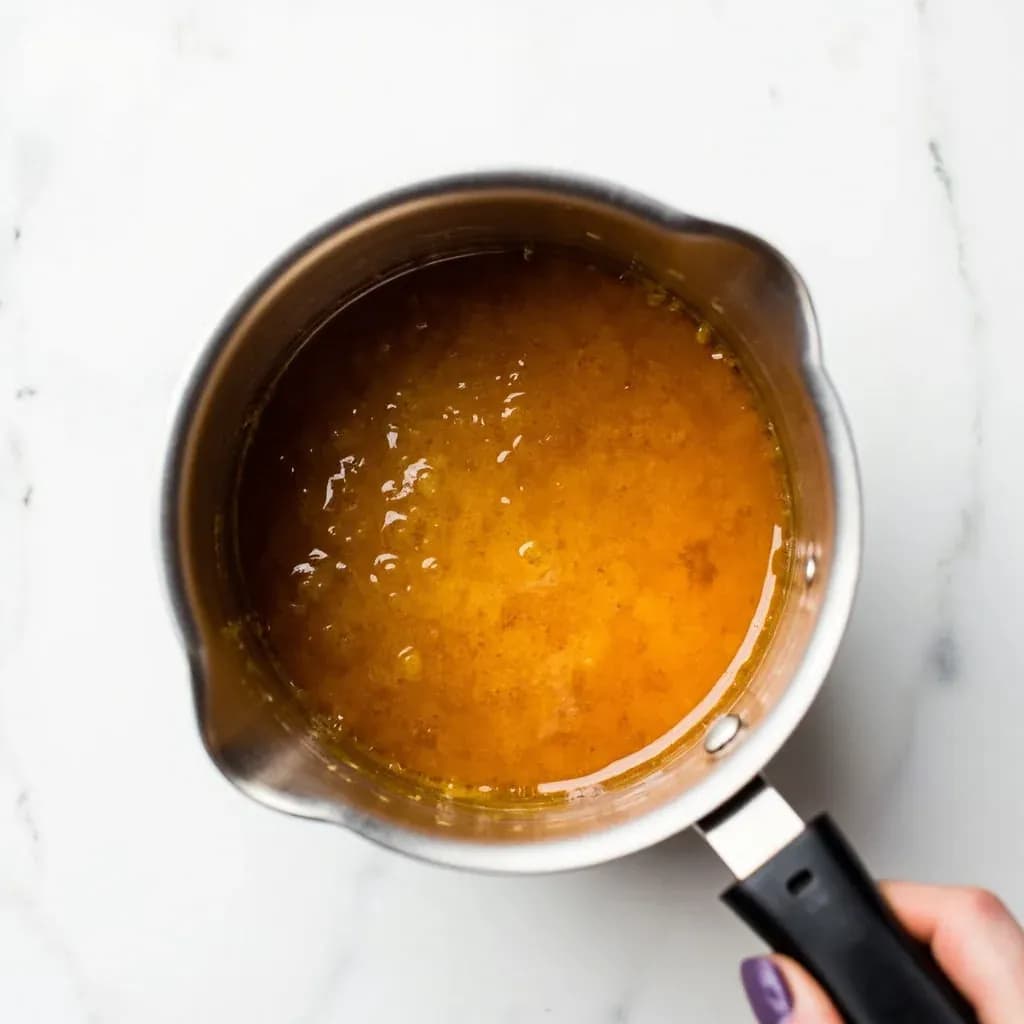
Heat & Fire
Gentle Warming (Liquefying)
Warming ingredients like honey, chocolate or butter just enough to soften or liquefy without cooking them.
Gentle warming applies low, controlled heat to make an ingredient pourable or fluid without scorching, splitting or chemically changing it. It is used to liquefy honey, melt chocolate, soften butter, or loosen a thick sauce. Methods include a low burner, a water bath or brief microwave pulses, with the goal of softening rather than cooking.
Gentle warming is the technique of raising the temperature of a heat-sensitive ingredient just enough to soften, liquefy, or pour — and no further. It lives in the narrow window between "too cold to use" and "hot enough to cook," and that window is surprisingly small: honey above 104°F begins to lose its enzymes, chocolate scorches before it visibly steams, and butter passes from creamy to greasy in a matter of seconds. The work is mostly about patience and monitoring rather than active cooking, which is why beginners tend to underestimate it.
A few degrees, held for an extra minute, will change the outcome of a recipe. Creaming softened butter (65–70°F) with sugar traps air and produces a tender crumb; the same butter fully melted yields a dense, greasy cake. Crystallized honey warmed to 95–104°F returns to a clear syrup with its floral aroma intact; the same honey heated to a simmer darkens, caramelizes its sugars, and tastes dull. Chocolate that is melted carefully at 40–45°C stays glossy and fluid; chocolate that sees a drop of water turns to a stiff, grainy paste within seconds. The line between success and waste is drawn by the thermometer, not by intuition.
In practice, gentle warming uses indirect or very low direct heat: a bowl over simmering water, a jar in a warm water bath, short pulses at reduced microwave power, or a precision sous-vide bath. The ingredient never contacts a flame, a hot pan, or boiling water directly. Stirring distributes heat evenly and an instant-read thermometer confirms when the target is reached; the cook then removes the bowl from the heat at the target, because residual warmth carries the temperature up further. The technique is distinct from tempering chocolate, which uses specific cool-down and re-warming steps to set stable cocoa-butter crystals, and from clarifying butter, which separates milk solids from fat — gentle warming's job is simply to reach a workable state without crossing into cooking.
- Difficulty
- Easy
Types & varieties
A bowl set over (not in) simmering or hot water; steam and indirect heat warm the ingredient gently. The classic method for chocolate and delicate butter sauces.
A jar or container set in a bowl of warm — not boiling — water. Ideal for crystallized honey, maple syrup, and small batches that need slow, even heat.
Short bursts of 10–20 seconds at 30–50% power, with stirring between each burst. The most convenient method for butter, chocolate chips, and coconut oil.
A thermostatically controlled low-temperature environment used in bakeries to hold chocolate, butter, or fondant at a steady target for extended work.
A precision water bath set to the exact target (e.g., 35°C for honey, 45°C for chocolate). The most accurate method and ideal for repeatable results.
Leaving the ingredient in a warm kitchen, near a sunny window, or beside a warm oven. The slowest method, used mainly for butter to reach room temperature.
How to do it
- 1
Choose the method for the ingredient
Pick a bain-marie for chocolate or custards; an off-heat warm water bath for jars of honey, maple syrup, or glucose; low-power microwave pulses for small amounts of butter or coconut oil; sous vide for precise, repeatable targets; and ambient warming only when butter needs to come to room temperature.
- 2
Prepare equipment and workspace
Have a heatproof bowl, a dry silicone spatula, and an instant-read thermometer ready. Wipe the bowl and tools completely dry — any trace of water is critical when melting chocolate and disastrous for clarified butter.
- 3
Set up indirect, low heat
For a bain-marie, bring a saucepan of water to a bare simmer and either remove it from the burner or turn the heat to its lowest setting. The bowl should sit over the water with a clear gap of a centimeter or more — never resting in it.
- 4
Add the ingredient and watch the temperature
Place the ingredient in the bowl (or lower the jar into the water bath) and insert the thermometer into the mass. Stir gently and frequently so heat distributes evenly and you don't get hot spots at the bottom or sides.
- 5
Remove at the target temperature
Pull the bowl off the heat when the ingredient reaches the target range for its job — about 35–40°C for honey, 40–45°C for untempered dark chocolate, 18–21°C for softened butter. Residual heat will carry it a degree or two further.
- 6
Use, hold, or cool as needed
Use the ingredient immediately for its purpose, or hold it over barely-warm water or in a warming drawer set to the target temperature. Softened butter can rest on the counter for 15–30 minutes without melting through; do not repeatedly reheat any of these ingredients, as each cycle degrades flavor.
Recognizing the target without a thermometer
A thermometer is the surest guide, but experienced cooks learn tactile and visual cues for each ingredient — useful when an instant-read isn't to hand.
- Honey: flows in a continuous ribbon from the spoon and feels slightly warm, not hot. Once crystallized honey has gone clear and smooth, stop; do not push to a faint steam.
- Chocolate: looks glossy and fluid, with no lumps and no grainy streaks. The outside of the bowl should feel warm but comfortable to hold — if you have to set it down, it's too hot.
- Softened butter: dents cleanly when pressed with a finger and holds the dent without collapsing. It should still feel cool to the touch; if it slumps or shines on the surface, it has crossed into melted.
- Cream cheese or mascarpone: a butter knife slides in without resistance, but the block still holds its shape on the plate. It should not look wet or weeping at the edges.
- Coconut oil: completely clear with no opaque streaks or cloudiness. Any milky patches mean it needs another minute.
- Gelatin: bloomed gelatin dissolved in warm liquid should look transparent, with no visible granules clinging to the bowl or spatula.
Common uses
Tips & pitfalls
- Use an instant-read thermometer — most failures (scorched chocolate, enzyme-killed honey, broken butter) come from guessing the temperature.
- Keep the bowl of melting chocolate above the water surface so no steam or splashes touch it; even a single drop of water will seize the chocolate into a grainy mass.
- For crystallized honey, heat the jar in water no hotter than about 104°F / 40°C — higher temperatures darken the honey, alter its flavor, and degrade enzymes such as diastase and invertase.
- When softening butter for baking, aim for 65–70°F: it should yield to a press but still hold its shape. Fully melted butter makes greasy, dense baked goods in any recipe that calls for softened.
- In the microwave, use short pulses at reduced power (30–50%) and stir between each — standing heat continues to warm the food after the appliance stops, and the last few seconds of carryover will finish the job.
- Never melt chocolate over direct heat or in a dry pan on the burner; it scorches at surprisingly low temperatures and develops a harsh, burnt taste that no amount of sugar will mask.
- If chocolate seizes from water contact, salvage it by whisking in warm cream or neutral oil a teaspoon at a time — you will not get glossy chocolate back, but you will get a workable ganache-style sauce.
- Stir gently and frequently — gentle warming is uneven, and hot spots at the bowl's edge or bottom will scorch before the center has even softened.
- Use a dry, perfectly clean bowl and spatula; even a film of condensation on the bowl or a wet finger is enough to seize chocolate and to cloud clarified butter.
- Work in small batches; large volumes of cold ingredient take much longer to warm evenly and risk overcooking the outer layer before the center softens.
- For buttercreams, frostings, and laminated doughs, the window is narrow: butter that is too cold cracks, butter that is too warm slumps. Aim for pliable but still cool to the touch.
- Hold liquefied ingredients at temperature rather than reheating repeatedly — each cycle degrades flavor and, in chocolate, breaks the fat structure so it will not reset the same way.
Good to know
- Also called
- Gentle melting, indirect-heat liquefying, bain-marie softening
- Target – honey
- 95–104°F / 35–40°C (dissolves glucose crystals, preserves enzymes and aroma)
- Target – dark chocolate (untempered)
- 104–113°F / 40–45°C
- Target – milk or white chocolate (untempered)
- 104–110°F / 40–43°C
- Target – softened butter
- 65–70°F / 18–21°C — pliable, holds a dent when pressed
- Target – fully melted butter
- 90–95°F / 32–35°C
- Target – coconut oil
- Above 76°F / 24°C (its natural melt point)
- Target – cream cheese or mascarpone (softened)
- 65–70°F / 18–21°C
- Target – bloomed gelatin, dissolved
- 95–104°F / 35–40°C
- Avoid
- Direct high heat, full-power microwave, dry pans, boiling water in contact with the bowl, any trace of water in melting chocolate
Also called
liquefying · warming through
Dishes that rely on it
Related

Sear
Blast the surface hot for a deep-browned, savory crust

Sauté
Cook quickly in a little fat over lively heat, tossing as you go

Stir-Fry
Toss bite-sized pieces over roaring heat for fast, smoky cooking

Pan-Fry
Crisp food in a shallow layer of hot fat, turning once or twice

Deep-Fry
Submerge in hot oil for an all-over crackling crust

Roast
Cook uncovered in dry oven heat for browned edges and tender centers

Bake
Cook with steady, surrounding oven heat — the soul of bread and pastry

Broil
Hit food from directly above with fierce overhead heat