Heat & Fire
Sardine Espeto Skewering
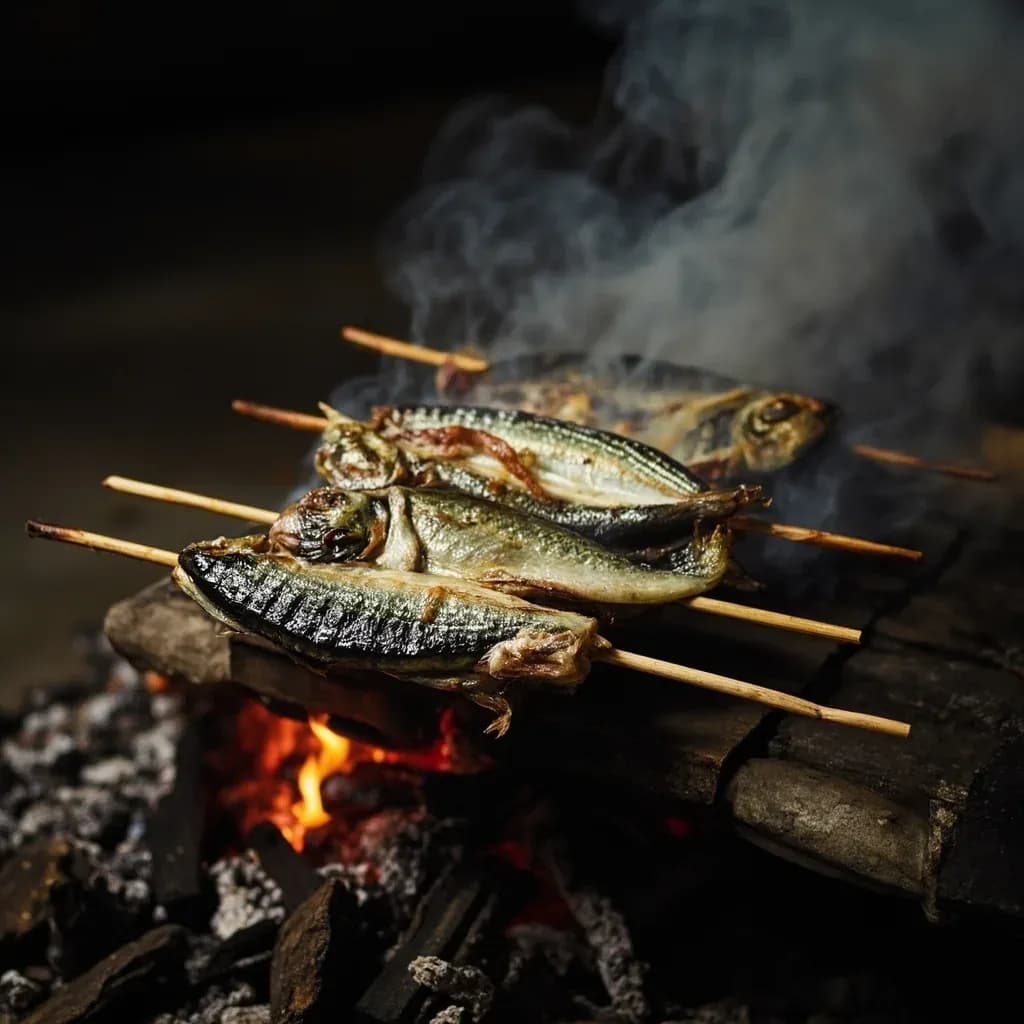
Threading sardines onto cane skewers planted beside open coals to grill them by radiant heat.
Espeto is the Andalusian beach technique of skewering whole sardines on cane sticks and planting them upright in sand or a boat-shaped grill beside a wood fire. The fish cook to one side of the coals by radiant heat, picking up smoke while the skin crisps and the flesh stays juicy. It is iconic on the Malaga coast, where the angle and distance from the embers are adjusted by eye throughout cooking.
Espeto skewering is a 19th-century Andalusian grilling technique, popularised in the beachside chiringuitos of El Palo on Málaga's coast, in which whole sardines are threaded head-first onto long sharpened canes that are then planted upright in a sand bed beside a fire. The fish cook by radiant heat alone, suspended 4–6 centimetres above a deep bed of olive-wood embers, never touching the coals or sitting over an open flame. The cane itself is part of the recipe: it gives the fish a faint grassy, ashy perfume, and its slight flexibility cushions the flesh from the radiant heat in a way that no metal rod can replicate.
What makes the technique distinct from ordinary grilling is its precision. The fish are not gutted, scaled, or filleted; the skin, scales, and belly fat protect the flesh and baste it during a cook that lasts only four or five minutes. They are seasoned with nothing but coarse salt on the embers-facing side, finished with a squeeze of lemon at the table, and traditionally served with a simple salad of tomato, pepper, onion, and olives and a glass of cold moscatel. Done well, the skin blisters to a brittle, salty crackling while the inside stays succulent and almost custardy.
Espeto is recognised as part of Málaga's gastronomic heritage, and in El Palo and along the Costa del Sol locals still ask for un espeto rather than unas sardinas — the cane is the unit of ordering. Outside the protected zone the technique is reproduced informally as far as the Granada coast, but the canonical version — olive-wood embers, fresh Sardina pilchardus of about 18 centimetres, dry caña planted in damp sand — remains the reference point against which every other version is measured.
- Difficulty
- Medium
Types & varieties
The Malagueño classic: medium sardines (Sardina pilchardus) on cane over olive-wood embers.
Larger Cantabrian anchovies treated the same way, common in northern Málaga province.
Chub mackerel, used when sardines are scarce — fattier and more assertive in flavour.
Atlantic mackerel; larger fish that need a longer cane and a slightly longer cook.
Red mullet threaded in pairs, offered as a premium alternative in some chiringuitos.
Whole cuttlefish bodies skewered and grilled the same way, common in late summer and autumn.
How to do it
- 1
Build the fire pit
In a brick-lined pit, a steel trough, or a deep tray of damp sand, stack olive-wood logs (or hardwood charcoal) and let them burn down to an even bed of glowing embers 15–20 cm deep. The coals should be grey-ashed and radiating strong orange heat; no flame should lick the sardines during cooking.
- 2
Prepare the canes
Cut dry caña (bamboo or carrizo) into 80–100 cm lengths. Sharpen one end to a fine point with a sturdy knife so it passes cleanly through a sardine's head and plants firmly in the sand. Have several canes ready — one per six to eight fish.
- 3
Choose and rinse the sardines
Select stiff-fresh medium sardines of 15–20 cm, kept on ice until the last moment. Rinse briefly in cold seawater or a 3% salt solution and pat dry. Do not gut, scale, or fillet them — the skin and belly fat are the whole point.
- 4
Thread the sardines
Hold a sardine belly-down on a board. Push the cane tip through the gill opening and out through the eye socket, sliding the fish down the shaft. Repeat head-to-tail, packing six to eight sardines tightly along each cane. The skewer passes through the bone of the head, which locks each fish in place.
- 5
Salt the embers-side flank
Sprinkle coarse sea salt on the side of each sardine that will face the embers, just before planting. A pinch per fish is plenty; the sardine is already briny and too much salt will draw out moisture.
- 6
Plant the cane in the sand
Drive the sharpened tip of the cane into the sand so the sardines stand vertically, 4–6 cm above the embers. Angle the cane so the heads sit closer to the heat and the tails point up and away. In a chiringuito row, eight to twelve canes are planted side by side along a long sand bed.
- 7
Grill by radiant heat
Cook for 2 to 2½ minutes until the embers-side skin bubbles and browns, then rotate the cane 180° and cook the other side for a further 2 minutes. The fish are ready when the skin crisps, the flesh firms, and the dorsal fin pulls free with a light tug.
- 8
Rest and serve
Pull the cane from the sand and lay it across a paper-lined platter. Slide the sardines off with a flat knife or fork, squeeze lemon over them, and serve at once with a green salad, crusty bread, and a cold beer or a glass of dry moscatel.
Why the cane matters
A metal skewer will hold a sardine over a fire, but it will not make an espeto. The dry caña does three things at once: it bends just enough to keep the fish from being scorched by the radiant heat, it weeps a faint grass-and-ash fragrance into the skin as it warms, and it leaves the cook's hands free — the cane is planted in the sand and left alone for the duration of the cook. A typical chiringuito row will hold eight to twelve canes in parallel, which is why an espeto is ordered as a cane, not as a portion.
- Bamboo or Spanish carrizo, 80–100 cm, sharpened to a fine point
- One cane per six to eight sardines
- Plant head-down so the fattier belly end sits closest to the embers
- Always slide the fish off the cane before serving — never plate them on it
Reading the fire
Espeto is a discipline of the embers, not the flame. The wood — traditionally olive prunings — is burned down to a uniform, ashed bed 15–20 cm deep, glowing dull orange rather than throwing flame. Any visible fire will blacken the skin before the flesh has firmed. The rule of thumb is that you should be able to hold your palm 10 cm above the coals for four or five seconds without discomfort; if you cannot, the heat is too fierce and the sardines will scorch rather than blister.
- Burn olive wood down to grey-ashed embers before threading fish
- No visible flame should reach the sardines at any point
- Aim for a bed 15–20 cm deep so the radiant field is even
- Resist the urge to add wood mid-cook — it only restarts the flame
Common uses
Tips & pitfalls
- Thread the sardine through the gills and out the eye socket, not through the tail — tail-threading tears the belly open and the fish falls into the embers.
- Buy sardines that are stiff-fresh: clear eyes, bright gills, silver-bright skin, and a clean sea smell. Anything flabby is past the point for espeto.
- Do not gut, scale, or fillet the sardines. The skin and belly fat protect the flesh and baste it during the short cook; filleting turns the espeto into an ordinary grilled fish.
- Salt only the embers-side flank and only at the last moment. Salting earlier draws moisture; salting both sides overwhelms the fish.
- Wait until the wood has burned down to a uniform bed of grey-ashed embers. Open flame blackens the skin before the flesh has firmed and ruins the texture.
- Plant the cane head-down, tails up. The thicker, fattier head end sits closest to the embers and cooks through; the thinner tails finish from residual heat.
- Rotate the entire cane 180° at the halfway mark rather than flipping individual fish — they tear easily off the skewer.
- Pull the cane out and slide the sardines onto a plate for serving. Leaving them on the cane at table risks splinters and bamboo fragments in the flesh.
- If you must fall back on metal skewers, double them and lay them across a rack — but accept that you will lose the cane fragrance that defines the dish.
Good to know
- Origin
- Málaga, Spain — the El Palo neighbourhood, popularised by 19th-century fishermen and now protected as part of the city's gastronomic heritage.
- Skewer
- Dry caña (bamboo or Spanish carrizo), 80–100 cm long, sharpened to a fine point at one end.
- Heat source
- Glowing embers of olive-wood logs, orujo-pruning wood, or hardwood charcoal — never a live flame against the skin.
- Cooking method
- Pure radiant heat; the fish hang 4–6 cm above the embers with no conductive contact.
- Cooking time
- About 4–5 minutes total, rotated once at the halfway mark.
- Seasoning
- Coarse sea salt on the embers-side flank only; lemon at the table.
- Per cane
- Six to eight sardines, threaded head-first through the gills and eye socket.
- Service
- Slid off the cane onto a paper-lined plate, with a green salad and cold beer or moscatel.
Also called
espeto · espeto de sardinas · cane skewering
Related

Sear
Blast the surface hot for a deep-browned, savory crust

Sauté
Cook quickly in a little fat over lively heat, tossing as you go

Stir-Fry
Toss bite-sized pieces over roaring heat for fast, smoky cooking

Pan-Fry
Crisp food in a shallow layer of hot fat, turning once or twice

Deep-Fry
Submerge in hot oil for an all-over crackling crust

Roast
Cook uncovered in dry oven heat for browned edges and tender centers

Bake
Cook with steady, surrounding oven heat — the soul of bread and pastry

Broil
Hit food from directly above with fierce overhead heat