Transform & Preserve
Flour Maturing / Aging
Letting milled flour rest and oxidize over weeks so it bakes with stronger gluten.
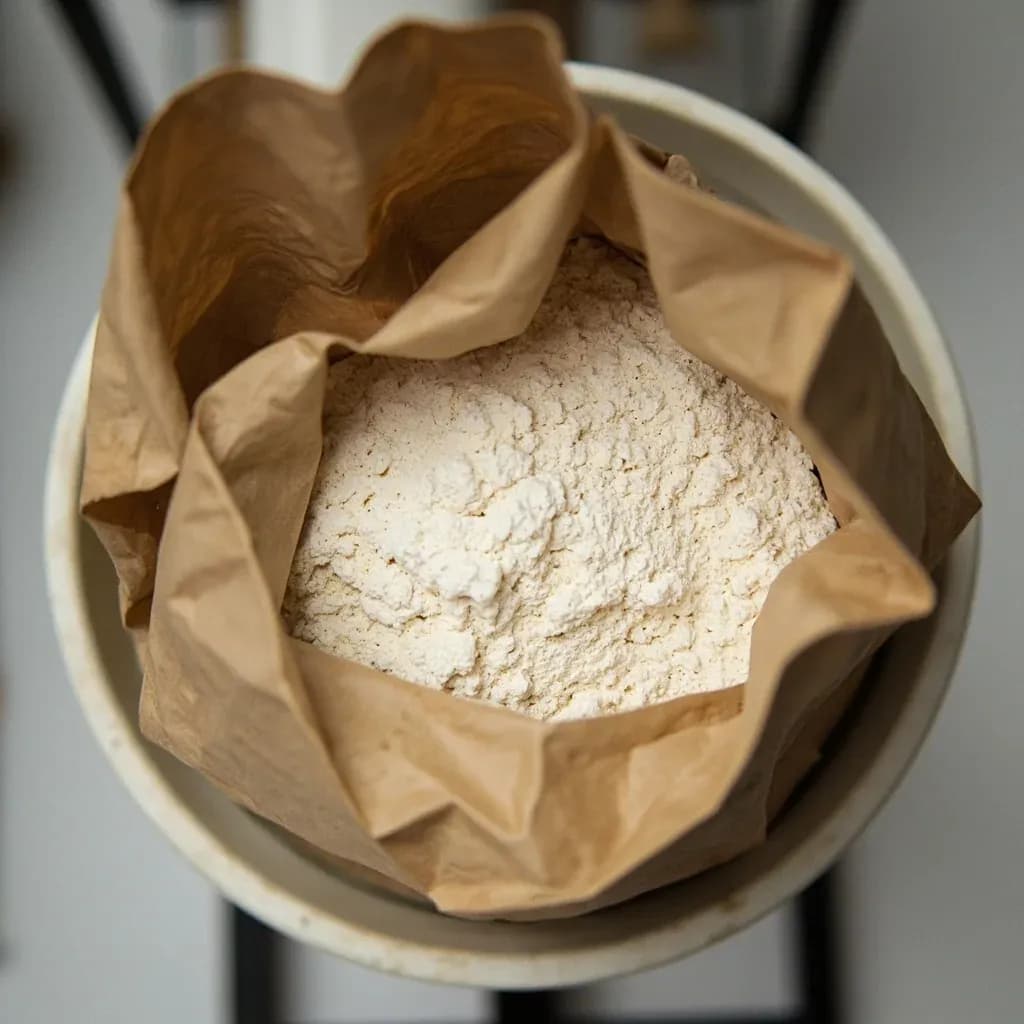
Flour maturing rests freshly milled flour for weeks so oxygen oxidizes its carotenoids and strengthens the gluten-forming proteins, whitening the flour and improving dough handling. Naturally aged flour produces better volume and elasticity than flour used straight from the mill. Industrial mills sometimes speed this with treatments, but artisan bakers often let flour age naturally.
Flour aging is the practice of letting milled flour rest in storage for weeks to months so that atmospheric oxygen can do its quiet work on the proteins and pigments inside. Oxygen gradually oxidizes sulfhydryl (–SH) groups on gluten-forming proteins into disulfide (S–S) bridges, knitting the network tighter so the flour hydrates into dough with better elasticity, higher absorption, and stronger oven spring. At the same time, carotenoid pigments in the endosperm slowly fade, lightening the flour from a faintly creamy yellow toward the pale ivory most bakers expect from a bag of all-purpose flour.
Historically this happened in wooden or cloth bins at the mill, and bakers simply ordered flour that had been sitting for six weeks to several months. Today's industrial mills skip the wait with chlorine gas, benzoyl peroxide, azodicarbonamide, or potassium bromate — chemical shortcuts that bleach and oxidize flour in hours. Natural aging is the patient, additive-free alternative: a passive technique whose only real cost is shelf space and a good label. For home bakers working with fresh-milled or small-batch flour, it is the single most effective way to translate an unpredictable bag of grain into a reliable loaf.
The technique behaves differently depending on the grain. Refined wheat flour, with its low moisture and no germ, ages slowly and can rest for months without spoiling. Whole-grain flour carries the fatty germ, so the same oxygen that strengthens gluten also turns those oils rancid if the window stretches past a few weeks. Rye, spelt, and heritage wheats each have their own sweet spot, generally one to three weeks. Understanding those windows — and knowing when to stop aging and start freezing — is the heart of the practice.
- Difficulty
- Medium
Types & varieties
Traditional method; bulk flour held in bins or jars at the mill or bakery for weeks to months, sometimes with weekly turning to admit oxygen.
Some mills pump purified O₂ through the silo to shorten the aging period to days while avoiding chemical bleaches; common for European Type 55, Type 65, and German Type 550 flours.
A brief 1–2 week rest for fresh-milled whole wheat, balancing gluten maturation against germ-oil freshness.
Rye flours benefit noticeably from 1–2 weeks of rest as pentosans hydrate and alpha-amylase activity settles, producing a tighter crumb.
Softer-gluten grains such as spelt, emmer, and einkorn develop enough strength for yeasted loaves after 2–3 weeks.
Low-protein pastry flours gain little from natural aging; most commercial cake flours are chlorinated, which is a related but distinct chemical-aging process.
How to do it
- 1
Mill or source fresh flour
Mill cleaned wheat or another grain to your target extraction rate, or buy directly from a small mill. Mark the date on every container with a permanent marker — this is the single most important step in the whole process.
- 2
Cool the flour to room temperature
If the flour came off the mill or out of a warm delivery, spread it on a clean sheet pan and let it cool fully before sealing. Trapped heat will jump-start rancidity in whole-grain flour.
- 3
Sift and aerate
Pass the flour through a medium sieve to break up clumps and expose fresh surface area to oxygen. Thirty to sixty minutes of airing in a shallow tray noticeably accelerates the first phase of oxidation, especially for whole-grain flour.
- 4
Pack in a breathable-then-sealed container
Use a food-grade bucket with a loose lid, a glass jar with a coffee filter tucked under the screw band, or a Mylar bag. During the first week, leave the lid slightly loose for more oxygen contact, then seal tightly for the remainder of the rest.
- 5
Store cool, dark, and dry
Keep the container at 18–22 °C (64–72 °F) and below 60% relative humidity. A pantry, cellar, or interior closet is ideal; avoid sunlit shelves, ovens, and laundry rooms.
- 6
Rest the flour
Refined wheat flour rests 4–12 weeks, with the safe window extending to about 3 months under cool, dry, dark conditions. Whole-wheat rests 1–2 weeks. Rye rests 1–2 weeks. Spelt, emmer, and other heritage wheats rest 2–3 weeks. Longer is not better — it is the start of spoilage for whole-grain flours.
- 7
Turn the bulk weekly (optional)
If you are aging a large bin of flour, scoop from the bottom and pour back on top once a week to redistribute oxygen and equalize moisture throughout the lot.
- 8
Test before committing a recipe
Bake a small roll or a mini baguette from the aged flour and compare it to one made from the same flour fresh. Tighter crumb, better oven spring, easier shaping, and a slightly paler color all signal that the gluten is mature.
- 9
Move to long-term storage
Once the flour has reached its ideal age, refrigerate whole-grain flour for 1–3 months or freeze it for 6–12 months. Refined flour can stay sealed at cool room temperature for 6–12 months post-mill.
- 10
Temper before opening
If refrigerated or frozen, set the sealed container on the counter for 1–2 hours before opening. This prevents warm, humid room air from condensing on cold flour and forming clumps or surface mold.
The chemistry, briefly
Two slow reactions run in parallel. On the protein side, oxygen pulls hydrogen off sulfhydryl groups on glutenin and gliadin, letting neighboring molecules form covalent disulfide bonds that lock the gluten network into a stronger web. On the pigment side, the same oxygen attacks the conjugated double bonds of xanthophyll carotenoids, breaking them into colorless fragments. The first reaction is what your dough feels; the second is what your eyes see.
Natural aging versus commercial bleaching
Natural aging and chemical bleaching are different in degree, not in kind. Chlorine gas is essentially an accelerated version of what oxygen does, and it has the side benefit of lowering pH, which strengthens cake flour's ability to hold sugar and fat. Azodicarbonamide and potassium bromate are pure oxidizers that work fast on gluten bonds. None of these, however, can replace the deeper flavor and aroma of well-aged flour, and several are restricted or banned — which is why 'unbleached, unbromated' is now a meaningful label rather than a marketing slogan.
- Chlorine: bleaches and acidifies, used for cake flours.
- Benzoyl peroxide: bleaches only, minimal effect on gluten.
- Azodicarbonamide (ADA): oxidizes gluten, banned in the EU and UK.
- Potassium bromate: oxidizes gluten, banned in the EU, Brazil, Canada, China; a possible carcinogen.
- Oxygen-enriched aging: the closest industrial analogue to natural aging.
When aging turns into spoilage
The same oxygen that helps gluten is the enemy of germ lipids. Whole-wheat and rye flours contain polyunsaturated oils that oxidize into aldehydes and ketones, producing the paint-like, crayon, or soapy aromas that signal rancidity. Once that off-note appears, aging is over — either bake with the flour soon or move it to the freezer. Refined white flour, having had the germ removed, sidesteps this problem and can age far longer.
- Paint, crayon, or soap smell = lipid oxidation, not gluten maturation.
- Refined flour: months at room temperature are safe.
- Whole-grain flour: 1–4 weeks at room temperature, then refrigerate or freeze.
- Freeze in small, working-size containers to avoid repeated thawing.
Common uses
Tips & pitfalls
- Label every container with both the mill date and your target use-by date — once the window closes, freshness, not age, becomes the enemy.
- Use airtight food-grade containers, but accept some oxygen exchange in the first week; this is oxygen you want.
- Refrigerate or freeze whole-grain flour the moment it passes peak age; refined flour can keep resting on the shelf.
- Never age flour above 24 °C (75 °F) — warmth speeds gluten oxidation and rancidity in equal measure.
- Bake a small test loaf to confirm readiness: better oven spring and finer crumb are the most reliable indicators.
- Spread fresh flour in a shallow tray for 24–48 hours to mimic months of aging in a pinch; useful when you are short on time.
- Skip chlorinated bleached flour for sourdough and long-fermentation breads — the chemistry can disrupt wild yeast and lactic acid bacteria.
- If your stored flour smells paint-like, crayon-like, bitter, or soapy, it has gone rancid; compost it and start over with a smaller batch.
- Store whole grains and mill only the flour you will use in 2–3 weeks; berries keep for years, flour does not.
Good to know
- Synonyms
- Flour conditioning, flour maturation, flour ripening, natural bleaching.
- Chemical principle
- Atmospheric oxygen oxidizes sulfhydryl groups on gluten proteins into disulfide bonds and bleaches carotenoid pigments in the endosperm.
- Storage temperature
- 18–22 °C (64–72 °F), below 60% relative humidity, in the dark.
- Refined-flour window
- 4–12 weeks at cool room temperature in a sealed container; very low moisture (~14%) refined flour ages slowly without spoilage.
- Whole-grain window
- 1–4 weeks at cool room temperature before germ oils oxidize noticeably; many bakers use it within 1–2 weeks.
- Effect on dough
- More extensible yet elastic dough, better oven spring, finer crumb, slightly higher water absorption (often +1–2% baker's percentage).
- Effect on color
- Faintly yellow fresh flour whitens as carotenoids break down; artisan bakers often prefer the cream tone for flavor.
- Industrial alternatives
- Chlorine gas, benzoyl peroxide, azodicarbonamide, or potassium bromate (banned in the EU, Brazil, Canada, and China) achieve the same effects in hours rather than weeks.
Also called
Flour Maturing · Flour Oxidation
Related

Confit
Cook slowly submerged in fat for silky tenderness and keeping

Cure
Draw out moisture with salt and time to preserve and concentrate

Pickle
Steep in acidic brine for bright, tangy, crunchy preservation

Ferment
Let friendly microbes transform food into tangy, complex flavor

Marinate
Soak in a seasoned mix to flavor and tenderize before cooking

Brine
Soak in salt water so meat stays juicy and seasoned throughout

Dehydrate
Slowly dry out moisture to concentrate flavor and extend shelf life

Cold-Smoke
Perfume cured food with smoke without cooking it through