Knife Skills
Hand-Mincing Meat
Chopping meat into mince by hand with a knife or cleaver for better texture.
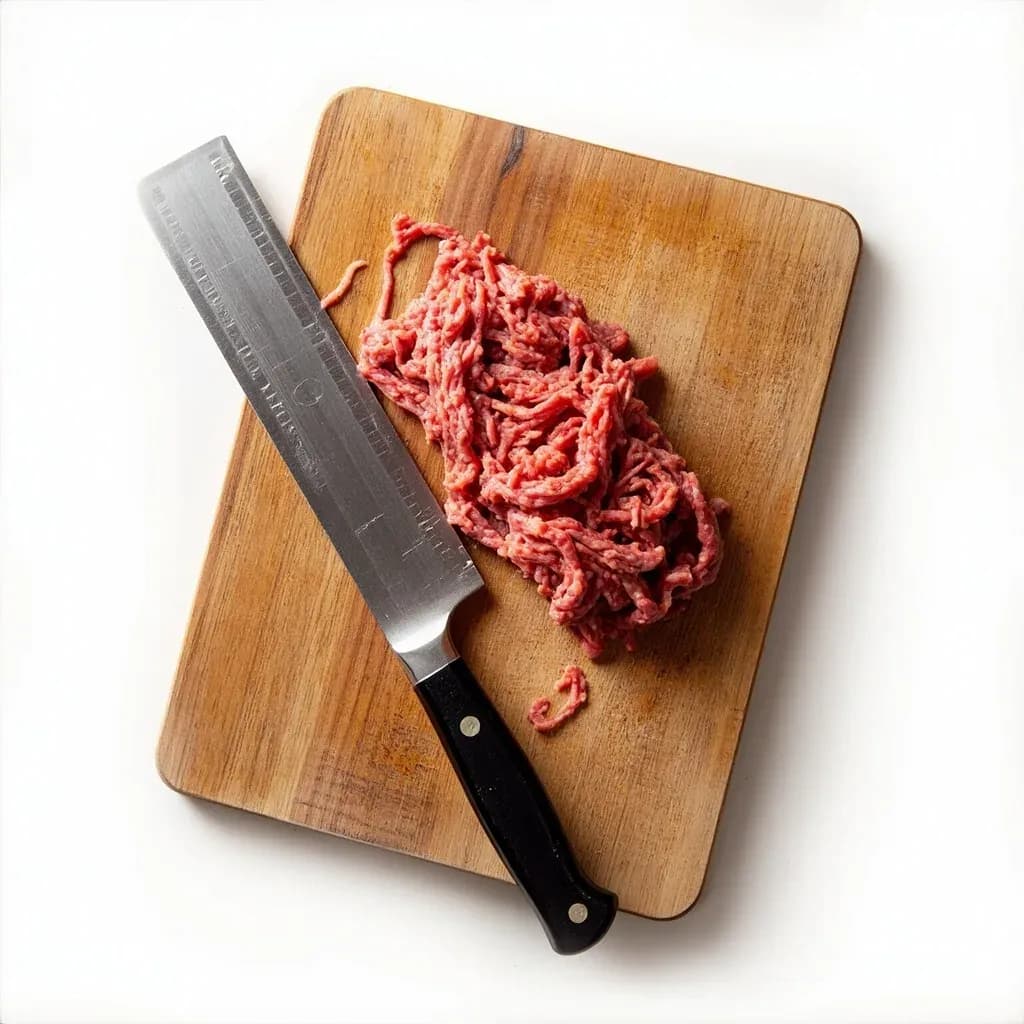
Hand-mincing meat uses a sharp knife or pair of cleavers to chop a cut into fine mince instead of running it through a grinder. The hand-cut texture stays loose and varied, with bits of fat distributed unevenly, which many cooks prize for dumplings, tartare, and dishes like larb. It also avoids the smearing and heat a grinder can introduce, keeping the meat clean-tasting.
Hand-mincing is the practice of reducing meat to small, irregular pieces with a heavy knife or cleaver rather than pushing it through a grinder plate. The distinction matters: a sharp blade severs muscle fibers cleanly, while a grinder plate shears and compresses them into a more uniform, denser paste. The result is a mince that holds visible grain, releases juices more slowly during cooking, and binds with comparatively little added fat — which is why hand-minced meatballs feel lighter, dumplings chewier, and tartare looser than their ground counterparts.
This is the canonical method for French haché preparations, the default in Chinese dumpling and meatball cookery, and the preferred approach across much of the Middle East, Italy, and Korea when texture is part of the dish's identity. A sharp, heavy blade and properly chilled meat are the two non-negotiables; the technique itself is largely a matter of patient rocking rather than force, with most of the work done by gravity and the knife's own weight.
The trade-off is volume. Hand-mincing scales poorly beyond about a kilogram per batch, and a coarse grinder plate finished with a few hand-chops is a fair compromise when time is short. For small to medium quantities, though, nothing matches the open, juicy texture of a well-executed hand mince.
- Difficulty
- Medium
Types & varieties
Hand-chopped beef used for steak haché, tartare, quenelles, and croquettes; emphasizes coarse, distinct particles.
Chinese technique with a heavy cleaver, used for jiaozi, wonton, lion's head meatball, and meat-tofu fillings.
Two cleavers used in parallel, common in Sichuan and Cantonese prep for very fine, even mince with minimal tearing.
Coarse hand-chopped pork or beef for ragù, polpette, and stuffed pastas.
Hand-chopped lamb for kibbeh and kofta where texture and visible fiber are desired.
How to do it
- 1
Chill the meat
Place the trimmed, well-marbled cut in the freezer for 15–30 minutes, or in the refrigerator for 1–2 hours, until it is firm to the touch but not frozen solid. Pat dry with paper towels.
- 2
Slice into strips
With a sharp chef's knife or cleaver, cut across the grain into 1–2 cm (about ½ in) thick slices, then stack and slice each slice into matchstick-thick strips. Keep your guiding hand in a claw grip.
- 3
Dice into cubes
Turn the strips 90° and cut across them into roughly 1 cm (½ in) dice. Aim for uniformity; this is what determines the final mince size.
- 4
First rock-chop pass
Pile the dice together. Hold the knife with one hand on the handle and the other on the spine near the tip. Use a rocking, circular motion to cut through the pile, moving the blade forward, down, and back. Keep the tip on the board.
- 5
Scrape and repeat
Use the blade's flat or a bench scraper to gather the mince into a tight mound, then chop across it again. Repeat 3–5 passes until pieces are 2–6 mm across and uniform. Stop as soon as the texture is right; over-chopping makes it pasty.
- 6
Season and bind (optional)
If the recipe calls for salt and a binder, sprinkle salt and a small amount of cold liquid (stock, water, or egg white) over the mince, then rock-chop once or twice more just to distribute. Use immediately or refrigerate.
Cuts, Marbling, and the Role of Temperature
The cut you choose sets the ceiling on texture. Lean steaks (sirloin, tenderloin) mince cleanly but produce a dry finished product unless you add fat; well-marbled shoulder cuts — beef chuck, pork butt, lamb shoulder, veal shoulder — bring their own fat and connective tissue, which translates to a more forgiving mince that stays juicy when cooked. Trim only the largest knobs of external fat and silverskin; leave interior marbling intact.
Temperature is the other lever. Warmer than about 40°F (4°C), the meat smears under the blade; fully frozen, it shatters and the knife bites unevenly. Aim for the firmness of cold butter: 15–30 minutes in the freezer after trimming is usually enough. The fibers cut cleanly, the dice holds its shape through the rocking passes, and myoglobin stays inside the cells instead of bleeding onto the board and turning the mince gray.
- Use chuck, shoulder, or butt — never lean steak for a hand mince destined to be cooked.
- Target 32–40°F: firm to the touch but not rock-hard; freeze 15–30 minutes as a shortcut.
- Pat the surface dry before chopping; surface moisture dilutes flavor and promotes smearing.
- Save any scrap trimming for stock — don't fold tough bits into a hand mince.
Common uses
Tips & pitfalls
- Sharpen before you start. A dull blade tears fibers and produces a pasty, gray mince.
- Chill to the firmness of cold butter — fully thawed meat smears, fully frozen meat shatters.
- Cut into uniform strips, then dice, then rock-chop; skipping straight to rocking leaves uneven pieces.
- Salt late. Adding salt too early draws out protein-bound water and turns the mince sticky and dense.
- Let the weight of the knife do the work; pressing down with force crushes rather than cuts.
- Re-collect the mince into a pile with the blade's flat between chops so you are always cutting, never smearing.
- For emulsified dishes like lion's head or meatballs, add salt and a splash of liquid only after the coarse chop, then take a few more passes to bind.
- Use a heavy round-bottomed wood block for cleaver work if available; it protects the blade edge and stabilizes the meat.
- Common mistake: mincing warm meat — it releases myoglobin, turns gray, and gives a mushy result.
- Common mistake: chopping too long after salting — the proteins tighten and the texture turns bouncy and sausage-like rather than open.
Good to know
- Technique family
- Hand chopping with a heavy knife or cleaver on a cutting board, in place of mechanical grinding.
- Etymology
- French: haché (chopped); Italian: tritato/tritare; Chinese: 剁 (duò, to mince with a cleaver).
- Ideal meat temperature
- Around 32–40°F (0–4°C) — chilled firm, often a brief 15–30 minute freeze so cuts stay clean.
- Typical knife
- Heavy Chinese cleaver (caidao), French or German chef's knife, or a heavy mezzaluna.
- Average time
- Roughly 8–12 minutes per pound (450 g) to a coarse hand-mince; longer for a finer paste.
- Best cuts
- Well-marbled cuts with connective tissue: beef chuck, pork shoulder, lamb shoulder, veal shoulder.
- Yield vs. grinder
- No measurable volume loss; texture is looser and more open than machine-minced meat.
- Difficulty
- Moderate; demands a sharp, heavy blade and a confident rocking motion.
- Texture outcome
- Distinct, irregular particles 2–6 mm across rather than a uniform paste; muscle fibers remain identifiable.
- Storage of finished mince
- Cook immediately or refrigerate up to 24 hours; do not refreeze raw hand-minced meat.
- Historical note
- Predates the mechanical meat grinder (patented in the 19th century); remains standard for dumplings, meatballs, and forcemeat in many cuisines.
Also called
Hand Mincing Meat · Hand-Chopped Mince
Related

Chop
Cut into rough, irregular pieces — the everyday workhorse cut

Dice
Cut into uniform cubes for even cooking and a tidy look

Mince
Cut as fine as possible so flavor melts evenly into the dish

Slice
Cut into even, flat pieces for consistent cooking and presentation

Julienne
Cut into thin matchsticks for fast cooking and elegant garnish

Brunoise
Cut into tiny, precise cubes — the finest dice in the kitchen

Chiffonade
Roll and slice leafy greens into delicate ribbons

Batonnet
Cut into tidy sticks, thicker than julienne — think classic fries