Heat & Fire
High-Heat Wok Tossing (Wok Hei)
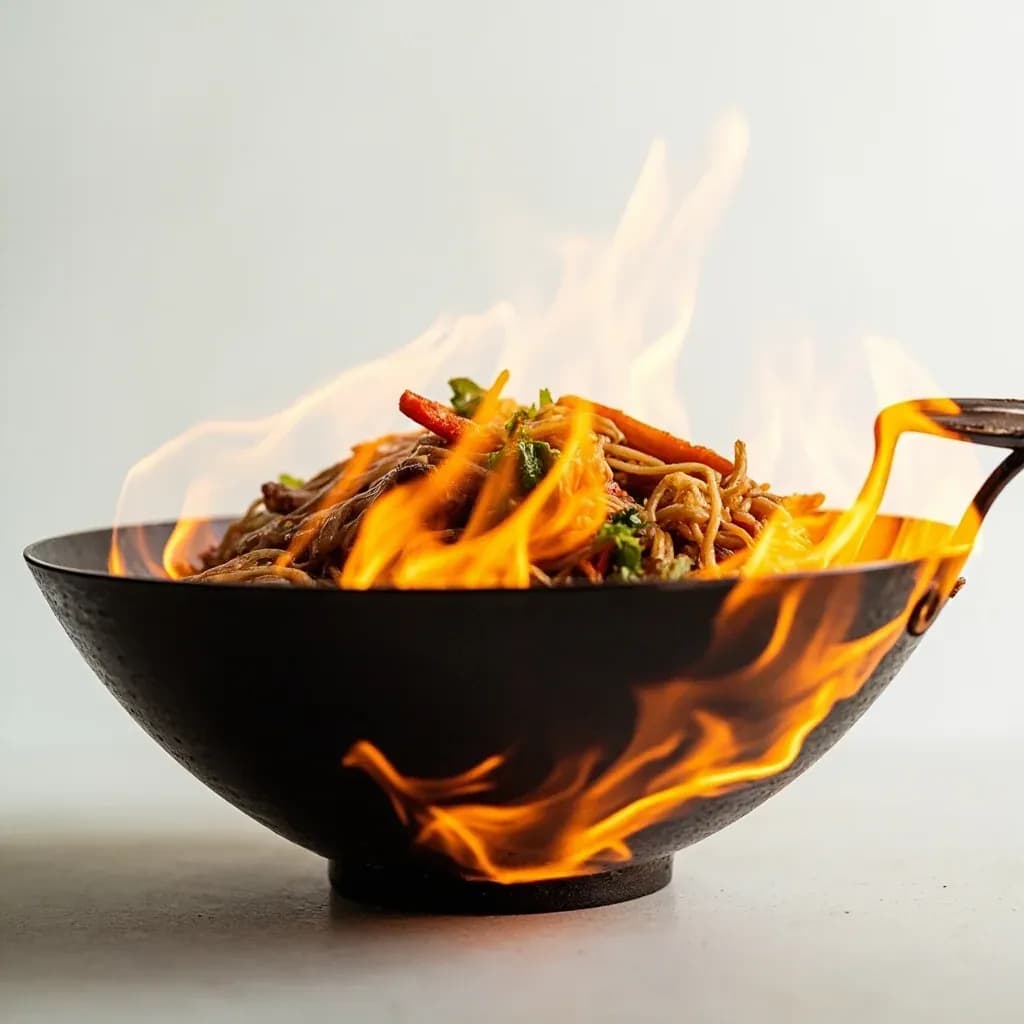
Tossing food through flames in a blazing wok to capture the smoky, charred 'breath of the wok' flavor.
High-heat wok tossing flips ingredients repeatedly through a roaring wok over maximum flame so oil aerosolizes and ignites, imparting the prized smoky-charred aroma called wok hei, the 'breath of the wok'. The constant motion sears food fast and evenly without stewing. Achieving it requires intense BTU heat, a hot dry wok, and confident tossing.
Wok hei — literally "breath of the wok" in Cantonese (鑊氣) — is the fleeting, smoky char that good stir-fry picks up in the seconds it spends tossed through the open flame above a screaming-hot wok. It is not a single flavor but a layered one: Maillard browning on the wok's seasoned surface, caramelization of sugars in sauces and vegetables, and the brief combustion of vaporized oil and sauce droplets igniting as they pass through the flame cone. The effect fades within a minute or two of leaving the wok, which is why restaurant stir-fry arrives at the table still smelling of the fire.
The technique is equipment-bound. Traditional Cantonese restaurant burners deliver 100,000 to 250,000 BTU per hour — roughly an order of magnitude more than a domestic gas ring — pushing wok-surface temperatures to 370–500°C (700–930°F). At home, the same result is only partially reproducible: a carbon steel wok on the largest burner you own, preheated until it visibly smokes, will brown food faster and hotter than any non-stick pan could, but the vaporization-and-combustion half of wok hei is hard to fake without an open flame jetting up past the food. Small batches, a well-developed patina, and strict discipline with timing narrow the gap considerably.
Cook time is short by design. An entire stir-fry, from the first aromatic to the final glaze, rarely runs longer than three or four minutes, and individual batches finish in 90 seconds to three minutes. That brevity is what preserves the snap in a scallop, the crunch in a bean sprout, and the distinct toasted grains of a properly fried rice. The technique rewards cooks who treat mise en place as a religion — once the food hits the wok, there is no time to chop another scallion.
- Difficulty
- Hard
Types & varieties
'Explosive stir-fry' — the most aggressive form, almost flame-kissed; classic for ginger-and-spring-onion scallops and flash-seared prawns
Fried-rice technique in which cold, day-old rice is tossed over maximum heat to develop distinct smoky edges on individual grains
'Dry-fry' or 'dry toss' with minimal sauce and intense heat; prized for beef ho fun (gon chow ngau ho) and chow mein
Saucier Cantonese style finished with a cornstarch-thickened gravy, as in tomato-and-egg or beef over rice
Char kway teow and Hokkien mee follow the same wok-hei principles, often finishing with lard for extra char
How to do it
- 1
Mise en place
Cut all ingredients into uniform, bite-sized pieces so they cook in seconds. Measure sauces, aromatics, and seasonings into small bowls within arm's reach. Lay the wok spatula and ladle beside the stove. This step is non-negotiable: high-heat wok work leaves no time to chop once the fire is up.
- 2
Heat the wok until smoking
Place the seasoned carbon steel wok over the highest possible flame. Wait until a wisp of smoke rises from the bare metal and the air above the wok shimmers. A drop of water flicked in should ball up and vanish in under a second. A lukewarm wok is the most common reason wok hei fails at home.
- 3
Add oil and bring to smoke point
Pour 1–2 tablespoons of a high-smoke-point oil — peanut, rice bran, or grapeseed — down the side of the wok and swirl to coat. The oil is ready when it just begins to ripple and smoke. Use only a thin film; excess oil smothers the flame and prevents the vaporized-droplet combustion that produces wok hei.
- 4
Aromatics, briefly
Add garlic, ginger, scallions, or dried chilies. Toss for 5–10 seconds only — fragrant, not browned. Push them to the sides of the wok or scoop them out if they would burn before the protein is ready.
- 5
Protein first, in a single layer
Add the protein and spread it across the hottest part of the wok. Leave it undisturbed for 15–30 seconds so it sears and develops fond, then begin the two-handed toss: the ladle scoops from underneath while the spatula flips and turns the food, sending it up through the flame.
- 6
Add vegetables, keep the wok moving
Add denser vegetables (carrots, broccoli stems, gai lan stems) first; leafy or quick-cooking items (bok choy, bean sprouts, choy sum leaves) a few seconds later. Maintain constant motion so nothing sits long enough to scorch but everything contacts the hot metal.
- 7
Sauce at the very end
Pour the pre-mixed sauce down the side of the wok — not directly onto the food — so it hits the hot metal and reduces almost instantly. Toss to glaze. This is the stage where vaporized sauce droplets ignite in the flame and produce the most recognizable wok-hei aromatics.
- 8
Final toss and serve
One last high toss to flash off excess moisture, then slide the food immediately onto a pre-warmed plate. Wok hei fades within 1–2 minutes of leaving the wok, so the dish must go straight to the table — reheat kills it.
The chemistry of wok hei
The flavor is the sum of three simultaneous reactions happening in a window of seconds. On the metal itself, proteins and sugars undergo Maillard browning and caramelization, building fond that tastes toasted rather than burned. In the sauce and oil, vaporized droplets rise with the toss and ignite briefly in the flame above the wok — a true combustion that contributes the smoky, almost charcoal-grilled note people mean when they say a dish 'has wok hei.' A well-seasoned restaurant patina contributes a fourth, subtler layer: years of polymerized oil seasoning the wok like a cast-iron skillet, which is why chefs guard their woks and never wash them with soap.
- Maillard browning and caramelization on the hot metal
- Combustion of vaporized oil and sauce droplets in the open flame
- Seasoned patina from years of polymerized oil
Why your wok hei doesn't taste like the restaurant's
The honest answer is equipment. A commercial Cantonese burner dumps 100,000+ BTU directly under a round-bottomed carbon steel wok, and the flame rolls up the sides and over the food as it is tossed. A home gas ring delivers a tenth of that and licks the bottom only. You can compensate by using the largest burner you own, buying a flat-bottom carbon steel wok (or a wok ring for a round-bottom one), preheating longer, working in much smaller batches, and finishing the dish by tossing the food up through whatever flame you can coax above the rim. It will not match a Hong Kong kitchen, but it can come surprisingly close.
- Use the largest burner you own, or add an outdoor jet burner
- Cook in half the portions a recipe suggests; reheat the second batch
- Angle or tilt the wok to concentrate flame contact
- Accept that patina-building takes months of daily use
Common uses
Tips & pitfalls
- Preheat the wok until it visibly smokes before any oil goes in; a lukewarm wok is the number-one reason wok hei fails at home.
- Cook in small batches — overcrowding drops the surface temperature and turns stir-fry into stewing.
- Use carbon steel, not non-stick; non-stick coatings max out around 260°C/500°F and contribute none of the seasoning flavor.
- Add a thin film of oil only; excess oil smothers the flame and prevents the vaporized-droplet combustion that creates wok hei.
- Common mistake: stirring constantly instead of letting ingredients sit 10–15 seconds to develop sear and fond.
- Common mistake: adding aromatics too early — garlic and ginger burn in seconds at wok temperatures and turn bitter.
- Wipe out carbonized bits between batches only if they smell acrid; a little fond is flavor, not filth.
- On a home stove, angle the wok so the bottom sits directly over the flame and tilt to concentrate heat; a wok ring or a flat-bottom carbon steel wok helps where there is no round-bottom burner.
Good to know
- Origin
- Cantonese (Guangdong) restaurant tradition, refined in Hong Kong dai pai dong and restaurant kitchens
- Cantonese name
- Wok hei (鑊氣), literally 'breath of the wok'
- Wok surface temperature
- 370–500°C (700–930°F) at the hottest point above the flame
- Commercial burner output
- 100,000–250,000 BTU/h; domestic gas rings typically 10,000–15,000 BTU
- Cook time
- 90 seconds to 3 minutes per batch; full stir-fry rarely over 4 minutes
- Wok type
- Carbon steel, round-bottomed, with a well-developed patina — never non-stick
- Signature tools
- Wok spatula (chǎn) used with a long-handled ladle (wok hoak) for the two-handed toss
- Source of flavor
- Maillard browning, caramelization, and brief combustion of vaporized oil and sauce droplets in the flame
Also called
wok-hei-searing · wok hei · wok tossing
Dishes that rely on it
Related

Sear
Blast the surface hot for a deep-browned, savory crust

Sauté
Cook quickly in a little fat over lively heat, tossing as you go

Stir-Fry
Toss bite-sized pieces over roaring heat for fast, smoky cooking

Pan-Fry
Crisp food in a shallow layer of hot fat, turning once or twice

Deep-Fry
Submerge in hot oil for an all-over crackling crust

Roast
Cook uncovered in dry oven heat for browned edges and tender centers

Bake
Cook with steady, surrounding oven heat — the soul of bread and pastry

Broil
Hit food from directly above with fierce overhead heat