Heat & Fire
High-Heat Explode-Fry (Bao Chao)
Sichuan technique of frying ingredients in screaming-hot oil for seconds to flash-cook and lock in juices.
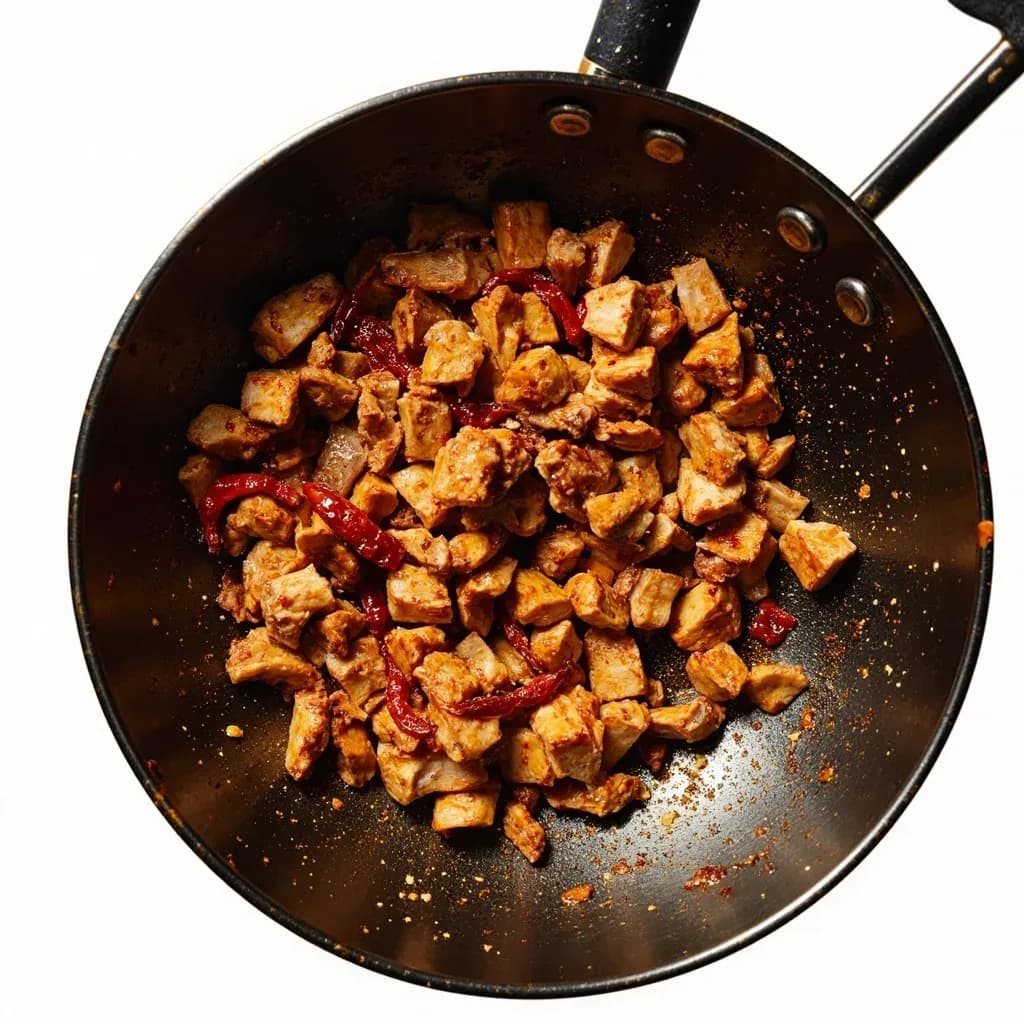
Explode-frying, or bao chao, cooks small, uniform pieces in extremely hot oil or a blazing wok for mere seconds, sealing the surface instantly while the inside stays tender and juicy. The intense, brief heat is key to dishes like kung pao chicken, preserving texture and crispness. It demands full prep beforehand because there is no time to react once cooking starts.
Bao chao (爆炒) sits at the most aggressive end of the Chinese stir-fry spectrum, where ingredients meet oil shimmering at or just past its smoke point for a cook time measured in seconds rather than minutes. The Chinese verb 爆 originally meant a brief oil-blanch, and that is still the heart of the method: food is seared on the surface while the interior stays nearly raw, then plated before carryover heat finishes the job. Done correctly, bao chao produces a lightly charred, smoky crust against a juicy, tender center — the contrast that defines the great Sichuan 'explode-fry' dishes, and the textural signature that home stoves most often fail to deliver.
What separates bao chao from an ordinary stir-fry (chao, 炒) is less the ingredient than the discipline of heat and timing. Standard chao can run two to four minutes over a medium-high flame; bao chao demands a wok hot enough to hold oil at 190–220 °C / 375–430 °F, with the entire cook finished in 60 to 90 seconds from the moment the main ingredient enters the wok. That window is too short to chop, season, or rescue anything, which is why mise en place is treated as part of the technique rather than a preliminary step. The reward is wok hei (镬气) — the breath-of-the-wok smokiness that only forms when fat, food, and metal meet at smoke point, and that no amount of post-hoc seasoning can imitate.
In a Sichuan kitchen, bao chao is both a verb and a class of dishes. A cook might speak of 'bao-ifying' a plate of tripe by tossing it through smoking oil for 30 seconds, or name a finished dish 'bao chao hua geng' — flash-fried calf tendons — to signal that the defining feature is the sear-juicy contrast. Mastery comes down to three things no recipe can substitute for: a properly seasoned carbon-steel wok, a flame fierce enough to hold temperature under load, and the discipline to have every slice, sauce, and garnish in position before a drop of oil touches the metal.
- Difficulty
- Hard
Types & varieties
A deep pool of smoking oil; ingredient is briefly submerged and drained. Classic for small shrimp, scallops, or sliced fish where a clean, oil-only sear is wanted.
A cooked-down bean or chili paste is tossed with the just-seared ingredient in the same wok for a glossy, clinging coating (e.g. jiang bao qiezi, jiang bao niu rou).
Generous amounts of scallion segments are the dominant aromatic; classic with quick-sliced lamb or beef, where the scallion carries the flavor more than a sauce.
Cilantro stems and leaves are added at the very end off heat; used for delicate proteins like mutton or tripe to lift gaminess without weighing the dish down.
Dried chilies and Sichuan peppercorns are bloomed in smoking oil, then the main ingredient is tossed through and served buried under the chilies — the la zi ji lineage.
How to do it
- 1
Prep everything (mise en place)
Slice the main ingredient thinly and uniformly (about 2–3 mm for meat, smaller for offal). Pat completely dry with a kitchen towel. Combine aromatics in one bowl, sauce or seasonings in another, and any finishing garnish in a third. Line everything up within arm's reach of the wok — once the oil is hot, there is no time to look away.
- 2
Heat the wok dry
Place a seasoned carbon-steel wok over the highest possible flame. Heat, swirling occasionally, until the surface just begins to haze with smoke — typically 3–5 minutes. A hot wok is the difference between a sear and a steam; skip this step and even smoking oil will behave like a warm bath.
- 3
Add oil and bring to smoking
Pour in a neutral, high-smoke-point oil (peanut, refined rapeseed, or rice bran) — enough to coat the wok and pool to about 3–5 mm. Heat until the oil shimmers and just starts to smoke. Do not let it burn; the window between shimmer and acrid is narrow.
- 4
Bloom aromatics (5–10 seconds)
Add garlic, ginger, scallion whites, dried chilies, and/or Sichuan peppercorns. Toss for a few seconds until fragrant and just turning golden — they should sizzle violently, not gently. Move immediately to the next step or they will scorch and turn the dish bitter.
- 5
Add the main ingredient
Slide the protein or vegetable into the smoking oil in a single, even layer if possible. Do not stir for the first 5–10 seconds — let the surface sear and color. Crowding or stirring too soon is the fastest route to a grey, steamed result.
- 6
Toss and sear (15–45 seconds)
Begin tossing with the wok spatula, lifting and folding rather than stirring. Keep the ingredient moving so it sears evenly without sticking. Total time in the wok from first add to plating should be well under one minute for most proteins and quick-cooking vegetables.
- 7
Season and finish
When the ingredient is just cooked through or still slightly under-done, add the pre-mixed sauce or salt, sugar, and soy. Toss two or three times so the seasoning clings and any liquid reduces almost instantly. Off heat, add delicate herbs (cilantro, scallion greens) and toss once — they should barely wilt.
- 8
Plate immediately
Slide the contents of the wok onto a warmed plate. Bao chao does not wait — residual heat finishes the cook on the plate, and the texture window between perfect and overdone is narrow. Have the receiving plate ready before the oil goes in.
Bao Chao vs. Chao vs. Hui Guo
Bao chao is the loudest, fastest, hottest end of a spectrum that includes two related techniques cooks often confuse with it. Standard chao (炒) — the everyday stir-fry — runs at moderate heat over two to four minutes, with liquid seasoning added gradually to form a light glaze. Bao chao collapses that window to under a minute at smoke-point heat; the protein sears before it can steam, and sauce, if any, is added only after the sear has happened. Hui guo (回锅), 'returning to the wok,' is a different beast entirely: the ingredient is fully cooked first, often chilled, then re-fried with aromatics and a paste (doubanjiang, for instance) so it absorbs rather than resists flavor. Bao chao is about the sear; hui guo is about the second fry; chao is about the steady toss. Knowing which you are doing changes the prep, the heat, and the order in which seasonings go in.
- Bao chao: smoke-point oil, 60–90 seconds total, protein seared first, sauce added at the end or not at all.
- Chao (standard stir-fry): moderate-high heat, 2–4 minutes, sauce and aromatics integrated throughout.
- Hui guo (twice-cooked): ingredient pre-cooked and often rested, then re-fried with a paste for a richer, fully flavored result.
Reading the Wok: Doneness Cues
Because bao chao has no time to test with a thermometer, cooks rely on sensory cues — sound, smell, and color — to know when to pull. Learning to read these is the difference between a juicy result and an overcooked one.
- The oil is ready when it shimmers, sends up a thin haze of smoke, and a flicked drop of water skitters across the surface before evaporating.
- Aromatics are ready when their sizzle is sharp and continuous, not lazy — silence means the oil has dropped below temperature.
- Thin-sliced meat is done when it has just lost its raw translucency at the edges and shows the first pale sear marks; the center should still look underdone, because carryover heat finishes it on the plate.
- Vegetables are done when they brighten in color and show a faint blister at the edges; if they release liquid into the wok, the temperature has collapsed and the sear is lost.
Common uses
Tips & pitfalls
- Mise en place is non-negotiable: every slice, every seasoning, every garnish must be ready before the oil goes in — once you start, there is no time to chop, and reaching for the cutting board guarantees a burnt batch.
- Heat the wok dry over a high flame until it just begins to smoke, then add oil and bring it back to a shimmer. A cool wok is the single most common cause of steamed, grey, sad results on a home stove.
- Pat proteins and vegetables completely dry with a kitchen towel before they hit the oil. Surface water drops oil temperature sharply and causes dangerous splatter — both problems at once.
- Never crowd the wok; cook in small batches if needed. Overloading drops the temperature below the sear threshold and the food stews in its own moisture instead of browning.
- Add aromatics first, but only briefly — a few seconds of violent sizzle, then move on. Aromatics burn fast in smoking oil, and burnt garlic will ruin an otherwise perfect dish.
- Salt raw protein only in a pre-marinade or at the very end. Salting in the hot wok draws out moisture and prevents the surface from making contact with the oil for a proper sear.
- Toss by tilting and scooping with the wok spatula rather than stirring — this keeps ingredients in contact with the hot wok wall and builds the sear that defines bao chao.
- Do not add sauce or wet seasoning until the protein has already seared. Liquid in the wok drops the temperature instantly and ruins both the texture and the wok hei. Reheat the wok fully between batches if you are cooking in rounds.
Good to know
- Chinese name
- 爆炒 (bào chǎo); 爆 = 'explode/burst,' 炒 = 'stir-fry'
- Cuisine of origin
- Sichuan (Chuān) cooking; the underlying 'bao' method is part of the wider Chinese stir-fry canon
- Oil temperature
- 190–220 °C / 375–430 °F — visibly shimmering and just beginning to smoke
- Total cook time
- 60–90 seconds from the first ingredient entering the wok; main ingredient typically cooks 15–45 seconds
- Required equipment
- Seasoned carbon-steel wok over a high-BTU wok range (猛火灶), long-handled spatula (锅铲/手勺), ladle or skimmer
- Flavor outcome
- Lightly charred, smoky exterior; juicy, near-raw interior; pronounced wok hei (镬气)
- Difficulty
- High — requires a properly seasoned wok, fierce heat, and total mise en place before the oil goes in
- Related family
- The broader 'bao' (爆) methods include oil-burst, sauce-burst, scallion-burst, cilantro-burst, and chili-burst
Also called
bao chao · explosive frying · flash-frying
Related

Sear
Blast the surface hot for a deep-browned, savory crust

Sauté
Cook quickly in a little fat over lively heat, tossing as you go

Stir-Fry
Toss bite-sized pieces over roaring heat for fast, smoky cooking

Pan-Fry
Crisp food in a shallow layer of hot fat, turning once or twice

Deep-Fry
Submerge in hot oil for an all-over crackling crust

Roast
Cook uncovered in dry oven heat for browned edges and tender centers

Bake
Cook with steady, surrounding oven heat — the soul of bread and pastry

Broil
Hit food from directly above with fierce overhead heat