Water & Steam
Layered Rice Cooking
Par-boiling rice, then layering it with meat or vegetables to steam together.
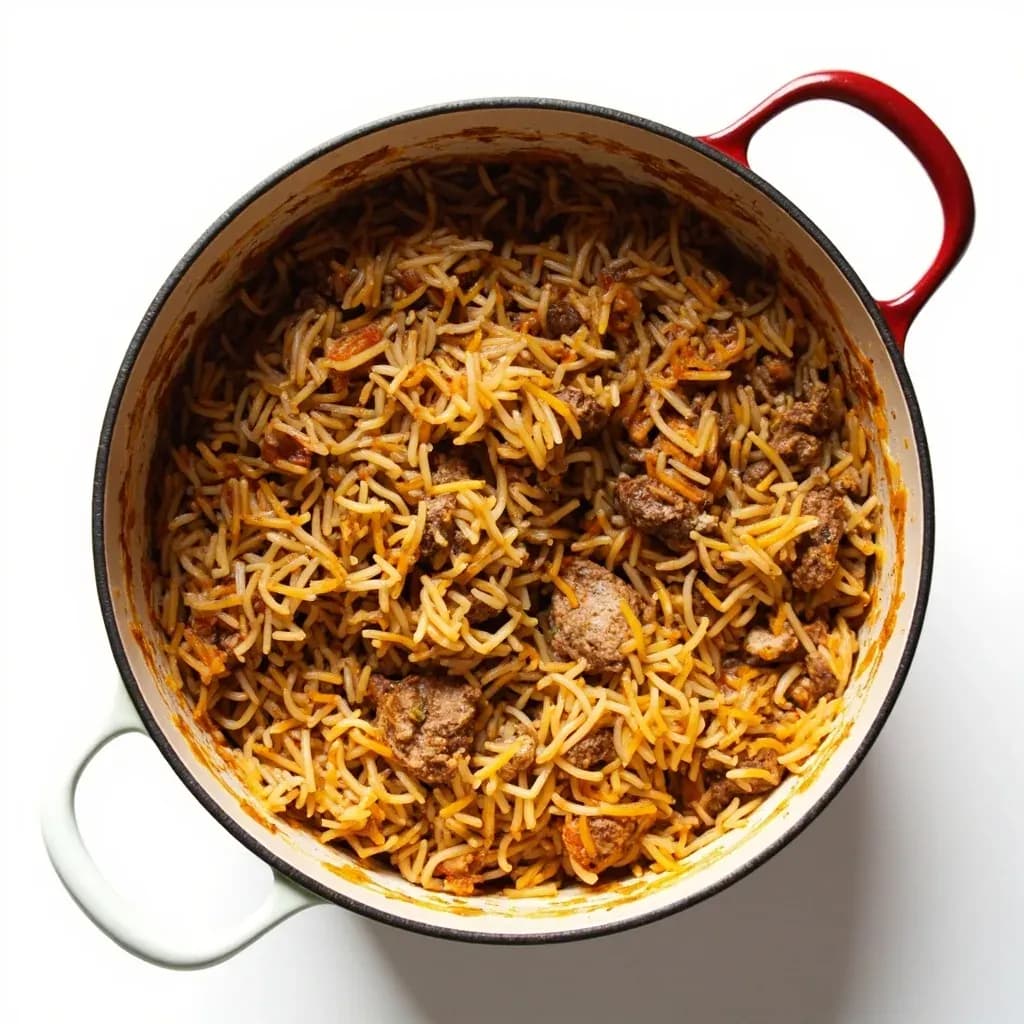
Layered rice cooking par-boils the grain before stacking it in a pot with meat, vegetables, and spices, then finishing on low heat so flavors steam upward through the rice. It defines dishes like machboos, biryani, plov, and maqluba, the last of which is dramatically flipped out of the pot to reveal its layers. A tight lid and gentle heat are key to building the prized crispy bottom crust while the upper grains stay fluffy.
Layered rice cooking is less a single dish than a family of methods that stretches from Lucknow to Sana'a and from Tehran to Dhaka. The unifying logic is simple: par-cook the starch to roughly 70 percent of doneness, layer it over (or under) a partially cooked, highly flavored partner — meat, vegetables, legumes, or all three — then finish the entire pot by gentle steaming, sealed tight, over the lowest possible heat. The starch absorbs the cooking liquid from below, the meat finishes in the trapped steam alongside the rice, and the grains emerge separate, perfumed, and tender without ever having boiled.
What separates a successful layered pot from a stodgy one is the marriage of three things: an accurate par-cook, a near-airtight seal, and patience during the final stage. The grains must lose their chalky core without going soft all the way through; the lid must trap steam so that the pot behaves like a closed oven rather than a simmering saucepan; and the cook must resist the urge to peek, stir, or raise the heat. Get those three right and the rest is assembly.
The payoff is more than convenience. A well-built layered pot delivers textural contrasts that a one-pot stew cannot — fluffy long grains beside yielding meat, a crisp golden crust at the base (the prized tahdig of Persian cooking), or a dramatic inverted dome where the meat caps the rice (the maqluba flip). It is also one of the most economical ways to feed a crowd from a small amount of expensive protein, stretching a few cups of meat across many cups of rice without anyone feeling shortchanged.
- Difficulty
- Hard
Types & varieties
South Asian (Hyderabadi, Lucknowi, Kolkata styles); marinated meat layered with par-boiled rice, fried onions, saffron, and mint; dum-steamed 20–40 minutes
Palestinian and Levantine; meat, eggplant, cauliflower, and chickpeas cooked first, rice layered on top, then the pot is inverted onto a platter so the meat caps the rice
Yemeni; meat cooks over smoking wood embers, with the rice pot beneath to absorb smoke and drippings; seasoned with hawaij spice
Saudi Arabian; chicken or lamb in a tomato-spice base, rice layered on top and finished by steaming
Afghan; lamb with caramelized carrots layered with rice, finished with raisins and slivered almonds
Persian; yogurt- and saffron-tinted rice pressed into the pot to form a golden crust (tahdig), with a meat or vegetable filling layered above
Bangladeshi and Eastern Indian; mildly spiced rice layered with bone-in meat and potatoes
How to do it
- 1
Cook the base layer
Brown or partially braise the meat with onions, whole spices, and a small amount of liquid until it is 60–70 percent done and most of its cooking liquid has reduced to a thick sauce. Cook any vegetables separately to the same stage. The base layer should be moist but not watery — excess liquid will make the bottom layer of rice soggy. For maqluba, this stage is the main chance to season the meat; for biryani, the marinade has already done much of that work.
- 2
Par-boil the rice
Bring a large pot of well-salted water to a rolling boil. Add rinsed, soaked long-grain basmati and cook 6–7 minutes, until the grains are tender on the outside but still show an opaque white core. Drain immediately, shake off excess water, and spread on a wide tray. Fluff gently with a fork to halt carryover cooking and to keep the grains separate.
- 3
Layer the pot
Spread the meat and vegetables evenly across the bottom of a heavy pot. A layer of potato or tomato slices over the meat helps protect the rice from direct contact and burning. Spoon the par-cooked rice on top in loose layers, interspersing fried onions, fresh herbs, and — for biryani — spoonfuls of saffron-milk and ghee to create color stripes. Do not press or compact the rice; steam must be able to move through it.
- 4
Add finishing liquid
Drizzle 1/4 to 1/2 cup of stock, water, or spiced yogurt over the rice — just enough to provide steam for the final cook. Dot the top with ghee or butter. The rice should look glossy but there should be no standing liquid at the base.
- 5
Seal and steam (dum)
Cover with a tight lid. For a traditional seal, press a rope of flour-and-water dough around the rim and seat the lid firmly. Place the pot on the lowest possible heat (a diffuser ring helps on gas) and cook 25–40 minutes depending on volume — long enough for the rice to finish absorbing steam and the flavors to meld. Do not lift the lid during this stage.
- 6
Rest
Remove from heat and let the pot sit, lid still sealed, for 10–15 minutes. The residual steam redistributes through the grains and the bottom layer sets into a cohesive cake (or, in Persian styles, a crisp tahdig).
- 7
Serve
For biryani and layered pulao, gently fold the layers together from the top down, lifting rather than stirring, to preserve grain length. For maqluba, run a knife around the pot edge, place a wide platter firmly on top, and invert in one swift motion so the meat caps the rice. Serve with raita, a sharp salad, or a tangy chutney.
The Logic of the Par-Cook
A grain of rice cooked entirely by boiling loses flavor to the cooking water and ends up waterlogged on the surface. A grain cooked entirely by absorption risks an uneven interior — tender outside, hard within. Layered rice cooking sidesteps both problems. The par-cook gelatinizes the outer starch so the grains are no longer crunchy, but stops short of softening the core. Once layered into a sealed pot with a moist, flavorful base, the rice finishes in its own steam and the rising aroma of the ingredients beneath it. The result is a grain that is fully tender, fully separate, and fully seasoned all the way through.
- Soak long-grain basmati 20–30 minutes before par-cooking for even hydration
- Salt the par-boil water generously (about 1 tbsp per quart) — the rice absorbs almost no salt during the final steam
- Drain promptly and spread on a wide tray; toss with a fork to halt carryover cooking
- The grains are ready when you can bite through the outside but the center still shows a thin white line
Building the Seal
The final stage of layered rice cooking is closer to baking in a closed oven than to stovetop simmering. Every escape of steam is moisture the rice will not recover, and flavor that escapes with it. A heavy pot with a snug lid is the modern minimum; the traditional flour-and-water dough rope pressed around the rim is still the gold standard. A clean kitchen towel tucked under the lid is a useful compromise — it traps condensate and tightens the seal without cementing the lid shut.
- Mix roughly 1 cup flour with about 1/2 cup water to form a stiff dough
- Roll into a rope, lay around the pot rim, then press the lid firmly into it
- A diffuser ring (or a second burner set to its lowest setting) is invaluable on gas stoves
- If you hear a hiss or see steam venting, the heat is too high or the seal has failed
Common uses
Tips & pitfalls
- Par-cook the rice only until it loses its chalky core — overcooking here guarantees mushy final rice and is the single most common mistake
- Drain the rice thoroughly and spread it on a tray to halt cooking; clumping means carryover heat is still at work
- Keep rice layers loose in the pot — never press or compact, or steam cannot penetrate evenly
- Alternate thin layers of rice with meat and fried onions rather than dumping it all in one go; the layering is what carries the flavor through the pot
- Seal the lid rigorously — escape of steam during the final 20+ minutes is the most frequent cause of dry, underdone rice
- Cook the final stage on the lowest possible heat; if you hear a vigorous boil or see steam venting, the flame is too high
- Always rest the pot off heat before opening — the rice continues to absorb steam and firms up during this window
- For a clean maqluba flip, let the pot rest 15 minutes, run a knife around the edge, and commit to a single swift inversion rather than easing into it
Good to know
- Also known as
- Dum cooking (South Asia); Maqluba-style assembly (Levantine); layered pilaf
- Core principle
- Par-cook rice to ~70%, then layer it with partially cooked meat or vegetables and finish by steaming in a sealed pot
- Par-cook doneness
- Grains should be soft outside with a firm opaque white core — about 6–7 minutes for soaked basmati in boiling salted water
- Primary fuel during final stage
- Very low heat so the rice steams in its own and added moisture; a vigorous boil means the heat is too high
- Typical pot
- Heavy-bottomed stockpot or Dutch oven with a tight-fitting lid; traditional versions sealed with a flour-and-water dough rope
- Seal methods
- Dough rope around the rim (traditional), clean kitchen towel tucked under the lid, or a Dutch oven with a heavy, well-fitting lid
- Rest time after steaming
- 10–15 minutes off heat, lid kept on, so steam redistributes through the grains
- Yield
- 1 cup raw basmati yields about 3 cups cooked; a 3-cup pot typically serves 6–8
Also called
Layered Pilaf · Rice Layering · Maqluba Layering · Par-Boil-and-Layer · Pot Flipping
Related

Boil
Cook in vigorously bubbling liquid at full rolling heat

Simmer
Hold liquid at a gentle shimmer for tender, unhurried cooking

Poach
Cook gently in barely-trembling liquid for silky, tender results

Steam
Cook in rising vapor to keep color, nutrients, and shape intact

Blanch
Plunge briefly in boiling water, then shock cold to lock color

Braise
Sear, then cook slow in a little liquid until fall-apart tender

Stew
Simmer bite-sized pieces fully submerged into a rich, unified pot

Sous-Vide
Seal and cook in precise warm water for edge-to-edge doneness