Transform & Preserve
Moisture Testing
Checking a food's water content to gauge doneness, drying, or shelf stability.
Moisture testing measures how much water remains in a product, used in baking, drying, curing, and cheesemaking to confirm a target texture or safe stability. Methods range from feel and weight loss to moisture meters and water-activity readers. In preserved foods, hitting the right moisture level is critical, as too much invites spoilage.
Moisture testing is two ideas wearing one label, and conflating them is the most common error in home preservation. Moisture content is the percentage of water in a food by weight — the figure a moisture meter or a kitchen scale plus an oven will give you. Water activity (aw) is the share of that water that is unbound and available to microbes, measured on a 0–1 scale. A country ham and a flour tortilla can carry the same moisture percentage yet behave very differently on the shelf, because salt in the ham binds water and pulls its aw down.
For everyday cookery — bread, cake, candy, jam — a thermometer, a refractometer, and a practiced hand handle most decisions. A refractometer reports sugar concentration in °Brix, which only inversely tracks free water in sugar-rich liquids like syrup, juice, jam, and honey; for solids and most other foods, moisture content must come from a meter or gravimetric drying. For preservation — jerky, dried fruit, honey, cured meats — water activity is the more honest number, and a dedicated water-activity meter is the tool that turns guesswork into a measured call. Either way, the principle is the same: pick a target first, test against it, and stop the process when the reading lands.
The methods range from free to sophisticated. A pinch, a tap, and a bend cost nothing and resolve most doneness questions in seconds; a halogen moisture analyzer or a Karl Fischer titrator runs into the thousands and resolves questions to a tenth of a percent. Knowing which level of precision your food actually needs is part of the skill.
- Difficulty
- Medium
Types & varieties
Pinch, squeeze, bend, snap, crack, and peel — fast, free, and experience-dependent
Knuckle-tap on bread or melon; sheen for tempered chocolate; color for caramel; surface wrinkle on a chilled saucer for jam
Older eggs lose moisture through the shell and the trapped air makes them float in cool water; a freshness proxy, not a safety test
A spoonful dropped on a chilled saucer; if it wrinkles cleanly when pushed with a finger after 30 seconds, the gel has set
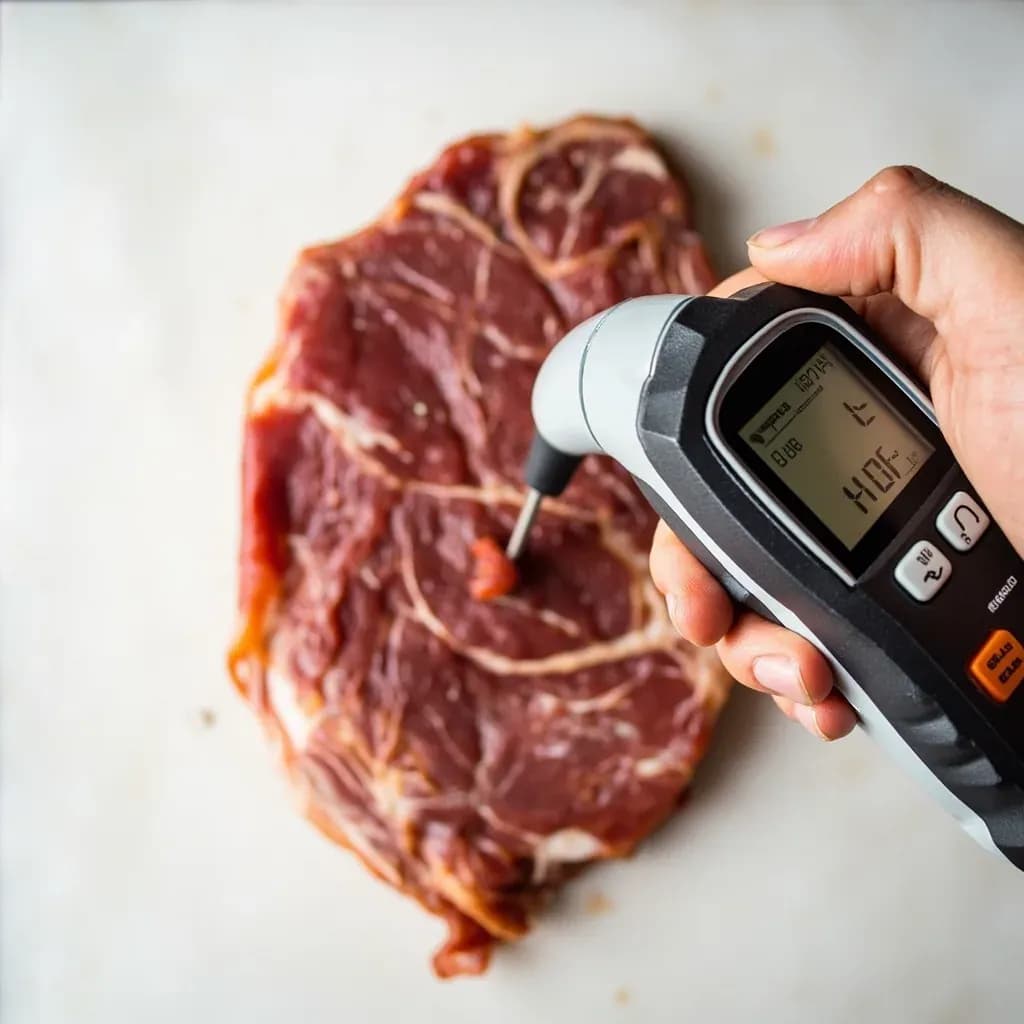
An instant-read thermometer is the most reliable indirect proxy for moisture in baked goods and confections
Optical instrument reading sugar concentration in °Bx; the standard for honey, jam, juice, and syrup; temperature-corrected to 20 °C
Resistance-based probe that reads % moisture; slightly destructive; requires a species- or food-specific calibration
Capacitance-based, scanned across the surface; non-destructive; ideal for finished products like chocolate bars and dried fruit
The reference method: weigh, dry at 100–105 °C to constant weight, reweigh; % moisture equals the weight loss
Benchtop balance combined with a heater that weighs the sample while drying; reads % moisture directly; common in test kitchens
Chemical method accurate to better than 0.1% moisture; gold standard for chocolate, oils, and spices; requires reagents and a titrator
Reads aw on a 0–1 scale via dew-point or capacitance sensors; the true indicator of microbial safety in dried and cured foods
How to do it
- 1
Set a target before you test
Decide the number that defines success for this food: under 20% moisture for jerky, aw under 0.86 for shelf-stable dried meat, internal 95 °C / 205 °F for a butter cake, 18.5% moisture for honey, gel on a chilled plate for jam. Without a target, any reading is ambiguous.
- 2
Match the method to the food and your tools
Tactile and sound tests for quick checks on bread, cake, jerky, and dried herbs. Thermometer for baked goods and candies. Refractometer for syrups, juices, jam, and honey. Moisture meter or water-activity meter for shelf-stability decisions. Gravimetric oven-drying when you need a reference value.
- 3
Prepare a representative sample
For solids, take pieces from the center and the edge — moisture is rarely uniform across a loaf, a tray, or a roast. For powders and grains, take several sub-samples and average. Bring refrigerated samples to room temperature so surface condensation does not bias the reading.
- 4
Run a quick tactile or visual test first
Pinch, bend, tap, crack, or peel. Properly dried jerky bends and cracks rather than snapping cleanly; dried herbs crumble to dust; tempered chocolate snaps with a quick-release sheen; bread sounds hollow when knocked on the bottom; a cake pulls from the pan and a tester shows moist crumbs rather than wet batter.
- 5
Confirm with an instrumented test when the stakes are high
Insert a calibrated probe or thermometer, read a refractometer, weigh a sample before and after oven-drying, or place a sample on a water-activity meter. Record the number and compare it to the target set in step one.
- 6
Adjust for environment and the food itself
Correct sugar stages for altitude (drop about 2 °C per 300 m / 1000 ft of elevation), correct refractometer readings for sample temperature, and remember that salt or sugar lowers aw without changing the moisture percentage. Note the ambient humidity — moisture meters drift noticeably in very humid or very dry kitchens.
- 7
Decide: finish, hold, or reject
If the reading hits the target, stop the process — kill the heat, pull the bread, jar the jam. If it is close, hold for another interval and re-test. If it has overshot (over-dried candy, scorched flour, overset jam), note the result and adjust next time; do not try to rescue over-dried food with steam unless the recipe explicitly allows it.
- 8
Cool fully before packing
Pack dried, baked, or candied products only after they reach room temperature. Warm food sealed in a container condenses moisture on the surface and restarts mold growth or sogginess. Label with the date and, when measured, the % moisture or aw so future batches can be compared.
Moisture content versus water activity
These two numbers tell different stories and are easy to confuse. Moisture content is a simple accounting of how much water is in the food. Water activity measures how much of that water is free to support microbial growth and chemical reactions. Salt, sugar, alcohol, and certain gums bind water and lower aw without changing total moisture, which is why salted cod, honey, and fruit preserves stay shelf-stable at moisture levels that would otherwise spoil. For doneness in the oven or on the stovetop, moisture content is what you care about. For deciding whether a dried food is safe to store unrefrigerated, aw is the number that matters.
Targets worth memorizing
Useful benchmarks keep you from guessing in the moment. These targets cover the foods most home cooks preserve or bake:
- Jerky and biltong: under 20% moisture and aw under 0.85
- Dried herbs: 8–10% moisture, brittle enough to crumble
- Dried fruit: 15–25%, pliable but not tacky
- Honey: under 18.5% moisture (refractometer reading)
- Jams and jellies: set on a chilled plate, gel at 104–106 °C / 220–222 °F at sea level
- Cakes: internal 96–99 °C / 205–210 °F, tester with moist crumbs
- Bread: internal 90–99 °C / 195–210 °F, hollow thud after 1–2 minutes rest
- Sugar syrups: thread at 110–112 °C, soft ball at 112–115 °C, hard ball at 121–130 °C, soft crack at 132–143 °C, hard crack at 149–154 °C
- Tempered chocolate: clean snap and a glossy finish that sets within 3–5 minutes at room temperature
Common uses
Tips & pitfalls
- Combine two tests whenever the stakes are high — tactile plus thermometer, scale, or meter — because any single method can mislead in the moment.
- For jerky, weigh the batch at the start; a 60–70% weight loss generally lands you under 20% moisture and below 0.85 aw without needing a meter.
- Calibrate moisture meters to the specific food; a setting intended for wood or drywall will give nonsense on jerky, chocolate, or flour.
- Use cool water for the egg float test — warm water slightly buoys eggs and skews the result toward older.
- The hollow-thud test on bread is unreliable right out of the oven because trapped steam sounds done; rest the loaf 1–2 minutes first.
- For home oven-drying, weigh at 30-minute intervals and stop when two consecutive readings match — that is your 'constant weight.'
- A refractometer reads sugar, not water; in acid-heavy jams correct for temperature and remember that 1 °Bx is roughly 1% sucrose by weight.
- Water activity (aw) is the safety number, not total moisture — salt-cured and high-sugar foods stay safe at higher moisture because aw is bound down.
- Pull a cake tester from the thickest part of the crumb; moist crumbs are correct, wet batter is not, and do not push all the way through to the pan.
- Pack dried foods only after they cool fully to room temperature; warm food in a closed container condenses and restarts mold risk.
Good to know
- Also known as
- Water content testing; water activity (aw) assessment
- Two core concepts
- Moisture content (% water by weight) and water activity (aw, 0–1 scale measuring unbound, available water)
- Key drying targets
- Jerky <20%, dried herbs 8–10%, dried fruit 15–25%, honey <18.5%, crackers <5%
- Water activity safety thresholds
- Most bacterial pathogens inhibited at aw <0.86; most molds at aw <0.80; shelf-stable dried foods typically <0.60
- Reference lab method
- AOAC oven-drying at 100–105 °C to constant weight (950.46 meat, 934.06 dried fruit, 920.151 cheese)
- Pin vs. pinless meters
- Pin meters read electrical resistance between two inserted probes; pinless meters use electromagnetic capacitance scanned across the surface
- Refractometer scale
- Brix (°Bx) reads sugar concentration as % w/w and inversely tracks free water in syrups, juices, jams, and honey
- Honey fermentation limit
- Below 18.5% moisture per Codex Alimentarius; refractometer is the standard instrument
- Difficulty
- Tactile and visual tests are easy; meter and refractometer use is easy to moderate; Karl Fischer and gravimetric lab work is advanced
Related

Confit
Cook slowly submerged in fat for silky tenderness and keeping

Cure
Draw out moisture with salt and time to preserve and concentrate

Pickle
Steep in acidic brine for bright, tangy, crunchy preservation

Ferment
Let friendly microbes transform food into tangy, complex flavor

Marinate
Soak in a seasoned mix to flavor and tenderize before cooking

Brine
Soak in salt water so meat stays juicy and seasoned throughout

Dehydrate
Slowly dry out moisture to concentrate flavor and extend shelf life

Cold-Smoke
Perfume cured food with smoke without cooking it through