Prep & Assembly
Noodle Pulling & Hand-Cutting
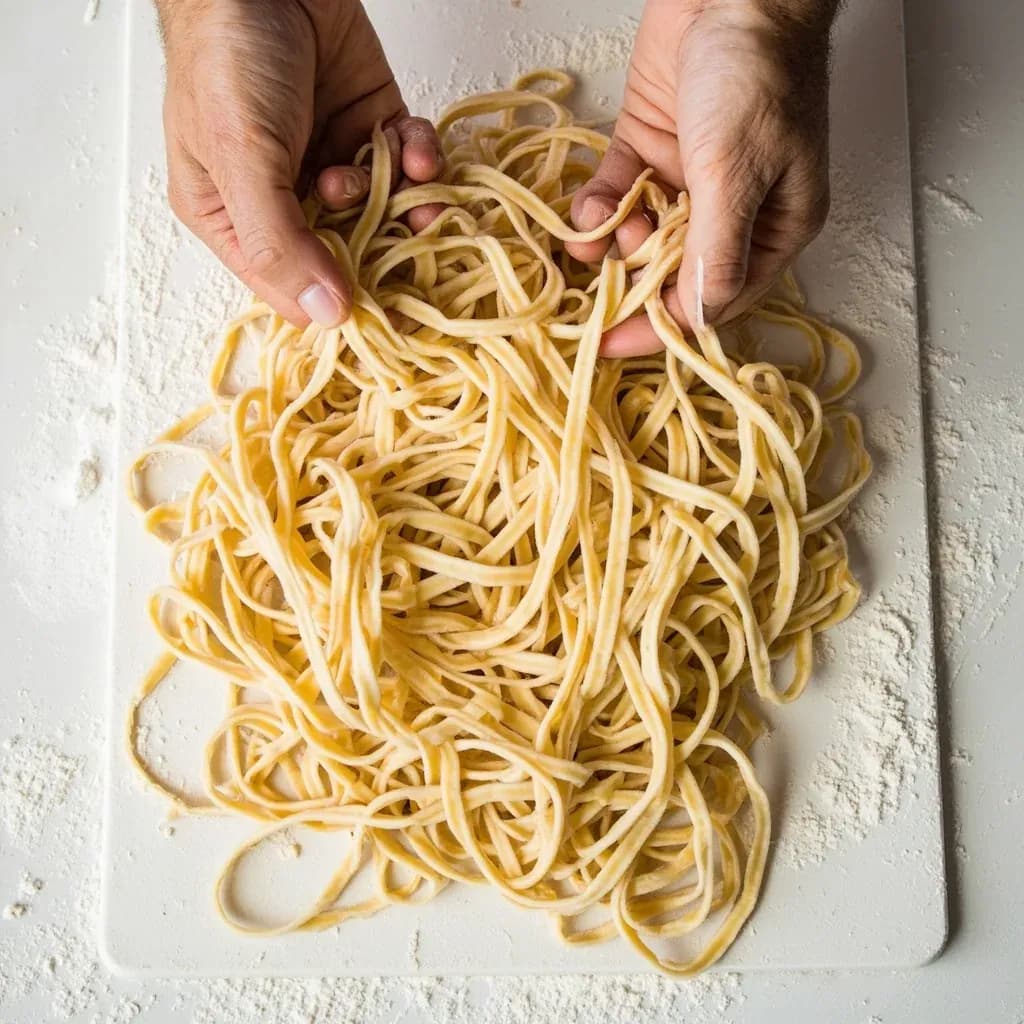
Stretching, rolling, or cutting dough by hand into fresh noodles.
Hand-making noodles turns a simple flour dough into fresh strands without machinery, through pulling, twisting, rolling, or cutting. Pulled noodles like lamian are repeatedly stretched and folded to multiply the strands, while others such as Central Asian lagman are hand-rolled and Kazakh beshbarmak noodles are hand-cut into sheets. The technique demands well-developed, rested dough so the gluten can stretch without tearing.
Noodle pulling and hand-cutting is a family of techniques from northwestern China that transforms a stiff, well-developed wheat dough into fresh noodles through three distinct physical actions: rhythmic stretching and folding (lamian), shaving with a curved blade (dao xiao mian), and pressing, stretching, and slapping into wide ribbons (biang biang mian). All three rely on the same science — high-protein flour, controlled hydration, salt to tighten gluten, and a long rest to relax the dough so it can be deformed without tearing — but the final shaping motion is entirely different in each tradition.
What sets these noodles apart from machine-cut or dried varieties is texture. Done well, the strands have a springy, almost rubbery chew on the bite while remaining tender at the core, and they absorb broth or sauce without going limp. The skill lies in reading the dough: knowing when gluten has relaxed enough to stretch, how much oil to use so strands separate cleanly, and how to let gravity and momentum do the work rather than muscling the dough with the hands.
The techniques are demanding — competent lamian takes months of daily practice — but the ingredients are humble and the equipment is minimal. A bag of bread flour, salt, water, oil, a wooden board, and patience are the entire toolkit. Mastering even one of the three variants puts a cook in control of a noodle most diners only ever eat in restaurants.
- Difficulty
- Hard
Types & varieties
Folded-and-pulled rope technique; strands stretched and doubled over the knuckles repeatedly. Backbone of Lanzhou-style beef noodle soup and the Muslim Hui noodle tradition of the Northwest.
Shanxi knife-cut noodles; a stiff dough is held in one hand while a curved blade shaves long thin strips directly into boiling water, traditionally with the pot behind or beside the cutter's shoulder.
Shaanxi wide belt noodles; rested dough is rolled or pressed into thick ribbons 2–3 cm wide, slapped against the work surface to stretch and shake off loose flour, then briefly boiled.
Oil-coated pulled noodles; dough rests under a film of oil and is pulled without any dusting flour, producing exceptionally glossy, chewy strands.
Small thumb-sized pieces pinched from dough and rolled against a board to form ear-shaped shells; a related hand-shaped Shanxi technique.
Hundreds of extremely fine pulled strands from a single dough, dusted in flour or starch; usually served as a dessert or celebratory banquet dish symbolizing longevity.
How to do it
- 1
Mix the dough
Combine high-gluten flour with water at 45–55% hydration by weight (lower for knife-cut, higher for biang biang) and salt at 1.5–2% of flour weight. Add kansui or ash water here if your tradition calls for it. Stir to a shaggy mass with no dry pockets.
- 2
Knead aggressively
Knead by hand for 10–15 minutes, or 6–8 minutes in a stand mixer with a dough hook, until the dough is very smooth, dense, and elastic. It should resist denting and spring back firmly when poked — much tighter than bread dough.
- 3
Rest the dough
Coat with a thin film of neutral oil, seal under plastic wrap or a damp cloth, and rest 1–4 hours at cool room temperature, or overnight in the refrigerator. The dough is ready when a pressed fingerprint slowly refills rather than snapping back instantly.
- 4
Form the initial rope
For lamian and you mian: roll the rested dough on an oiled surface under your palms into a smooth cylinder 2–3 cm thick. For biang biang: divide into 50–80 g portions and roll each into a short thick rope. For dao xiao mian: leave the dough as a single firm loaf, untouched.
- 5
Oil the rope
Brush the rope thoroughly with neutral oil so the entire surface is slick. This prevents strands from welding together as you pull and means you do not need to dust with flour during shaping.
- 6
Loop and pull (lamian)
Pick up the oiled rope by its two ends, let it hang briefly, and swing gently to take out slack. Loop the two ends over the index and middle fingers of each hand. With a smooth pendulum motion — outward and downward — let the weight of the dough stretch as you guide it through your finger loops; the two strands will pass through and double the count. Pinch the bottom together, fold in half, re-loop, and pull again. Each cycle doubles the strand count. Continue for 6–10 cycles for restaurant fineness.
- 7
Shake off and portion
Once strands reach the desired thickness, gently shake or slap the bundle against the work surface to dislodge any loose flour and align the strands. Cut through the loop once with a knife or bench scraper to free the bundle into individual serving portions. Work quickly — pulled noodles begin to dry within minutes.
- 8
For biang biang: stretch and slap
Press a portion of dough flat with the heel of your hand, then grip it by the ends and stretch outward while simultaneously slapping it down onto the work surface. The slap both lengthens the noodle and sheds excess flour. Aim for ribbons about 2–3 cm wide and 60–80 cm long.
- 9
For dao xiao mian: shave into the pot
Hold a curved noodle blade (or angle a heavy Chinese cleaver) in the right hand with the edge facing outward, and the stiff dough loaf in the left. Position the boiling pot beside or just behind your working shoulder. With a quick outward flick of the wrist — never downward pressure — shave long thin diagonal strips so they fly directly into the pot. Rotate the loaf a quarter turn after each strip to keep cuts even.
- 10
Cook immediately
Drop noodles into a large pot of rapidly boiling, well-salted water. Thin pulled strands cook in 60–90 seconds; biang biang belts take 2–3 minutes; knife-cut strips 3–5 minutes depending on how thickly they were shaved. For clear broth applications, drain and give a quick rinse under hot water to remove surface starch. Serve at once — these noodles have no preservatives and turn gummy within a few hours.
Reading the Dough
The single skill that separates a working noodle maker from a frustrated one is judging gluten relaxation. Press a fingertip into the rested dough: if the indent stays put, the gluten is still tense and the dough will snap back when you try to pull. If it slowly refills within a second or two, the dough is ready. If it never refills, you have over-relaxed and the strands will sag rather than stretch.
- After kneading, the dough should feel noticeably tight and resistant — much stiffer than bread dough.
- During rest, the surface becomes satiny as gluten strands align and the dough softens to the touch.
- Humidity is the enemy. On rainy days, shorten rest time and reduce added water by 2–3%.
- Always oil the dough the moment it comes out of rest — exposed dough forms a skin within minutes that will crack during pulling.
- Trust the fingerprint test over the clock; dough behaves differently with flour brand, room temperature, and humidity.
Common uses
Tips & pitfalls
- Use bread flour or a high-protein 00; cake flour and weak all-purpose tear on the first pull — the single most common cause of failure.
- Rest the dough until it relaxes completely; press a finger in and it should slowly rebound, not snap back. Rushing this is the number one reason noodles break mid-pull.
- Oil the dough, never dust heavily with flour during pulling. Excess flour makes gummy, pasty noodles in the pot and dulls the broth.
- Pull in a smooth, even rhythm — jerky tugs snap strands. Let the weight of the dough do the work; your fingers guide, they do not force.
- When looping lamian over your fingers, keep each new fold centered. Off-center folds produce tapered, uneven strands that cook at different rates.
- For dao xiao mian, the signature curled cross-section comes from a flicking wrist motion, not downward pressure. Pressing the blade produces flat, dense strips.
- For biang biang, the slap against the counter is functional, not theatrical — it both stretches the noodle and sheds excess flour.
- Cook the same day you pull. Fresh hand-shaped noodles have no preservatives and turn gummy within hours; if you must hold them, toss with a little oil and refrigerate for at most a few hours.
Good to know
- Origin
- Northwestern China — Shanxi, Shaanxi, Gansu, Ningxia, Qinghai, and Xinjiang; pulled noodles are documented in the Han Dynasty, knife-cut noodles in Shanxi from the Yuan Dynasty (13th–14th century)
- Flour
- High-gluten wheat flour, 11–13% protein (bread flour or specialty noodle flour); cake flour or weak all-purpose tears on the first pull
- Dough hydration
- Pulled noodles 45–55% water; knife-cut 40–45%; wide belt noodles 45–50% — firmer than most Western pasta doughs
- Salt
- 1.5–2% of flour weight; tightens gluten so the dough survives aggressive pulling without snapping
- Rest time
- 1–4 hours at cool room temperature, or overnight refrigerated; the dough is ready when a pressed fingerprint slowly rebounds rather than snapping back
- Cook time
- Thin pulled noodles 60–90 seconds; biang biang belts 2–3 minutes; knife-cut strips 3–5 minutes depending on thickness
- Yield
- Roughly 100–120 g noodles per 100 g flour; the dough more than doubles in length with each pull cycle
- Mastery benchmark
- One Shaanxi tradition counts 8,192 strands (2¹³) from a single dough as the standard of a fully trained noodle master
Also called
Noodle Pulling · Hand-Rolling Noodles (Lagman) · Hand-Cutting Noodles (Beshbarmak) · Hand Noodle Pressing · Hand-Twisting Busiate Pasta · Dropping Nokedli (Galuskaszaggatás)
Dishes that rely on it
Related

Whisk
Beat ingredients smooth and aerated with a looping wire motion

Sift
Pass dry ingredients through mesh to aerate and remove lumps

Strain
Pour through mesh to separate solids from liquid for a smooth result

Filter
Pass liquid through fine material to clarify out the smallest particles

Rice
Press cooked potatoes through small holes for fluffy, lump-free texture

Mash
Crush soft cooked food into a rustic, creamy purée

Grind
Crush food into a coarse to fine texture, from spices to meat

Grate
Shred food into fine bits against a sharp-toothed surface