Prep & Assembly
Dusting with Semolina
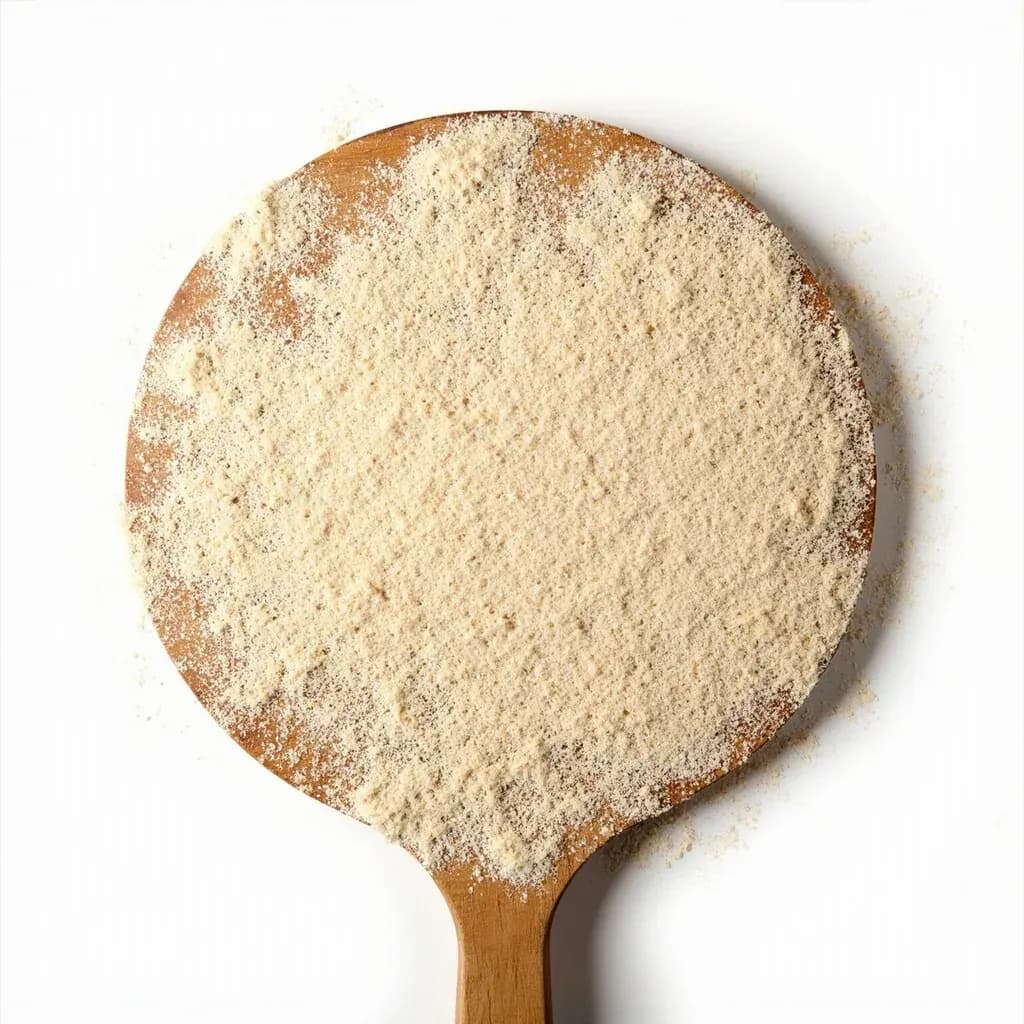
Scattering semolina or flour to keep dough from sticking to the peel, board, or pan.
Dusting with semolina coats a pizza peel, work surface, or pan with a thin layer of coarse flour so dough releases cleanly and slides off. Semolina is favored because its larger granules act like tiny ball bearings and resist burning better than fine flour. The technique prevents sticking when launching pizzas or shaping bread.
Dusting is the simplest, oldest technique in the bread-and-pizza cook's kit: scatter a thin layer of dry starch on a working surface so dough doesn't weld itself to it. That starch can be wheat flour of any grade, rice flour, cornmeal, or — the focus here — semolina, the coarse golden flour milled from durum wheat. The principle is the same across all of them; what changes is the granulation, the moisture absorption, and the way each behaves under heat, and those differences matter more than most home cooks realize.
Semolina earns its place at very high oven temperatures and with very wet doughs. Its larger, harder granules absorb less water than ordinary flour, so they don't dissolve into a gluey paste under a 75%-hydration dough, and they tolerate the radiant heat of a Neapolitan deck oven — where cornmeal scorches and turns acrid above roughly 700°F (370°C) — without breaking down. A 50/50 blend of semolina and all-purpose flour splits the difference, giving easier handling than pure semolina with a touch more crunch than pure flour. The trick is restraint: a barely-there veil always outperforms a heavy hand.
- Difficulty
- Easy
Types & varieties
Fine-reground durum-wheat semolina — the classic Italian choice for pizza peels; pale yellow, slightly gritty, low moisture absorption
Larger granulation; adds visible crunch to the crust bottom and is sometimes mixed with flour for pizza
Italian finely milled soft wheat flour; gives a smoother, less gritty base than semolina — common in Neapolitan pizzerias
The everyday default in home kitchens; works fine but can clump and burn at very high oven temperatures
Higher protein; absorbs more water than AP, so use slightly less
Naturally gluten-free and very fine; often blended with semolina for frying batters and gluten-free baking
More common in American pizzerias than Italian; adds strong corn flavor and a sandy texture, can scorch at high heat
A balanced compromise — easier handling than pure semolina with a touch more crunch than pure flour
How to do it
- 1
Choose your dusting medium
Match the dusting to the job: coarse semolina or a 50/50 semolina–flour blend for high-heat pizza and wet doughs; '00' or all-purpose flour for general bread and pastry work; rice flour (often blended with semolina) for frying and gluten-free baking.
- 2
Prepare the surface or peel
Wipe the peel, board, or pan clean and make sure it is dry. A wet or oily surface will cause the dusting to clump and the dough to weld itself in place.
- 3
Sift or sprinkle a light, even layer
Hold a small pinch of semolina or flour between your fingers and scatter it over the area, or sift through a fine-mesh sieve. Aim for a thin, uniform veil — you should still see the color of the peel or board through it.
- 4
Spread and tap off the excess
Tilt and shake the peel in all directions (or spread with the flat of your hand on a board) so the dusting is evenly distributed. Invert and tap to discard any loose grains; too much is the most common mistake.
- 5
Lay the dough down and check mobility
Place the shaped dough on the dusted area. Give the peel a short, confident back-and-forth shake — the dough should glide freely. If it sticks at the edge, lift it and slip a little more dusting underneath before continuing.
- 6
Launch, transfer, or proof as needed
For pizza, immediately transfer to the oven stone or steel. For shaped loaves, flip the dough onto a lined sheet or peel the dusted dough off the board and into a banneton. If proofing in a basket, dust the basket generously and place the shaped dough seam-side up; when you unmold, the dusted surface becomes the bottom of the loaf, with the banneton's spiral pattern pressed into it.
Choosing Between Semolina and Flour
Both are wheat, both work, but they behave differently once the dough goes into the oven. The points below are a working rule of thumb, not a law.
- Use semolina (or a semolina-heavy blend) for high-hydration doughs above about 70% hydration, and for any pizza baked at 500°F (260°C) or above — its low absorption prevents gumminess and its coarse granulation tolerates the heat.
- Use all-purpose or '00' flour where you want a smooth, unmarked surface — rolled pasta, short pastry, and laminated doughs are the main cases.
- Use rice flour (often blended with semolina) for gluten-free baking and as a component of dredges for frying, where its fine texture gives a crisp, pale coating.
- Use bread flour only if it's all you have on hand for bread work; it absorbs more water than AP, so dust lightly.
- Reserve cornmeal for American-style pizzas baked at moderate oven temperatures; it adds flavor and crunch but burns above roughly 700°F (370°C).
Common uses
Tips & pitfalls
- Use less than you think you need — a fine, even veil is enough; excess semolina ends up gummy under the dough and gritty on the crust.
- Shake the peel (or tilt the board) after dusting and discard the loose excess before laying the dough down.
- Test the dough's mobility by giving the peel a quick back-and-forth shake before launching; if it sticks, lift the edge and add a little more dusting underneath.
- For very wet doughs (70%+ hydration), prefer semolina or a semolina/flour blend over all-purpose flour, which turns pasty faster.
- Avoid cornmeal as the only dusting under Neapolitan-style pizza baked above 700°F (370°C) — it scorches and tastes acrid.
- Never reuse dusting that has fallen off the peel and onto the oven floor — it can smoke or catch fire; sweep it out first.
- For laminated doughs (croissant, puff pastry), use flour only — semolina's grit will tear the butter layers.
- If the dough keeps sticking despite dusting, the surface is usually too wet, not under-dusted; lightly dry the dough's underside with flour first.
Good to know
- Also called
- Flouring (when all-purpose or bread flour is used); semolina dusting specifically refers to coarse durum-wheat semolina
- Primary purpose
- Prevent dough from adhering to the work surface, peel, sheet pan, proofing basket, or rolling pin
- Common dusting mediums
- Semolina (semola), '00' flour, all-purpose flour, bread flour, rice flour, cornmeal, or a 50/50 semolina-flour blend
- Texture effect on crust
- Adds a subtle crunch and a faintly sandy, golden bottom when baked at high heat
- Why semolina over flour
- Coarser grind and lower moisture absorption keep the dough from getting gummy and tolerate oven heat above 500°F (260°C) without scorching as quickly
- Amount
- A light, even sprinkle — roughly 1–2 tablespoons per standard 12-inch pizza peel; more is counterproductive
- Tools used with
- Pizza peel (wooden or metal), bench scraper, proofing basket (banneton), sheet pan, rolling pin, parchment
- Difficulty
- Beginner; the skill lies in restraint, not in application
Also called
Flour Dusting · Bench Flour
Dishes that rely on it
Related

Whisk
Beat ingredients smooth and aerated with a looping wire motion

Sift
Pass dry ingredients through mesh to aerate and remove lumps

Strain
Pour through mesh to separate solids from liquid for a smooth result

Filter
Pass liquid through fine material to clarify out the smallest particles

Rice
Press cooked potatoes through small holes for fluffy, lump-free texture

Mash
Crush soft cooked food into a rustic, creamy purée

Grind
Crush food into a coarse to fine texture, from spices to meat

Grate
Shred food into fine bits against a sharp-toothed surface