Prep & Assembly
Raw Oil Finishing (Olio a Crudo)
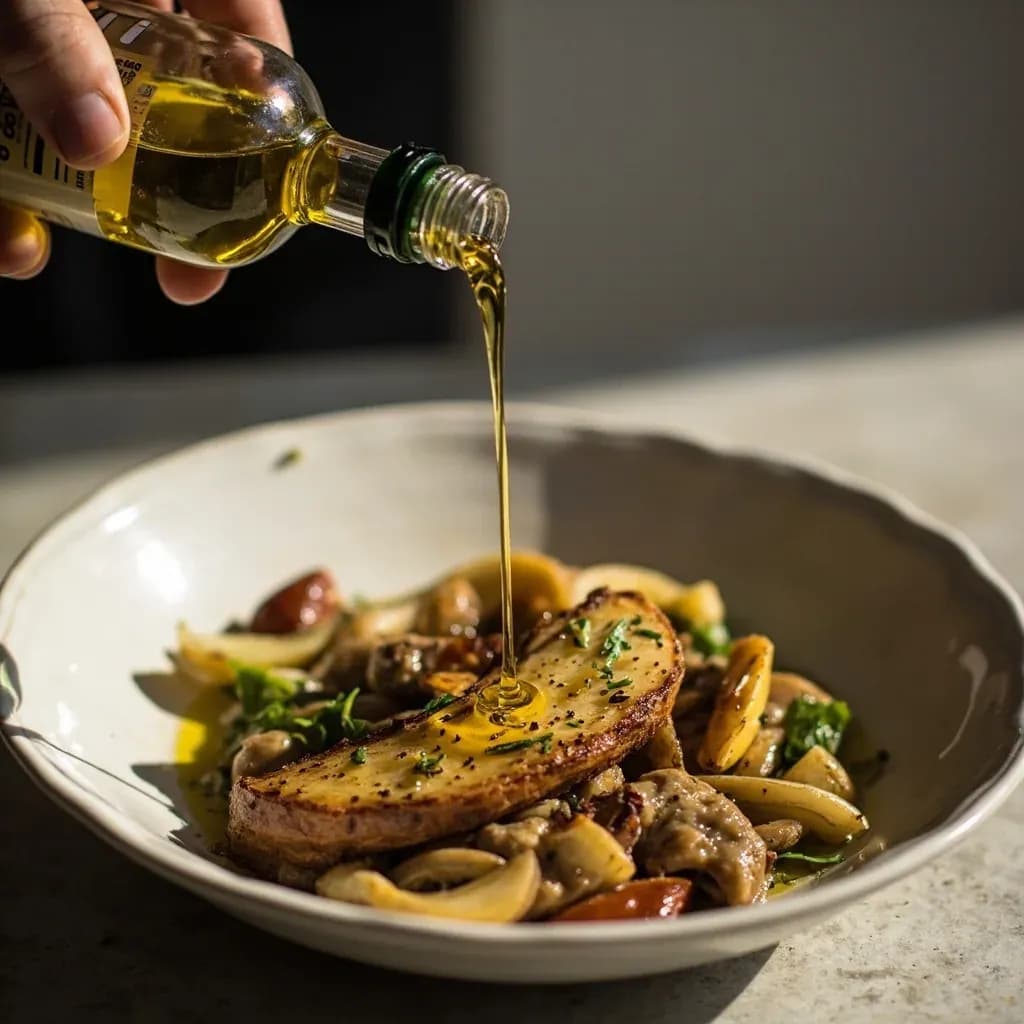
Drizzling raw, unheated olive oil over a finished dish to add aroma and richness at the end.
Olio a crudo means adding good extra-virgin olive oil to a dish raw, off the heat, just before serving. Because the oil is never cooked, its peppery, grassy, fruity aromatics stay intact and lift soups, beans, grilled vegetables, and pasta. It is a defining Italian and Mediterranean finishing move where the oil acts as a seasoning rather than a cooking fat.
Olio a crudo — literally "raw oil" — is the Italian technique of finishing a finished dish with a pour of high-quality extra virgin olive oil that has never been heated. It is not a cooking step but a final aromatic and textural gesture, applied at the table or in the last seconds before serving, when the food is plated and ready to eat. In Italian kitchens, especially across Tuscany, Liguria, Puglia, and Umbria, the move is so habitual that phrases like un giro d'olio (a turn of oil) and a filo d'olio (a thread of oil) describe both the motion and the modest quantity involved.
The reason finishing oil is held back from heat is chemistry, not tradition. A fresh extra virgin olive oil carries volatile aldehydes, esters, and polyphenols — the grassy, peppery, artichoke, or tomato-leaf notes a taster smells on first pour. Many of these compounds begin to break down well below the oil's smoke point, and almost all are muted or driven off once the oil meets a hot pan. A raw drizzle preserves them intact, so they reach the diner through the nose on the first bite, not as background.
In the mouth, the raw oil behaves like a liquid seasoning. It coats starches, lifts fat-soluble flavors (garlic, herbs, tomatoes, aged cheese), and gives a glossy, lubricating finish that rounds out the dish. Because nothing is cooked off, a little goes a long way; the oil should be a bright top note, not a pool. A second small cruet at the table is traditional for soups and bread, letting each diner add a thread of oil to taste.
- Difficulty
- Easy
Types & varieties
A thin circular stream of oil poured over hot pasta, soup, or grilled food at the moment of serving.
Oil offered in a small cruet or dish for diners to add themselves; common with pinzimonio, bread, or sliced tomatoes.
A shallow puddle of oil the food sits in or rests on, as with bruschetta, carpaccio, or a cheese plate.
Oil briefly emulsified with lemon juice, vinegar, or a few drops of water, drizzled on fish, vegetables, or beans.
Finishing with newly pressed oil for maximum grassiness, bitterness, and peppery polyphenol bite.
The same no-heat technique applied with premium walnut, hazelnut, pumpkin seed, or pistachio oils on milder dishes.
How to do it
- 1
Select the oil
Choose an extra virgin olive oil whose flavor matches the dish — grassy, peppery, mild, or fruity. The oil should smell clean and fresh, with no musty or crayon-like (rancid) notes. Bring the bottle to room temperature so the aromatic compounds are expressive when poured.
- 2
Cook the dish without the finishing oil
Prepare the food using your usual method — boil and drain pasta, simmer a soup, grill a steak, roast vegetables, bake a pizza. The finishing oil is never added to the pan or pot; it is held back for the end.
- 3
Plate and let the surface settle
Transfer the cooked food to a serving plate or individual bowls. For hot dishes, rest 30–60 seconds so the surface liquid is no longer at a rolling boil. The oil needs a calm surface to sit on so it does not split or get blown off by steam.
- 4
Drizzle the raw oil
Pour the oil in a thin, controlled stream from a bottle with a spout, a small cruet, or a spoon. Aim for about 1 tablespoon per portion of pasta or vegetables, and slightly less for soup. Distribute it in a loose spiral so each bite will carry some oil.
- 5
Finish and serve immediately
Bring the dish straight to the table so the lifted aromas reach the diner on first whiff. Optionally, set the oil bottle on the table for second helpings. The raw oil should be the final, fragrant note on the palate.
Regional pairings in Italy
The phrase changes meaning with the oil on the table, and Italian cooks treat the pairing as fixed. In Tuscany, a peppery, polyphenol-heavy oil is the traditional finish for bistecca alla fiorentina, ribollita, and panzanella — its bite is meant to stand up to charred beef and bitter greens. In Liguria, the delicate Taggiasca oil is reserved for caprese, pesto, boiled fish, and trofie, where a heavy oil would smother the herbs. In Puglia, robust Coratina or Peranzana oils are drizzled on grilled vegetables, octopus, and bruschetta, while Umbrian oils land on legumes, strangozzi, and torta al testo. Following the regional match — light with seafood and herbs, robust with grilled meat and bitter greens — is the simplest rule for a cook working outside Italy.
When not to use olio a crudo
The technique depends entirely on having an oil worth tasting raw. Skip it (or switch to a milder finishing fat) in two situations: when the only olive oil on hand is old, oxidized, or past its best — it will taste waxy and unpleasant; and when the dish is so strongly spiced, pickled, or fermented that a finishing oil adds nothing (a Sichuan mapo tofu or a heavily vinegared ceviche, for example). A third caution is mechanical, not stylistic: if the surface of a hot dish is still steaming so hard that the oil slides off, wait 30–60 seconds for the surface to calm before drizzling.
Common uses
Tips & pitfalls
- Use your best extra virgin olive oil here — heat would mask the flavor elsewhere, so this is where premium oil earns its price.
- Bring the oil to room temperature before pouring; cold oil mutes the aromatics and tastes flat.
- Time the drizzle at the very end of cooking, just before serving, so the aromatics lift into the nose on first bite.
- Wait 30–60 seconds after plating hot food before drizzling; a hard-boiling surface will split the oil, turn it greasy, and let it slide off.
- Match intensity to the dish — a peppery Tuscan oil suits grilled steak and ribollita, while a milder Ligurian Taggiasca suits seafood, pesto, and caprese.
- Drizzle, don't drown: roughly 1 tablespoon per portion of pasta or vegetables is usually enough; the oil should coat, not pool excessively.
- Never reuse oil that has already been heated as a finishing oil — it must be fresh to deliver the intended raw aroma.
- Keep the bottle capped between uses and store away from light and heat; oxygen, warmth, and light are what turn finishing oil stale.
- Add coarse salt, grated cheese, or chopped herbs after the oil, not before, so the oil remains the top note.
Good to know
- Italian name
- Olio a crudo (literally "oil raw" / "uncooked oil")
- Primary oil
- High-quality extra virgin olive oil (EVOO), at room temperature
- Heat applied
- None — the finishing oil is never heated
- Purpose
- Preserves volatile aromatics and polyphenols that heat would degrade or drive off
- Typical amount
- Roughly 1 tablespoon per portion for pasta or vegetables; less for soup
- Oil temperature
- Room temperature, not refrigerated, so the aromatics are expressive
- Storage of oil
- Sealed bottle, away from light and heat; ideally used within 6–12 months of bottling
Also called
olio a crudo · finishing oil · raw oil drizzle
Dishes that rely on it
Related

Whisk
Beat ingredients smooth and aerated with a looping wire motion

Sift
Pass dry ingredients through mesh to aerate and remove lumps

Strain
Pour through mesh to separate solids from liquid for a smooth result

Filter
Pass liquid through fine material to clarify out the smallest particles

Rice
Press cooked potatoes through small holes for fluffy, lump-free texture

Mash
Crush soft cooked food into a rustic, creamy purée

Grind
Crush food into a coarse to fine texture, from spices to meat

Grate
Shred food into fine bits against a sharp-toothed surface