Prep & Assembly
Plantain Smashing (Mofongo Mashing)
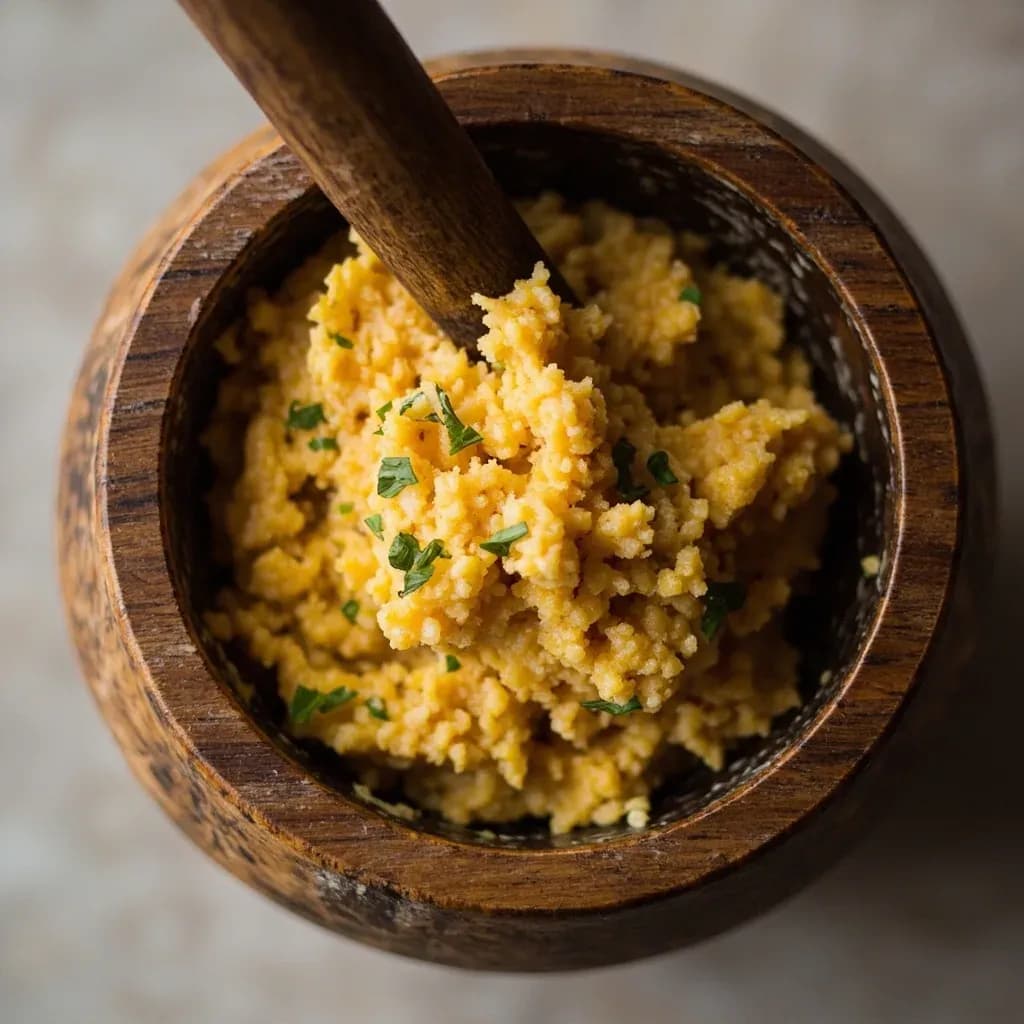
Mashing fried green plantains with garlic and pork into the dense base of mofongo.
Plantain smashing is the Puerto Rican technique of pounding fried green plantains, traditionally in a wooden pilon (mortar), with garlic, olive oil, and crispy pork to make mofongo. The plantains are mashed until cohesive but still slightly chunky, then pressed into a dome that holds its shape on the plate. The same smash, done lighter, produces tostones when each slice is flattened and re-fried.
Plantain smashing is the foundational technique behind Puerto Rican mofongo — a rhythmic, forceful pounding of fried green plantains with garlic, salt, and pork fat in a wooden pilón until the flesh coheres into a dense, chunky, slightly sticky mound. The method matters as much as the ingredients: a correct pounding shears the plantain cells rather than crushing them flat, releasing just enough starch to bind the mash while leaving visible pieces of flesh. The result is not a purée or a paste but a textured starchy base built to absorb and carry the juices of whatever is ladled over or stuffed inside it.
The technique carries clear West African DNA. Enslaved Africans carried the fufu-pounding method across the Atlantic and adapted it to the green plantain, a starchy staple that behaved much like the yams and cocoyams of home. A proper pilón, traditionally carved from lignum vitae or guayacán, is more than decorative: its dense wood absorbs excess oil, doesn't chill the plantains the way metal does, and its rough grain helps shear rather than smash. Skip the wooden bowl and the difference shows on the plate — metal bowls and conventional potato mashers produce a gluey, leaden result.
A cook who masters the rhythm — rotating the pestle against the curve of the bowl, layering the plantains in batches, stopping while pieces are still visible — produces something rustic, savory, and structurally sturdy enough to act as a vessel for a stew. A cook who overworks it produces paste. That line between rustic and ruined is the whole game.
- Difficulty
- Medium
Types & varieties
The Puerto Rican classic — fried green plantains mashed with garlic, salt, olive oil, and crushed chicharrones.
The mash is shaped into a hollow or dome and stuffed or topped with stewed chicken, shrimp criollo, shrimp in garlic sauce, pernil, or vegetables.
Canary Islands adaptation that folds mojo verde or mojo rojo into the mash alongside or instead of the garlic-oil base.
Salt-cod version in which desalted, flaked bacalao is layered into or over the mash.
Pounded with cilantro, parsley, or culantro and olive oil for an herb-forward version popular in Dominican-influenced kitchens.
Omits chicharrones and relies on roasted garlic, good olive oil, and aggressive salt for savoriness.
Dominican boiled-and-mashed green plantain, served with pickled red onions, eggs, and salami — same pilón technique but no frying and no pork.
How to do it
- 1
Select and peel the plantains
Choose plantains that are entirely green, with no yellow patches and no soft spots. Cut off both ends, stand each plantain upright, and slice lengthwise through the peel in 3 or 4 lines — score the thick skin only, not the flesh. Pry the peel away with your thumbs or the back of a knife; it should come off in wide strips. Keep the peeled plantains under a damp towel so they don't oxidize while you work.
- 2
Slice on the diagonal
Cut each plantain into roughly 1-inch-thick slices on a 30–45° bias. The angled cut increases surface area for browning, helps rounds hold their shape in the oil, and gives the finished mash more edges to catch seasoning.
- 3
Fry in batches
Heat 1–1½ inches of neutral oil (or olive oil) in a heavy pot or deep skillet to 325–350°F. Fry plantain slices in a single layer without crowding, 3–4 minutes per side, until deeply golden and a paring knife slides through with slight resistance. Drain on a paper-towel-lined tray and season lightly with salt while still steaming-hot.
- 4
Prepare the pilón with garlic and salt
In the wooden pilón, combine 6–8 peeled garlic cloves with about 1 teaspoon coarse salt. Pound in a circular motion with the pestle until you have a coarse, wet paste. The salt acts as an abrasive and draws moisture from the garlic, so the paste seasons every fiber of the plantain that follows.
- 5
Smash the plantains in batches
Add about a third of the fried plantains to the pilón. Pound firmly, but rotate the pestle against the curved wall rather than just pressing straight down — this shears the plantain into rough pieces instead of flattening it into a disc. When the first batch is broken up, push it to the sides and add the next third. Repeat until all the plantains are partially crushed but still visibly chunky.
- 6
Work in the chicharrones and fat
Add about ½ cup crushed chicharrones (or 3–4 crisped bacon strips, crumbled) and 2–3 tablespoons of warm olive oil or lard. Pound just enough to integrate; the cracklings should remain identifiable, not dissolved. Taste and adjust salt — plantains swallow seasoning, and mofongo almost always wants more salt than you think.
- 7
Shape and serve
Wet the pestle or your hands with cool water to prevent sticking. Pack the mash into a tight dome, or press it against the sides of the pilón to form a bowl shape with a well in the center for a stew. Invert onto a warm plate and serve at once, either plain as a side or with chicken, shrimp, or broth ladled over or into the well. Eat the same day — mofongo does not survive the refrigerator well.
The role of the pilón
The wooden pilón is not a stylistic flourish. Its dense wood absorbs excess surface oil, prevents the plantain from chilling on contact (as metal would), and its rough interior wall helps shear the flesh as the pestle rotates against it. The result is a ragged, broken texture — exactly what mofongo needs. A smooth-walled marble mortar or a metal bowl gives you different physics: the plantain slides and compresses into a paste. The closest household substitute is a heavy wooden salad bowl paired with a flat-bottomed wooden pestle; a sturdy Dutch oven with a flat-bottomed mug is a workable last resort, though the texture will lean denser and more uniform. Expect to lose some character, not the dish.
Texture targets and common failure points
Authentic mofongo looks like coarse mashed potatoes with personality — you should be able to identify individual plantain pieces roughly the size of a fingernail. Three mistakes account for most of the bad mofongo a cook will ever eat:
- Over-ripened plantains. Any yellow on the skin means the starches have converted to sugar, and sugar-laden plantains will not hold shape; they slump into a sweet, gummy paste.
- Mashing when cool. Fried plantains must be pounded while still steaming-hot. Once they cool below body temperature, the starches set and the mash will not cohere — you will be fighting it the whole way.
- Pulverizing instead of shearing. Pressing straight down makes discs; rotating the pestle against the wall of the pilón makes ragged chunks. The difference in mouthfeel is enormous.
Common uses
Tips & pitfalls
- Use only fully green plantains. Yellow skin signals converted starch; sweet, ripe plantains collapse into a gummy paste that will not hold the dish together.
- Score the peel in 3–4 long lines and pry it off with your thumbs. Trying to pare a green plantain with a paring knife wastes time and a lot of flesh.
- Cut on a 30–45° diagonal, about 1 inch thick. The angle gives more browning surface and helps the rounds keep their shape in the fryer.
- Hold the oil at 325–350°F. Too hot and the outside burns before the inside softens; too cool and the slices drink oil and turn soggy, and the final mash will feel greasy.
- Mash the plantains while they are still steaming-hot. Cold plantains have already set their starch and will refuse to cohere — you will fight them the entire way.
- Add the plantains in two or three batches, pounding each layer before adding the next. Piling everything in at once leaves a half-mashed bowl with raw, intact rounds hiding at the bottom.
- Stop while the mash is still chunky. The moment mofongo looks like a uniform paste, you have gone too far — visible pieces of plantain are the point.
- Fold the chicharrones in at the very end. Heavy pounding earlier crushes them into the background; a light final turn keeps the crunch that defines the dish.
Good to know
- Origin
- Puerto Rico, with West African fufu-pounding roots carried to the Caribbean through the slave trade
- Primary ingredient
- Green (unripe) plantains — fully green or with only the barest yellow; ripening produces unwanted sweetness and a gluey mash
- Traditional equipment
- Pilón, a wooden mortar and pestle typically carved from guayacán or lignum vitae
- Aromatics and fat
- Garlic in generous quantity, coarse salt, olive oil or annatto-tinted lard, and chicharrones de cerdo (pork cracklings)
- Plantain cooking method
- Deep-fried at 325–350°F (163–177°C) until deeply golden and just tender at the center
- Target texture
- Dense, coarse, slightly sticky mound with visible plantain chunks — never a smooth purée
- Difficulty
- Intermediate; physically demanding because of the sustained pounding
- Storage of finished mash
- Best eaten immediately; holds warm 30–45 minutes in the pilón under a towel but turns gummy if refrigerated and reheated
Also called
Mofongo Mashing · Pilon Mashing
Related

Whisk
Beat ingredients smooth and aerated with a looping wire motion

Sift
Pass dry ingredients through mesh to aerate and remove lumps

Strain
Pour through mesh to separate solids from liquid for a smooth result

Filter
Pass liquid through fine material to clarify out the smallest particles

Rice
Press cooked potatoes through small holes for fluffy, lump-free texture

Mash
Crush soft cooked food into a rustic, creamy purée

Grind
Crush food into a coarse to fine texture, from spices to meat

Grate
Shred food into fine bits against a sharp-toothed surface