Transform & Preserve
Renneting (Coagulation)
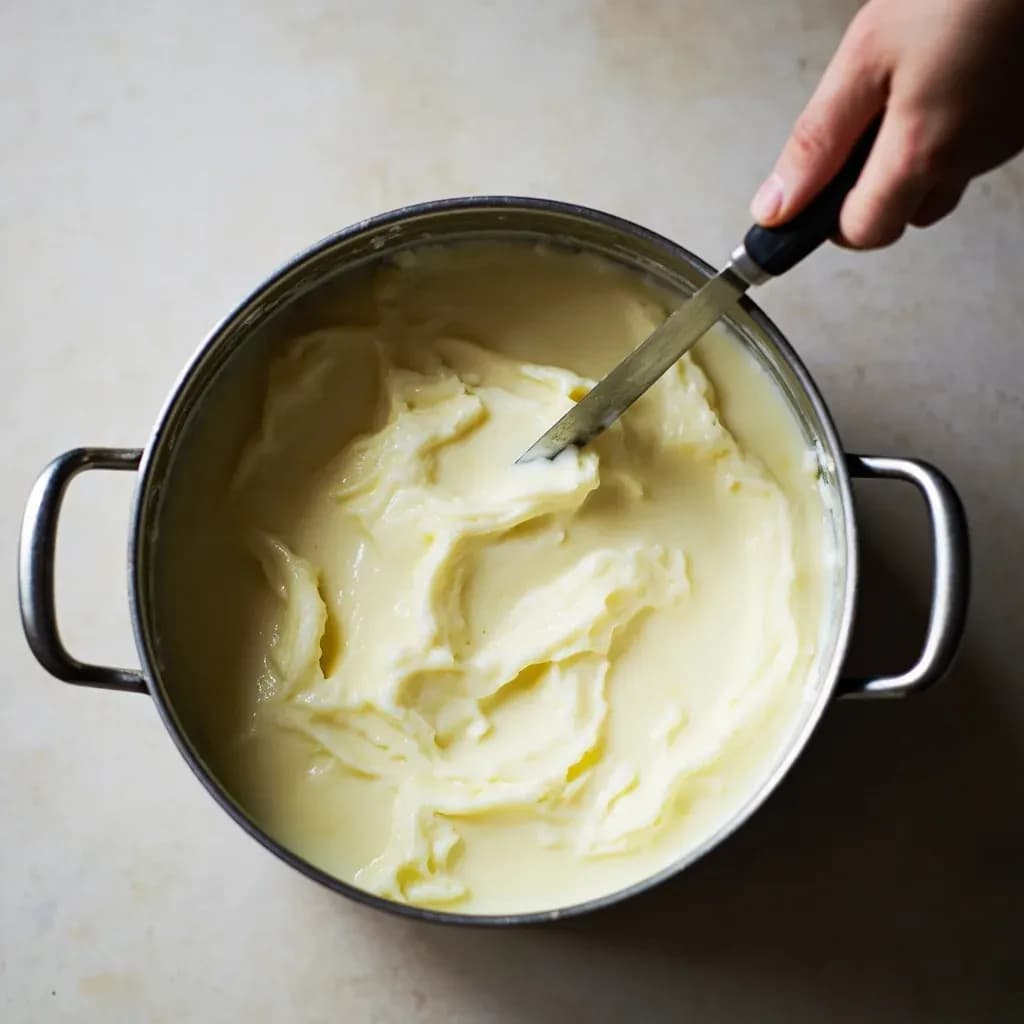
Adding rennet to warm milk to coagulate the proteins into curds for cheesemaking.
Renneting introduces the enzyme rennet to warm milk, which cleaves the casein proteins so they bond and set the liquid into a soft, sliceable curd. The curd is then cut and drained from the whey, the first decisive step in turning milk into cheese. The set point, called the clean break, is judged by how cleanly the gel splits around a knife or finger, and timing it well governs the final texture.
Renneting is the enzymatic coagulation of milk — the moment in cheesemaking when dissolved proteins snap from liquid to gel, and the cook commits to a particular style of cheese. The active agent is rennet, whose principal enzyme is chymosin (accompanied by pepsin in traditional animal preparations). Chymosin cleaves a specific bond on κ-casein, the protective 'hairy' protein that keeps casein micelles from clumping; once that coat is stripped, the micelles aggregate into a continuous network that traps fat and water. The result is a tender, calcium-rich curd that captures more solids than acid coagulation alone, which is why rennet-set cheeses range from pillowy fresh mozzarella to grating-aged Parmesan.
In practice, renneting is rarely a solitary event. By the time the enzyme is added, a starter culture has usually lowered the milk's pH from ~6.7 to 6.4–6.6, and the calcium balance has been adjusted if needed. Temperature, acidity, calcium, and dose all conspire to determine whether the curd will be brittle or silky, slow-setting or quick, suitable for stretching or destined for the cave. Understanding renneting is therefore less about a single ingredient than about timing the enzyme to arrive at the right physicochemical moment.
A working knowledge of renneting also clarifies what rennet is not. Junket tablets sold for dessert custards are a heavily diluted, low-activity formulation unsuitable for cheesemaking. 'Vegetarian' labels on cheese usually mean microbial or recombinant chymosin, not plant extract. And aged cheeses, despite the dominance of recombinant chymosin in industry, are still commonly made with animal rennet on the belief — disputed but persistent — that trace lipase and pepsin contribute to long-aged flavor complexity.
- Difficulty
- Medium
Types & varieties
Traditional standard; mostly chymosin with pepsin. The reference choice for aged hard cheeses; many cheesemakers believe it produces more complex, 'picante' flavors during long aging.
Stronger and richer in lipase than calf rennet. Used in some Mediterranean and raw-milk traditions; imparts sharper, peppery notes.
Fungal-derived, typically from Mucor miehei or M. pusillus. The workhorse of commercial vegetarian cheeses. Can produce slight bitterness in long-aged wheels.
Identical chymosin produced by microorganisms (Aspergillus, Kluyveromyces, or E. coli) carrying the calf gene. Purer than animal rennet (no pepsin or lipase), now dominant in industrial cheesemaking. Sold as Chy-Max, Fromase, Hannilase, and others.
Cynara cardunculus (thistle) for Portuguese and Spanish cheeses like Serra da Estrela, Torta del Casar, and Queso de La Serena; fig sap or nettle appear in some West African and southern European traditions. Tend to give softer, more brittle curds and a faintly bitter, vegetal edge.
Commercial potency grades — double-strength delivers the same clotting at half the volume. Adjust dosing carefully when switching.
How to do it
- 1
Prepare the milk
Heat the milk to your recipe's setting temperature, typically 30–35°C (86–95°F). For pasteurized store-bought milk, stir in calcium chloride — about ¼ teaspoon of a 33% solution per gallon — to replace calcium lost in pasteurization and ensure a firm set.
- 2
Ripen with starter culture
Sprinkle mesophilic or thermophilic starter onto the milk surface, let it rehydrate 1–2 minutes, then stir in thoroughly. Cover and let the milk ripen until it reaches the target acidity for your cheese (commonly 0.14–0.18% titratable acidity, or a recipe-specific pH).
- 3
Dilute the rennet
Just before adding, dilute the measured rennet in 20–50 mL of cool, non-chlorinated water. Do not prepare the solution in advance — potency drops once rennet is diluted.
- 4
Add rennet and stir
Pour the diluted rennet over the milk surface. Stir with a slotted spoon or whisk in a slow, deliberate figure-eight pattern for 25–35 seconds to distribute it evenly. Stop the moment the milk begins to thicken visibly — agitation after this point breaks the forming gel.
- 5
Let the milk set undisturbed
Cover the pot, kill the heat, and leave the milk completely still at the set temperature. Most cheeses set in 30–45 minutes. Avoid drafts, vibrations, and the temptation to peek.
- 6
Test for a clean break
Insert a knife, thermometer probe, or finger at a 45° angle, then lift slowly. A ready curd splits cleanly, with translucent green-yellow whey filling the gap. If the break is soft or smeared, wait another 5–10 minutes.
- 7
Cut the curd
For aged or semi-soft cheeses, cut the curd to the size your recipe specifies — about 1 cm cubes for Cheddar, rice-grain size for Parmesan. Let the cut curd rest 5 minutes so the surfaces can firm up ('heal') before you begin stirring.
The science in one paragraph
Casein in milk exists as micelles — tiny spheres of protein stabilized at the surface by a layer of κ-casein. Chymosin is exquisitely specific: it clips off a small piece (the caseinomacropeptide) of κ-casein, destabilizing the micelle surface. Once the surface is compromised, the micelles link into a three-dimensional gel that traps fat globules and the watery phase (whey). Acid, calcium, and temperature modulate how tight that gel becomes: more acid and more calcium push toward a firm, brittle curd; less acid and gentle temperature keep it soft and stretchy. This is why a single rennet dose can yield everything from squeaky fresh curds to crystalline aged cheese — the enzyme is the trigger, but the surrounding chemistry writes the recipe.
Troubleshooting
Most renneting problems trace back to one of four causes.
- No set at all: rennet is old, or was inactivated by chlorinated water, excess heat, or premature dilution. Test a small dose in 100 mL of warm milk before discarding a batch.
- Soft, mushy curd: under-dosing, milk too cool, or calcium-deficient milk — common with pasteurized store-bought milk. Add calcium chloride before renneting.
- Bitter finished cheese: over-dosing, the curd was cut too small and shed fat, or rennet residue lingered in a long-aged wheel.
- Late set or drifting cut: the pot was jostled, the surface was disturbed, or a draft cooled one side. Always cover and let the milk rest in still air.
Common uses
Tips & pitfalls
- Use only non-chlorinated water for dilution — chlorine deactivates both rennet and starter cultures. Filtered or distilled water is safest.
- Add diluted rennet to the milk surface and stir in a slow figure-eight for ~30 seconds, then stop. Stirring once the gel begins to form produces a weak, broken set.
- Trust the clean-break test over the clock. Temperature, acidity, and milk quality all change setting time; the curd tells you when it is ready.
- For pasteurized milk, add calcium chloride (¼ teaspoon of 33% solution per gallon) before renneting — without it, the curd is often soft and reluctant to set.
- Use the flocculation method to dial in cutting time: count seconds from rennet addition to the first visible clumping on the surface, then multiply by a cheese-specific factor (×3 for Cheddar, ×2.5 for Gouda) to get total set time.
- Over-dosing rennet yields bitter, harsh cheese; under-dosing gives fragile, wet curds. If in doubt, start with less — you can add more, but you cannot take it back.
- Test old rennet on 100 mL of milk before committing a batch. Aged rennet often gives a soft, slow set that ruins a careful recipe.
- Rennet activity roughly doubles for every 10°C (18°F) rise up to about 50°C, and is destroyed above ~60°C. Never add rennet to scalding milk.
Good to know
- Technique type
- Enzymatic coagulation of milk
- Active agent
- Rennet — primarily chymosin (with pepsin in animal preparations), traditionally extracted from the fourth stomach (abomasum) of unweaned ruminants
- Target protein
- Casein, specifically κ-casein, which is cleaved to allow micelle aggregation
- Optimal milk temperature
- 30–35°C (86–95°F); style-dependent — ~30°C for Parmesan, ~32°C for Cheddar, ~33–35°C for fresh cheeses
- Target pH at setting
- Roughly 6.4–6.6 for most cheeses
- Setting time
- Typically 30–45 minutes; can range from 20 minutes (high-heat, firm cheeses) to over an hour
- Typical dosage
- About ¼ teaspoon single-strength liquid rennet per gallon (~3.8 L) of milk; halve for double-strength
- Strength units
- IMCU (International Milk Clotting Units); single-strength animal rennet is commonly ~150 IMCU/mL
- Equipment
- Use non-reactive vessels (stainless steel, food-grade plastic, enamel, glass); avoid copper, iron, and aluminum, which disrupt coagulation
Also called
rennet coagulation · milk coagulation · curdling
Dishes that rely on it

Related

Confit
Cook slowly submerged in fat for silky tenderness and keeping

Cure
Draw out moisture with salt and time to preserve and concentrate

Pickle
Steep in acidic brine for bright, tangy, crunchy preservation

Ferment
Let friendly microbes transform food into tangy, complex flavor

Marinate
Soak in a seasoned mix to flavor and tenderize before cooking

Brine
Soak in salt water so meat stays juicy and seasoned throughout

Dehydrate
Slowly dry out moisture to concentrate flavor and extend shelf life

Cold-Smoke
Perfume cured food with smoke without cooking it through