Water & Steam
Rinsing Rice
Washing rice in water to remove surface starch for fluffier, separate grains.
Rinsing rice swirls the grains in several changes of cold water until the cloudy starch washes away. Removing this surface starch keeps cooked rice from clumping and turning gummy, which matters for steamed and pilaf-style rice. Cooks rinse until the water runs nearly clear, though some dishes like risotto and paella deliberately skip rinsing to keep that creamy starch.
Rinsing rice is the simple but consequential practice of agitating raw rice in cold water, then decanting the cloudy liquid, repeated until the rinse water runs clear (or nearly so). The cloudiness is loose surface starch left over from milling; that starch is the very thing that makes grains fuse into a gummy, porridge-like mass on the plate. Washing it away lets each grain cook up distinct, with the surface still slick enough to hold its own steam and flavor.
The behavior of rinsed rice depends on how thoroughly you wash it. A couple of quick rinses for a long-grain pilaf yields fluffy, separate grains with a faint haze in the final water; five or six rinses for Japanese short-grain or sushi rice produces water that is essentially transparent and grains that cling just enough to be eaten with chopsticks. Cold water is essential — warm or hot water starts to gelatinize the outer starch, leaving the grains tacky and defeating the purpose. The technique is taught as a given in Japanese, Korean, Chinese, Indian, Persian, and Middle Eastern rice cookery, and it is one of the first habits a serious cook adopts.
Beyond texture, rinsing also clears milling dust and, when combined with cooking in excess water that is then drained, can reduce inorganic arsenic in white rice by roughly 10–30%. The tradeoff is a small loss of water-soluble B vitamins and any enrichment coating, which is why some U.S.-packaged enriched rice is pre-washed at the mill. None of this matters much in practice for plain table rice — the benefits far outweigh the cost — but it explains why some recipes (risotto, parboiled rice) deliberately skip the rinse.
- Difficulty
- Easy
Types & varieties
The default in most home kitchens: rice in a wide bowl, cold water added, gentle hand swirl, then decant the cloudy water.
Faster draining and good for long-grain rices; risk of small grains slipping through on wide mesh.
A wooden or bamboo paddle used in circular motion; considered gentler on grains than fingers and traditional in Japanese kitchens.
Many modern Japanese rice cookers automate fill, swirl, and drain with a dedicated rinse program.
Rinse first, then soak basmati 20–30 minutes in cool water before draining to deepen aroma and lengthen grains.
Italian risotto (Arborio, Carnaroli, Vialone Nano) deliberately skips rinsing to preserve chalky surface starch for creaminess.
How to do it
- 1
Measure and place
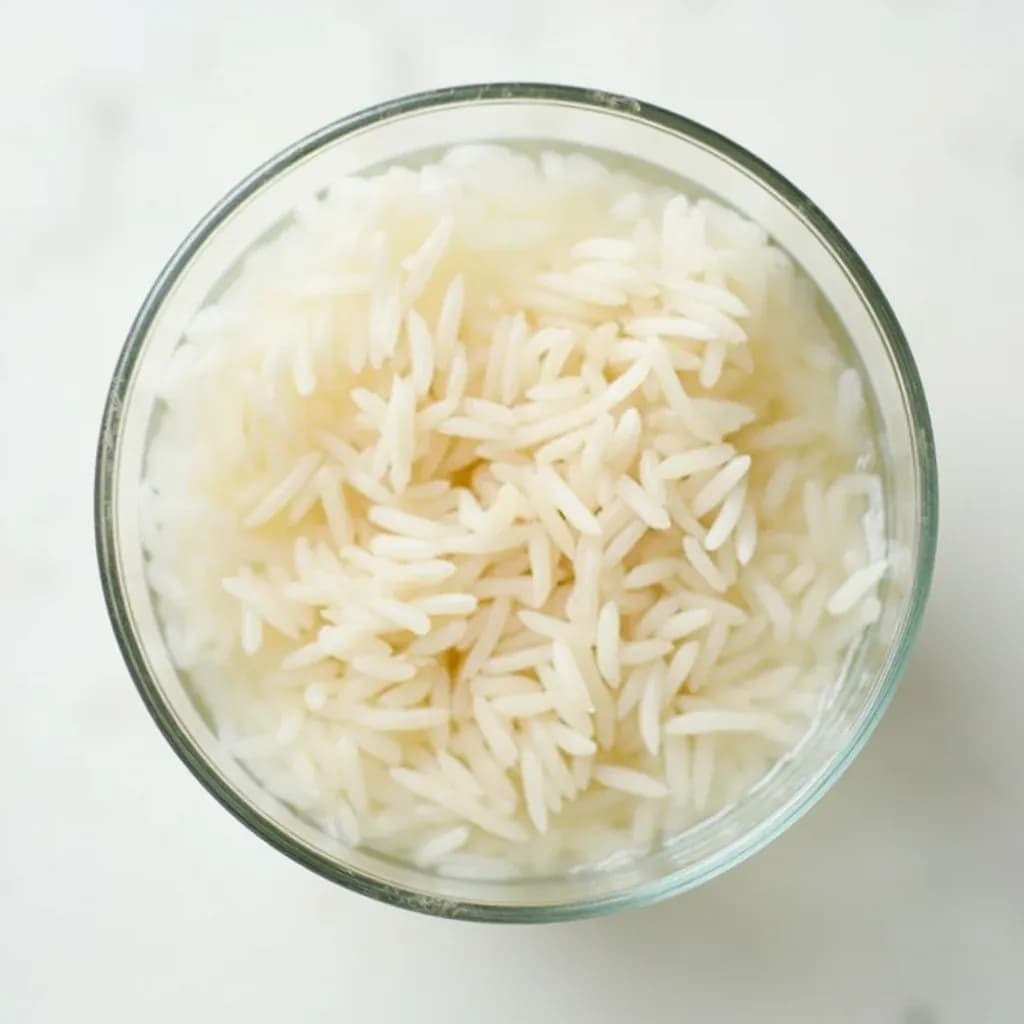
Measure the rice into a wide bowl rather than a narrow cup — a wider surface area means better water contact and faster clearing. A glass bowl lets you see the cloudiness directly so you know when you are done.
- 2
First rinse
Cover the rice with 2 to 3 times its volume of cold water. Stir briefly with your fingertips or a wooden paddle in one direction, not back and forth, to avoid fracturing the grains. The water will turn milky almost instantly.
- 3
Decant
Let the rice settle for 5 to 10 seconds, then tip the bowl slowly so the cloudy water pours off while the grains stay behind. A fine-mesh sieve set over the sink is a good backup for beginners who lose grains during pouring.
- 4
Repeat
Refill with cold water, swirl, and decant again. For most long-grain rices, 2 to 3 rinses are enough. For Japanese short-grain and sushi rice, continue for 4 to 6 rinses until the water is nearly transparent.
- 5
Optional soak
For basmati, jasmine, and some medium-grain rices, cover the rinsed grains with fresh cold water and let stand 20 to 30 minutes. This lets the grains relax and elongate as they cook. For most Japanese short-grain, limit the soak to 15 to 20 minutes.
- 6
Final drain
Pour the rice into a fine-mesh sieve and let it drain for at least 5 minutes so the cooking liquid is not diluted. Shake gently to dislodge clinging drops.
- 7
Cook
Transfer the rice to a rice cooker, pot, or donabe and proceed with your recipe's water ratio. Because surface starch is gone, you can usually reduce the cooking water by roughly 5 to 10% compared with a recipe calibrated for unrinsed rice.
When not to rinse
Rinsing is not universal. The two clearest exceptions are Italian risotto-style rices and parboiled (converted) rice. In risotto, the chalky surface starch on Arborio, Carnaroli, and Vialone Nano is exactly what releases into the stock to build the dish's creamy body — washing it away defeats the dish. Parboiled rice has been steam-treated at the mill, driving nutrients and starch into the grain, and the surface has been hardened by that process; rinsing strips flavor and leaves a chalky residue with no real benefit. Brown rice is a softer case: rinse it to dislodge loose bran and grit, but understand that the bran layer locks in most of the arsenic, so a rinse alone has limited effect — pair it with cooking in excess water that is then drained.
- Risotto rices (Arborio, Carnaroli, Vialone Nano): keep the starch for creaminess.
- Parboiled/converted rice: the surface has been steam-set; rinsing strips flavor.
- Brown rice: rinse for cleanliness, but arsenic reduction is minimal without excess-water cooking.
Regional standards for clarity
There is no single correct end point for rinsing. Japanese and Korean cooks push for nearly transparent water because their table rice and sushi rice are meant to glisten and cling gently; Indian and Persian cooks accept a faintly hazy final rinse because basmati and jasmine benefit from a trace of surface starch to help grains separate in a pilaf without drying out. Both are correct for their cuisine. The practical test for basmati is water that is 'clear as a tear' — a faint milkiness is normal and even desirable. For sushi rice, take the rinses further until the water is essentially clear, and the grains will squeak faintly between your fingers when rubbed.
- Japanese short-grain / sushi: aim for transparent final water and a slight squeak on the grains.
- Basmati / jasmine / pilaf rice: a faint haze is normal and acceptable.
- Fried rice: push for clear water so the grains toss and brown rather than steam together.
Common uses
Tips & pitfalls
- Always start with cold water — warm or hot water begins to cook the outer starch and leaves grains tacky.
- Swirl gently; aggressive rubbing fractures grains and releases more starch than you want.
- Decant rather than pour all the rice out — tip the bowl slowly so the heavy grains settle and the cloudy water leaves first.
- For sushi rice, take the rinses further until the water is essentially transparent; for basmati, a faint haze is normal and traditional.
- Don't skip rinsing just because the bag says 'pre-washed' — a quick single rinse still removes transport dust and tightens the texture.
- Drain thoroughly after the final rinse so you control the cooking-water ratio precisely.
- Reserve a measured amount of rinse water and use it as part of the cooking liquid if you want to keep every bit of starch.
- Don't rinse risotto rices (Arborio, Carnaroli, Vialone Nano) — their chalky starch is what makes the cream.
- Don't rinse parboiled/converted rice — the steaming process has already set the surface and washing strips flavor.
- If your tap water is very hard, a final rinse with filtered water can prevent mineral cloudiness on the cooked grains.
- Brown rice benefits from rinsing, but the bran layer means the arsenic-removal effect is much smaller — drain and cook in excess water if that is the goal.
Good to know
- Origin
- Ancient practice across rice-growing regions of Asia; integral to Japanese gohan, Indian chawal, and Korean bap traditions.
- Purpose
- Removes loose surface starch and milling dust so grains cook up distinct rather than gummy.
- Typical rinses
- 2 to 4 changes of water; up to 5–7 for basmati and Japanese short-grain sushi rice.
- Water temperature
- Cold or cool tap water; warm water prematurely gelatinizes the surface starch.
- Water-to-rice ratio
- About 2 to 3 times the rice volume per rinse, enough to cover and swirl freely.
- Total time
- Roughly 3–8 minutes of active work, depending on rice variety and desired clarity.
- End point
- Final rinse water ranges from nearly clear (Japanese short-grain, sushi) to faintly cloudy (basmati, jasmine) depending on tradition.
- Equipment
- Wide bowl with hand-swirling, fine-mesh sieve, or dedicated Japanese rice-washer (zaru) with paddle.
- Arsenic reduction
- Rinsing plus cooking in excess water removes roughly 10–30% of inorganic arsenic from white rice; far less effective for brown rice.
- Nutrient effect
- Leaches a small amount of water-soluble B vitamins and any enrichment coating.
- Skill level
- Beginner; one of the first techniques taught in any rice-centric cuisine.
Also called
Rinsing Rice (Togu) · Rice Washing · Rice Rinsing
Dishes that rely on it

Related

Boil
Cook in vigorously bubbling liquid at full rolling heat

Simmer
Hold liquid at a gentle shimmer for tender, unhurried cooking

Poach
Cook gently in barely-trembling liquid for silky, tender results

Steam
Cook in rising vapor to keep color, nutrients, and shape intact

Blanch
Plunge briefly in boiling water, then shock cold to lock color

Braise
Sear, then cook slow in a little liquid until fall-apart tender

Stew
Simmer bite-sized pieces fully submerged into a rich, unified pot

Sous-Vide
Seal and cook in precise warm water for edge-to-edge doneness