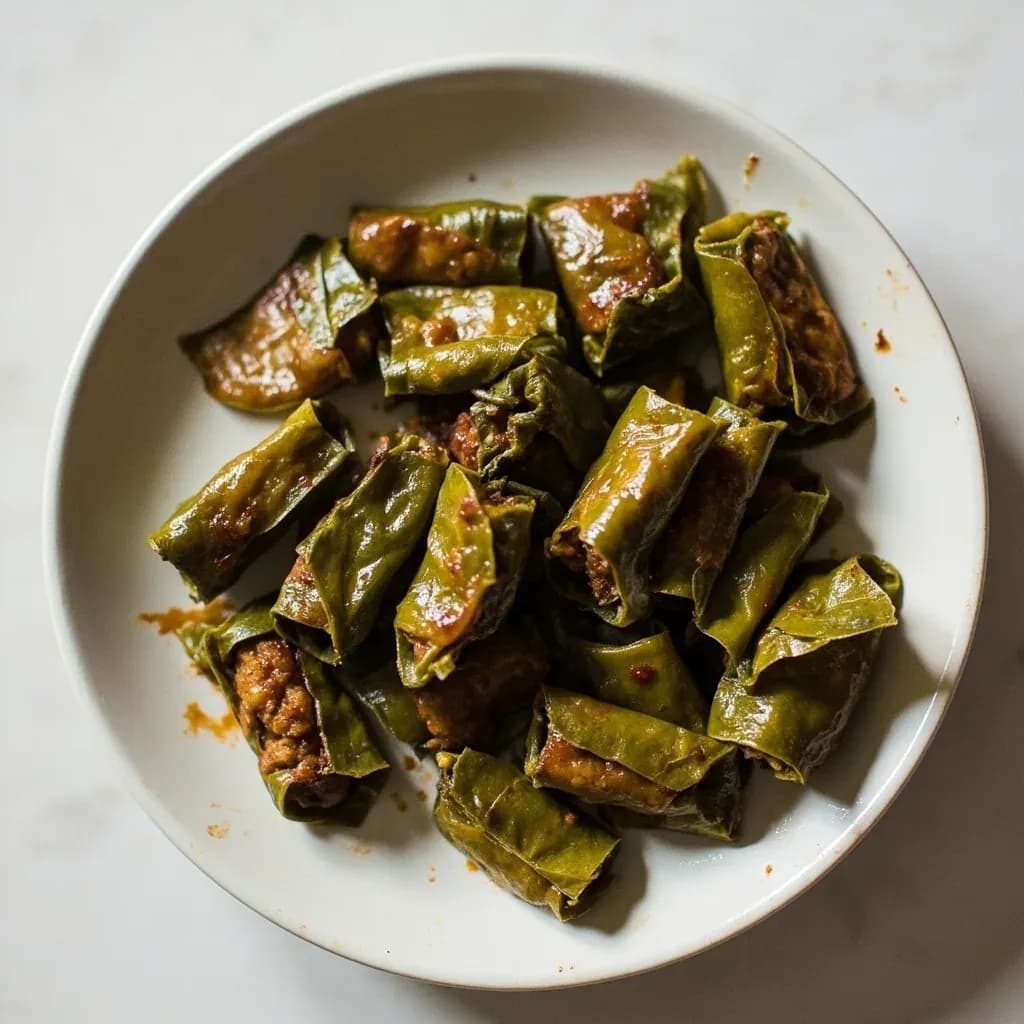
Prep & Assembly
Rolling Grape Leaves
Wrapping seasoned rice or meat in grape or cabbage leaves into tight little cigars or rolls.
Rolling grape leaves tucks a filling of rice, herbs, and sometimes meat into a blanched leaf, folding in the sides and rolling it snugly into a compact cylinder for dolma, sarma, and stuffed rolls. The rolls are packed tightly into a pot and simmered so they hold their shape and absorb the cooking liquid. The same technique extends to cabbage leaves for sarmale and thin meat sheets for involtini.
Rolling grape leaves is a foundational prep technique in the Eastern Mediterranean and Middle Eastern kitchens, where a thin vine leaf becomes a wrapper that holds seasoned rice, meat, or both through a long simmer. The leaf does three jobs at once: it steams the filling, contains it, and absorbs the cooking liquid's flavor, which is why the technique matters as much as the recipe itself. Master the hand motion once and you've effectively learned to wrap cabbage, chard, and fig leaves, because the geometry is the same.
A proper roll is a tight cigar about the length of a thumb, packed with a heaped teaspoon of filling, no more. That tight geometry is the whole game: a loose roll opens as the rice expands during cooking, while an overstuffed one splits at the seam. The leaf has no give once it's wet, so the roll you set in the pot is largely the roll you plate. The good news is that the technique forgives small errors: a torn leaf goes into the bottom of the pot as a liner, a half-teaspoon under is better than a half-teaspoon over, and an off-center roll still tastes correct.
Get the packing right and a 2-quart pot holds 30 to 40 neat rolls in tight concentric layers, ready for 30 to 60 minutes of gentle simmering under a weighted plate. The dish wears many names (dolma, dolmades, warak enab, yaprak sarması, tolma) but the hand motion is the same across the region.
- Difficulty
- Medium
Types & varieties
Rice-based filling with tomato, parsley, mint, and dill; cooked in olive oil and lemon; served cold or at room temperature, often with garlicky yogurt.
Adds ground lamb or beef to the rice filling; braised in a meat-based broth rather than a lemon-oil liquid.
Very close to Turkish yaprak; sometimes finished with avgolemono (egg–lemon sauce); the meat version with avgolemono is called yialantzi.
Vegetarian rice filling with tomato, mint, parsley, and lemon; cooked in a lemony broth and served warm or cold with labneh or plain yogurt.
Typically uses a meat-and-rice or meat-and-bulgur filling with warm spices; sometimes wrapped in cabbage, Swiss chard, or vine leaves interchangeably.
Often includes dried fenugreek or dried Persian limes, frequently mixed with split peas along with rice; cooked with saffron and turmeric.
Central European take with a meat-and-rice filling braised in a paprika-laced tomato broth, eaten warm with sour cream.
The same rolling technique applied to blanched cabbage leaves; a useful fallback when grape leaves are unavailable.
How to do it
- 1
Prepare the leaves
If using jarred brined leaves, drain and rinse well under cold water; taste and soak briefly if salty, then pat dry. If using fresh leaves, blanch 20–30 seconds in salted boiling water, shock in ice water, and drain. Stack leaves, glossy side down.
- 2
Trim and sort
Lay one leaf vein-side up. With a paring knife, slice the stem off flush with the leaf base — leaving a stem stub can pierce the roll and let filling escape. Sort leaves by size and set the smallest, torn, or oddly shaped ones aside as pot liners.
- 3
Make the filling
Sauté finely chopped onion in olive oil until soft. Combine with rinsed short- or medium-grain rice, chopped tomato (or a spoon of tomato paste), chopped parsley, mint, and dill; for the Levantine style, fold in a handful of pine nuts and/or currants. For meat versions, add raw ground lamb or beef plus warm spices (cinnamon, allspice, black pepper). For vegetarian versions, par-cook the rice 5–7 minutes so it finishes inside the leaf; for meat versions, leave the rice raw so it cooks in the broth. Season with salt, pepper, and lemon juice. The filling should be moist but not wet, holding together when pressed in a spoon.
- 4
Set up the rolling station
Arrange a wide board or counter with the stacked leaves within reach, the bowl of filling beside them, and the empty pot at one end. Have a kettle of water or broth and a small bowl of lemon–olive oil mixture nearby for layering.
- 5
Portion the filling
Lay a leaf vein-side up, stem end toward you. Spoon about 1 teaspoon (a heaped 5–7 g) of filling just above where the stem was, leaving a 1–1.5 cm border on the sides and bottom.
- 6
Fold the base
Lift the stem end of the leaf up and over the filling, tucking it under to form a tight pocket around the rice.
- 7
Fold the sides
Fold the left and right sides of the leaf inward over the filling, like closing a burrito — these flaps keep the rice from spilling out the ends.
- 8
Roll forward
Roll the parcel away from you, away from the stem end, keeping firm pressure so the roll is tight but the leaf is not torn. Place seam-side down on the board and continue with the remaining leaves.
- 9
Line the pot
Scatter torn and trimmings leaves, or a layer of thin potato slices, across the bottom of a heavy pot to insulate the rolls from direct heat and prevent scorching.
- 10
Pack the rolls
Arrange rolls seam-side down in tight concentric circles, fitting them snugly against each other and the pot wall. Continue layering in tight circles; smaller rolls go in the upper layer. Looseness is the main cause of rolls opening during cooking.
- 11
Add the cooking liquid
Drizzle a generous amount of olive oil and lemon juice over the top. Pour in enough water, stock, or tomato broth to come about 1 cm (just under ½ inch) above the rolls. For vegetarian versions, the liquid should taste distinctly lemony; for meat versions, a richer stock with a spoon of tomato paste works well.
- 12
Weigh and bring up to heat
Place an inverted heat-safe plate directly on the rolls to keep them submerged and compact. Cover the pot and bring to a gentle boil over medium heat, then reduce to the lowest simmer.
- 13
Simmer
Cook vegetarian rolls 30–40 minutes, meat versions 45–60 minutes, until rice is fully tender and a tester roll shows no chalky center.
- 14
Rest and serve
Remove from heat, keep the pot covered, and let rest 15–20 minutes — the rolls will firm up and soak up the broth, which noticeably improves the texture. Serve warm (meat versions) or cool to room temperature (vegetarian versions) with extra lemon and a drizzle of olive oil; yogurt or garlicky labneh is a classic accompaniment.
Leaf prep: fresh vs. brined
The choice between fresh-picked and jarred leaves is mostly a question of season and geography, because both work. Fresh young vine leaves are available from late May through July in most of the Northern Hemisphere, and they need only a 20- to 30-second blanch in salted boiling water followed by an ice bath to make them pliable. Older, larger leaves are tougher and should be skipped or relegated to pot liners. Jarred brined leaves, sold in most Middle Eastern, Greek, and Armenian markets, are picked young and preserved so they stay tender year-round. The trade-off is salt: drain and rinse them thoroughly under cold water, taste a piece, and if it reads noticeably salty, soak 10 to 15 minutes before patting dry. Wet leaves make a slippery roll; dry ones grip the rice and stay put through the simmer.
- Fresh leaves: pick palm-sized, light green, and unblemished; blanch 20–30 seconds in salted water; shock in ice water.
- Jarred leaves: drain, rinse, taste; soak 10–15 minutes if salty; pat dry with a clean towel before rolling.
- Reserve torn, small, or oddly shaped leaves for the pot lining — they prevent sticking and insulate against direct heat.
- A leaf that is too old or too large will not soften enough to roll cleanly; use it as a liner instead of forcing the wrap.
Common uses
Tips & pitfalls
- Rinse brined leaves thoroughly under cold water and taste one; if too salty, soak 10–15 minutes and pat dry so the rice cooks properly rather than stewing in brine.
- Trim the stem flush with the leaf base; a stem stub will pierce the roll and let filling escape during the simmer.
- Place the leaf vein-side up and glossy side down on the counter; this lets the rougher underside grip the next roll when packed and prevents unrolling.
- Less is more: a heaped teaspoon is plenty. Overfilled rolls split at the seam as the rice expands — underfilled rolls stay tight.
- Tear the smallest or torn leaves into liners for the bottom and top of the pot — they insulate the rolls and prevent sticking or scorching.
- Weight the rolls with a heavy plate (a 'press') so they don't float, shift, and unwrap as the liquid simmers.
- For vegetarian versions, keep the cooking liquid distinctly tart with lemon — acid keeps the rice fluffy and prevents it from turning gluey inside the leaf.
- Pull a single roll from the edge at the 30-minute mark to test the rice; if still chalky, add a splash of hot broth and continue simmering rather than cranking the heat.
Good to know
- Also known as
- Dolma, dolmades, warak enab (waraq enab), yaprak sarması, tolma, töltött szőlőlevél, sarma, hod boaregh (Assyrian)
- Origin
- Ancient technique rooted in Ottoman, Persian, and broader Middle Eastern / Mediterranean cookery; documented in 8th–9th century Baghdad manuscripts
- Season
- Fresh leaves late May through July in the Northern Hemisphere; jarred brined leaves are available year-round in Middle Eastern, Greek, and Armenian markets
- Leaf source
- Young, palm-sized Vitis vinifera leaves, picked late spring to early summer; preserved in brine for year-round use
- Typical roll size
- About 6–8 cm (2.5–3 in) long, roughly the length of a thumb
- Filling amount
- About 1 teaspoon (5–7 g) per leaf; overstuffed rolls burst during cooking
- Cooking time
- 30–40 minutes for vegetarian rolls, 45–60 minutes for meat versions, at a gentle simmer
- Yield
- Roughly 40–60 rolls per 1 lb jar of preserved leaves; a 2-quart pot holds 30–40 medium rolls in tight layers
- Difficulty
- Beginner to intermediate — the hand motion is easy to learn, but speed and tightness come with practice
- Storage
- Uncooked rolls keep 1–2 days refrigerated, freeze up to 3 months; cooked rolls keep 3–4 days and improve after a day of resting
- Calories (approx.)
- About 40–60 kcal per vegetarian rice roll; meat versions run 80–120 kcal each
Also called
Wrapping Grape Leaves · Dolma Rolling · Sarma Rolling · Involtini Rolling
Related

Whisk
Beat ingredients smooth and aerated with a looping wire motion

Sift
Pass dry ingredients through mesh to aerate and remove lumps

Strain
Pour through mesh to separate solids from liquid for a smooth result

Filter
Pass liquid through fine material to clarify out the smallest particles

Rice
Press cooked potatoes through small holes for fluffy, lump-free texture

Mash
Crush soft cooked food into a rustic, creamy purée

Grind
Crush food into a coarse to fine texture, from spices to meat

Grate
Shred food into fine bits against a sharp-toothed surface