Water & Steam
Salsa Verde (En Salsa Verde)
A Basque method emulsifying fish, olive oil, garlic, and parsley into a glossy green pan sauce.
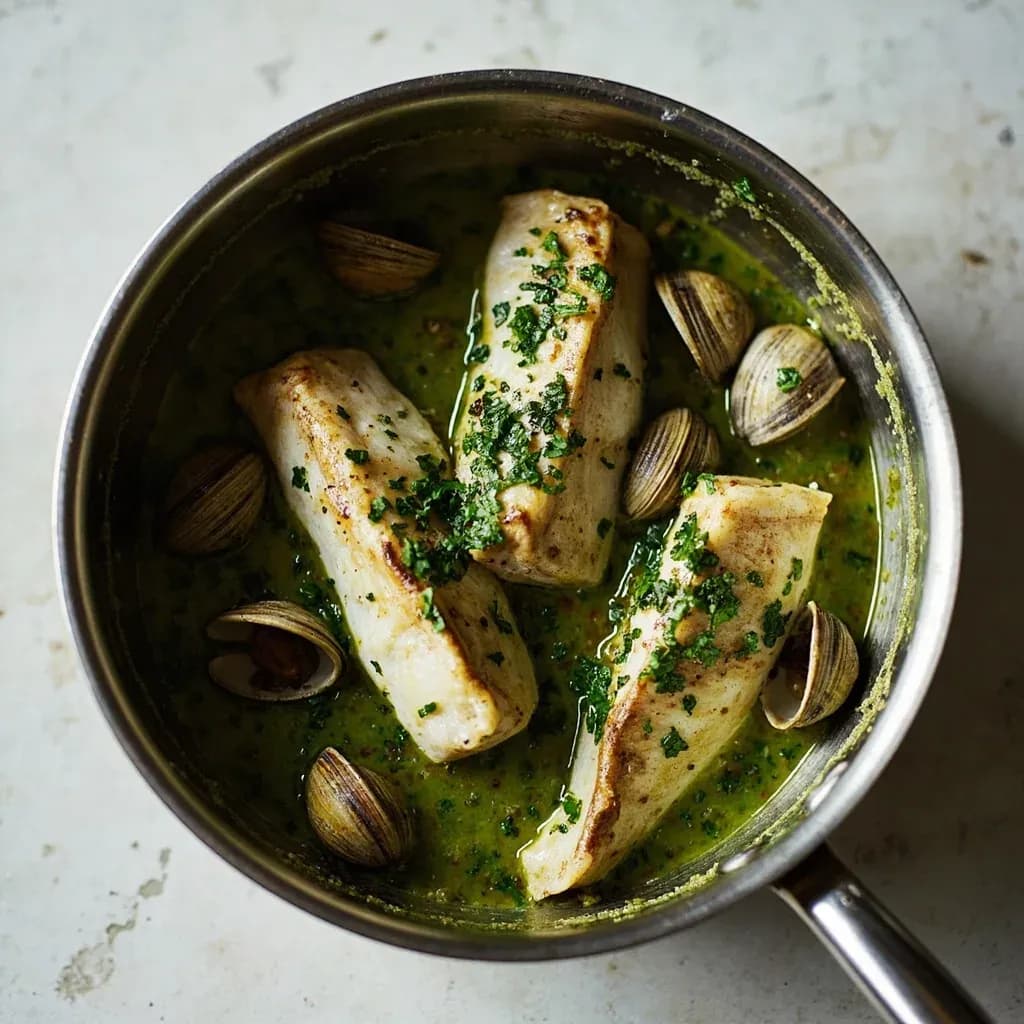
Cooking en salsa verde gently swirls fish or shellfish in a pan with olive oil, garlic, parsley, and a little stock or wine, agitating constantly so the fish gelatin and oil emulsify into a pale green sauce. The pan is shaken rather than stirred to build the velvety texture without separating. It is a Basque signature, classically used for hake and clams, and a la koskera refers to the version finished with peas, eggs, and asparagus.
Salsa verde, in the Basque sense of the phrase, is less a sauce than a method: a way of cooking delicate white fish in a shallow pool of olive oil, garlic, parsley, and stock while coaxing those liquids into a glossy, pale-green emulsion that clings to the fish and pools on the plate. The dish, almost always introduced as 'en salsa verde' (so-and-so in green sauce), is a cornerstone of Basque home cooking and the everyday backbone of the region's seafood repertoire. Its appeal is partly visual — that unmistakable herb-flecked sheen — and partly technical: when the emulsion is right, the sauce tastes far richer than its handful of ingredients would suggest, the oil carrying the perfume of parsley and wine rather than sitting heavy on the tongue. The technique belongs in the water-and-steam category because the fish is essentially poached in a flavored, oily liquid at the barest simmer; the sauce is simply what is left in the pan when the poaching is done well.
The technique is a close cousin of pil-pil, the famous Basque emulsion made from the gelatinous juices of cod or hake, garlic, and oil. Salsa verde is what you get when you add parsley and a splash of white wine to that same logic. Because the fish cooks gently in liquid, the method suits any firm, lean white fish that would dry out under higher heat: hake, cod, turbot, sole, monkfish, and even shellfish opened directly in the pan. Master the meneado — the rhythmic tilt-and-scoop that binds oil to cooking juices — and you have a sauce that turns plain fish into something vivid and complete in well under half an hour, with bread or potatoes standing by to soak up the green juices.
- Difficulty
- Hard
Types & varieties
The canonical version; hake fillets poached in the green emulsion.
Salt cod, often desalted first, poached in the same style.
Turbot, a celebratory variation, often cooked on the bone for flavor.
Sole, filleted, very quick in the pan.
Monkfish medallions, sturdy enough to hold their shape in the sauce.
Clams opened directly in the sauce; overlaps with 'a la marinera'.
Mussels steamed in the parsley–garlic emulsion.
Small squid braised in the same style, common in coastal Basque homes.
How to do it
- 1
Prepare the fish
Clean and portion the fish into serving pieces. Salt lightly and let rest 10 minutes. Reserve heads, bones, and trim; if time allows, simmer them 15 minutes in lightly salted water with a bay leaf to make a quick fumet, then strain.
- 2
Infuse the oil
Warm a generous slick of olive oil in a wide, low-sided pan over low heat. Add the paper-thin garlic and cook gently, swirling, until just pale gold and soft — never browned. Pull the pan off the heat for a moment if the garlic threatens to color.
- 3
Lightly thicken
Sprinkle in a small pinch of flour and stir with a wooden spoon for about 30 seconds to form a loose, blond roux. This helps the sauce hold its emulsion; skip it for a more traditional texture or replace with a small piece of bread soaked in the cooking liquid.
- 4
Reduce the wine
Pour in a splash of dry white wine and let it bubble down by about half so the raw alcohol smell disappears.
- 5
Add fish and liquid
Lay the fish in the pan, skin-side down if using fillets. Add enough fumet (or lightly salted water) to come roughly halfway up the fish — it should not be submerged. Tuck in the parsley stems.
- 6
Build the emulsion
Bring to the gentlest possible simmer. Cook the fish uncovered, tilting the pan away from you and scooping the oil–juice mixture back over the fish in a steady rhythm (the meneado). After 6–10 minutes the sauce will turn glossy, pale green, and lightly thickened.
- 7
Finish with parsley
When the fish is just opaque and flakes at the touch, scatter the chopped parsley leaves across the pan. Give one last gentle swirl, take off the heat, and let rest 1–2 minutes so the sauce sets.
- 8
Serve
Spoon the fish into shallow warmed bowls, nap with the sauce, and bring to the table with patatas panaderas, boiled potatoes, or country bread to soak up the green juices.
The meneado: the whole technique in one motion
Salsa verde lives or dies by the meneado — the rhythmic tilt-and-scoop that builds the emulsion. Holding the pan by its handles, you tip it away from you so the oil pools at the far rim, then lift that oil back over the fish in a steady, repeating pour. The motion does two things at once: it keeps the fish basted so it stays moist, and it shears droplets of oil into the watery cooking liquid until the two phases bind. After 6–10 minutes of this, what was a separated, oily puddle becomes a glossy, slightly thickened sauce the color of spring grass.
The key is patience and rhythm, not force. A wooden spoon used for frantic stirring will not build the same emulsion and tends to break the fish. Keep the heat at the barest possible simmer — a single bubble breaking the surface now and then is plenty — because a rolling boil shatters the emulsion and toughens the protein. If the sauce looks thin and oily, you are not tilting fast enough or the heat is too high; if it looks greasy and split, the heat is too high. Done right, the sauce should coat the back of a spoon lightly and pool on the plate without running to the edges.
- Tilt the pan away from you, then scoop the pooled oil back over the fish in a steady, repeating motion.
- Keep the heat at a bare simmer — visible bubbles should be occasional, not constant.
- Never stir vigorously with a spoon; the emulsion is built by gentle shearing, not agitation.
- If the sauce splits, pull the pan off the heat and whisk a tablespoon of warm water into the oily parts to bring it back.
Salsa verde and pil-pil: same logic, different garnish
Pil-pil is the more austere of the two: cod or hake cooked slowly in oil with garlic until the fish's own gelatin emulsifies the oil into a trembling, ivory sauce. Salsa verde is pil-pil with two deliberate additions — a generous handful of parsley and a splash of white wine — and a slightly more relaxed attitude toward the fish. The wine adds acidity and a little extra liquid for the emulsion to grab onto; the parsley adds color, freshness, and the herbal note that gives the sauce its name.
Understanding the relationship is useful in the kitchen. If your pil-pil is breaking, you are working too hot or too fast; the same fix applies here. If you have a pan of pil-pil and want to turn it into salsa verde, finish with chopped parsley and a squeeze of lemon rather than cooking the parsley in from the start, which dulls its color. Some old recipes thicken the sauce with a slice of bread soaked in the cooking liquid (called 'sopa') instead of flour; it adds body and a faint, starchy sweetness that pairs well with hake.
Common uses
Tips & pitfalls
- Use the freshest fish you can — the sauce is naked and shows everything off, good and bad.
- Slice the garlic paper-thin so it softens in the oil without browning; browned garlic will dominate and turn the sauce bitter.
- Add most of the parsley at the very end so its color stays bright green and its flavor stays fresh; the stems can go in earlier for body.
- Master the meneado: tilt and swirl the pan rhythmically to bind the oil into the fish juices — this is the whole technique, not a finishing flourish.
- Keep the heat at a bare simmer; a rolling boil breaks the emulsion and toughens the fish.
- A small pinch of flour after the garlic helps stabilize the emulsion for nervous cooks, though traditional recipes often use a soaked slice of bread instead.
- Do not confuse this with Italian salsa verde (capers, anchovies, often served cold) or Mexican salsa verde (tomatillo-based) — they share the name, not the technique.
- Save fish bones and trimmings for a quick fumet; it makes a noticeable difference in the depth of the sauce.
Good to know
- Origin
- Basque Country (País Vasco / Pays Basque)
- Also known as
- A la vasca; merluza en salsa verde is the most common named form
- Defining ingredients
- Olive oil, garlic, generous fresh flat-leaf parsley, dry white wine, fish stock
- Classic protein
- Hake (merluza) — the canonical version
- Cooking method
- Gentle poaching/braising in an oil-and-stock emulsion
- Texture
- Glossy, emulsified, pale green, lightly thickened
- Active time
- About 10 minutes
- Total time
- 20–30 minutes
- Yield
- Sauce for 4 portions from roughly 600 g fish
- Traditional vessel
- Cazuela de barro (earthenware) or wide, low-sided copper or steel pan
- Related technique
- Pil-pil — the same oil-and-fish-gelatin emulsion; salsa verde is pil-pil with the addition of generous parsley, a splash of white wine, and usually a little stock
- Storage
- Best eaten immediately; refrigerated up to 1 day (re-emulsify gently when reheating)
Also called
a-la-koskera · en salsa verde · Basque green sauce
Related

Boil
Cook in vigorously bubbling liquid at full rolling heat

Simmer
Hold liquid at a gentle shimmer for tender, unhurried cooking

Poach
Cook gently in barely-trembling liquid for silky, tender results

Steam
Cook in rising vapor to keep color, nutrients, and shape intact

Blanch
Plunge briefly in boiling water, then shock cold to lock color

Braise
Sear, then cook slow in a little liquid until fall-apart tender

Stew
Simmer bite-sized pieces fully submerged into a rich, unified pot

Sous-Vide
Seal and cook in precise warm water for edge-to-edge doneness