Prep & Assembly
Sheeting (Rolling to Thickness)
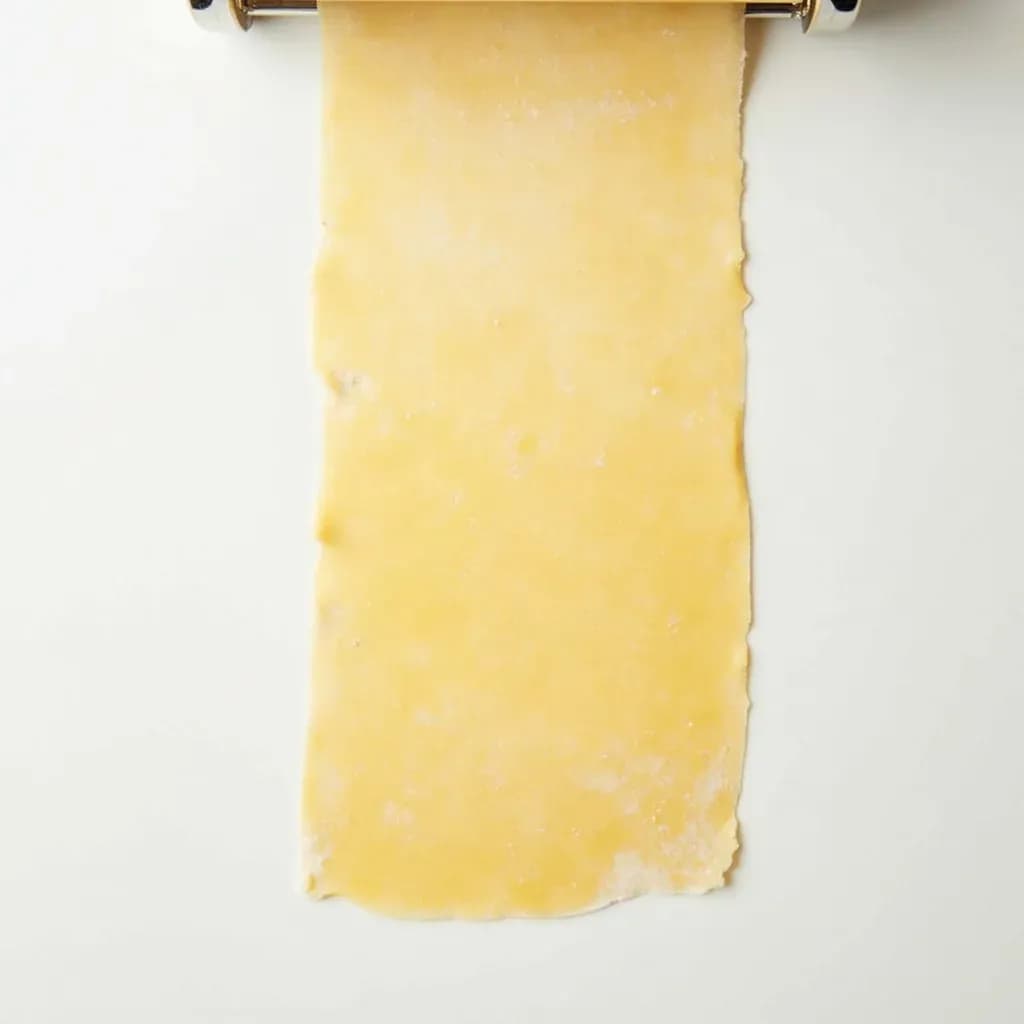
Rolling dough into an even sheet of a target thickness for pasta, pastry, or noodles.
Sheeting rolls dough through a pasta machine or with a pin into a uniform, controlled-thickness sheet. Consistent thickness ensures pasta, laminated pastry, or noodles cook evenly and shape cleanly. The dough is typically passed through progressively narrower settings, with rests to relax the gluten and prevent tearing or springback.
Sheeting is the controlled reduction of a dough to a uniform, predictable thickness — the foundation of even baking, consistent pasta, and successful lamination. Unlike a casual roll-out, it is done with a specific target number in mind, whether that is a 3 mm pie shell, a 1 mm fresh egg pasta, or a precise envelope for folding butter into puff pastry. The thickness of the sheet governs almost everything that happens next: how the dough bakes, how a filling cooks inside it, and whether layers of fat stay distinct or smear.
A rested, properly developed dough sheets easily; an unrested one fights back, springs, and tears. The technique works by repeatedly compressing the dough — under a pin, between two rollers, or through a hand-cranked pasta machine — so that the gluten network is stretched and aligned without snapping, and any fat in pastry or laminated dough remains in clean, even layers. The skill is less about force than patience: working in small reductions, resting when the dough resists, and keeping the surface lightly floured but never caked.
In professional kitchens the word "sheeting" usually means running dough through a mechanical roller, while "rolling" refers to a pin on the bench; at home the two are interchangeable. What matters is the result: a sheet that is the same thickness at the center as at the edges, the same from one pass to the next, and matched to the recipe's needs.
- Difficulty
- Medium
Types & varieties
Traditional method on a floured bench; best for pie and tart dough and rustic pasta. Harder to achieve perfect evenness without guides.
Hand-cranked roller with stepped thickness settings; the most reliable way to get uniform sheets for fresh egg pasta, dumpling wrappers, and noodles.
Rollers that fit onto a stand mixer such as a KitchenAid; identical results to a standalone pasta machine with easier cleanup and storage.
Motorized, conveyor-belt machine used in pizzerias, bakeries, and pastry shops; handles large batches and very stiff laminated doughs like croissant and puff pastry.
Repeated rolling and folding (single, book, or letter fold) to build hundreds of alternating dough-and-butter layers for puff pastry, croissants, kouign-amann, and Danish.
How to do it
- 1
Prepare the dough
Mix and bring the dough together, then shape it into a rough flat disc or short rectangle. Wrap tightly in plastic and refrigerate for at least 30 minutes — longer for laminated doughs — so the gluten relaxes and any fat firms up. Cold dough sheets cleanly; warm dough tears and sticks.
- 2
Set up the work surface
Wipe down a clean, cool bench. Lightly dust it and the dough with flour — use semolina or tipo 00 for fresh pasta, plain all-purpose for pastry. Have a bench scraper, a ruler or thickness guide, and your pin or machine within reach.
- 3
Rough out the dough
Press the dough flat with the heel of your hand, or give it a few firm whacks with a rolling pin, until it is roughly 1–1.5 cm thick. Trying to roll out a thick lump evenly from the start leads to ragged edges and a stretched-out center.
- 4
Begin rolling (by hand)
With a rolling pin, start at the center and push outward in gentle, even strokes. Rotate the dough a quarter turn every few passes, lift it with a bench scraper to dust underneath, and keep checking that the edges stay roughly square.
- 5
Begin rolling (pasta machine)
Set the rollers to their widest opening. Feed the dough through, fold it in thirds like a letter, and pass it through the same setting two or three more times. This smooths the dough, evens the texture, and squares off the shape before you begin reducing thickness.
- 6
Reduce thickness gradually
Lower the setting by one notch per pass — do not skip. Each pass aligns the gluten and relaxes it a little more. Aim for the target thickness listed in the recipe, and stop short if the dough begins to stick, tear, or spring back.
- 7
Rest if the dough resists
If the sheet shrinks, cracks at the edges, or goes tacky, wrap it and chill it for 10–15 minutes. Gluten tightening is the cause, not lack of flour. Resume sheeting once the dough is cold and pliable again.
- 8
Maintain shape and dust sparingly
Guide the sheet so it stays roughly rectangular. Re-dust the bench and dough very lightly only when sticking occurs; excess flour folds into the dough and toughens the final product, especially in fresh pasta and tender pastry.
- 9
For laminated doughs, fold and repeat
After the first envelope of butter has been enclosed and rolled out, perform the fold the recipe specifies — single, book, or letter — rotate 90°, and roll out to the same envelope size again. Repeat for the full number of turns, resting the dough in the refrigerator for 20–30 minutes between turns to keep the butter firm and the gluten relaxed.
- 10
Reach final thickness and use
Check the sheet against a ruler at the edges and center. Transfer it to a floured sheet pan, drape it over a pasta drying rack, or move it directly to its pan or mold. Cut, fill, fold, or bake according to the recipe — and if you are not using the sheet immediately, slide parchment between layers so they do not fuse.
Target thicknesses by application
Most recipes assume a thickness, not a visual estimate. Measuring with a ruler, dowel, or marked rolling pins for the first few attempts will train your eye far better than guessing, and it is the single biggest fix for uneven baking and inconsistent pasta.
- Pie and tart shells: 3–4 mm — thick enough to support a filling, thin enough to crisp.
- Puff pastry and rough puff: 4–5 mm before each fold; the sheet is reduced and re-extended many times.
- Croissant and Danish dough: similar to puff, kept cold at every stage.
- Fresh egg pasta: 1–1.5 mm for tagliatelle, pappardelle, and fettuccine; about 1.5 mm for lasagna sheets.
- Hand-cut Asian noodles and dumpling wrappers: 1.5–2 mm before folding and cutting.
- Crackers, lavash, and matzo: 2–3 mm for even baking and snap.
- Thin-crust pizza (sheeted): 3–4 mm for a crisp base that still has some chew.
- Cookie doughs (cut-out and slice-and-bake): an even 5–8 mm so every cookie bakes through at the same rate.
Why dough rests before — and between — sheeting
Every dough has elastic memory. The moment kneading stops, the gluten network is taut and will spring back the instant it is stretched. Resting lets the strands relax and the fat firm up, so the dough extends instead of recoiling. For most pasta and pastry, 30 minutes wrapped in the refrigerator is enough; laminated doughs need longer rests between each turn so the butter can re-chill and the gluten can recover. If a dough resists, gets tacky, or tears at the edges mid-sheet, that is the dough telling you it needs a 10–15 minute rest — not more flour, not more force.
Common uses
Tips & pitfalls
- Rest the dough — at least 30 minutes wrapped in the refrigerator — before you begin. Unrested dough shrinks, fights the pin, and tears.
- Reduce thickness in small steps. On a pasta machine, drop the setting one notch per pass; jumping from thick to final tears the gluten and rips the dough.
- Dust with semolina or tipo 00 for fresh pasta, not bread flour. The coarser flour sands the surface and keeps sheets from tearing as they thin out.
- Rotate the dough a quarter turn between passes, especially by hand. This keeps the sheet roughly square and prevents one side from cementing to the bench.
- Use a bench scraper to lift and reposition the dough. Grabbing and pulling stretches it unevenly and leaves you with a ragged, thin center.
- If the dough springs back, sticks, or tears at the edges, stop and rest it for 10–15 minutes. More flour or more pressure is the wrong fix.
- For laminated doughs, work cold and fast. If the butter softens and starts to smear into the dough layers, chill the whole sheet until firm before continuing, or the lamination will fail.
- Measure with a ruler the first few times you sheet. Eyeballed thickness is the most common reason for uneven baking, raw centers, and inconsistent pasta.
Good to know
- Definition
- Compressing dough into a uniform sheet of a specific target thickness, by hand with a rolling pin or mechanically with a pasta machine or dough sheeter.
- Common target thicknesses
- Pie and tart dough 3–4 mm; puff pastry 4–5 mm before folds; cracker dough 2–3 mm; thin-crust pizza 3–4 mm; fresh egg pasta 1–1.5 mm; lasagna sheets about 1.5 mm.
- Pasta machine settings
- A typical home machine runs from setting 1 (about 1.5 mm) to setting 7–9 (0.5–0.6 mm). Settings are not standardized across brands — a Marcato #7 is roughly an Imperia #6.
- Dough rest before sheeting
- Most doughs need at least 30 minutes wrapped in the refrigerator; laminated doughs benefit from longer rests between turns.
- Methods
- Hand rolling pin, hand-cranked pasta machine, stand-mixer pasta attachment, or commercial conveyor dough sheeter.
- Difficulty
- Beginner for single sheets of pastry or pasta; intermediate for laminated doughs and very thin pasta.
- Time
- A few minutes per sheet once the dough is rested; laminated doughs require one to two hours over multiple rest-and-roll cycles.
Also called
Sheeting Noodle Dough · Rolling to Thickness · Laminating Sheet
Dishes that rely on it





Related

Whisk
Beat ingredients smooth and aerated with a looping wire motion

Sift
Pass dry ingredients through mesh to aerate and remove lumps

Strain
Pour through mesh to separate solids from liquid for a smooth result

Filter
Pass liquid through fine material to clarify out the smallest particles

Rice
Press cooked potatoes through small holes for fluffy, lump-free texture

Mash
Crush soft cooked food into a rustic, creamy purée

Grind
Crush food into a coarse to fine texture, from spices to meat

Grate
Shred food into fine bits against a sharp-toothed surface