Water & Steam
Skimming Broth
Removing surface foam and fat from simmering stock for a clear broth.
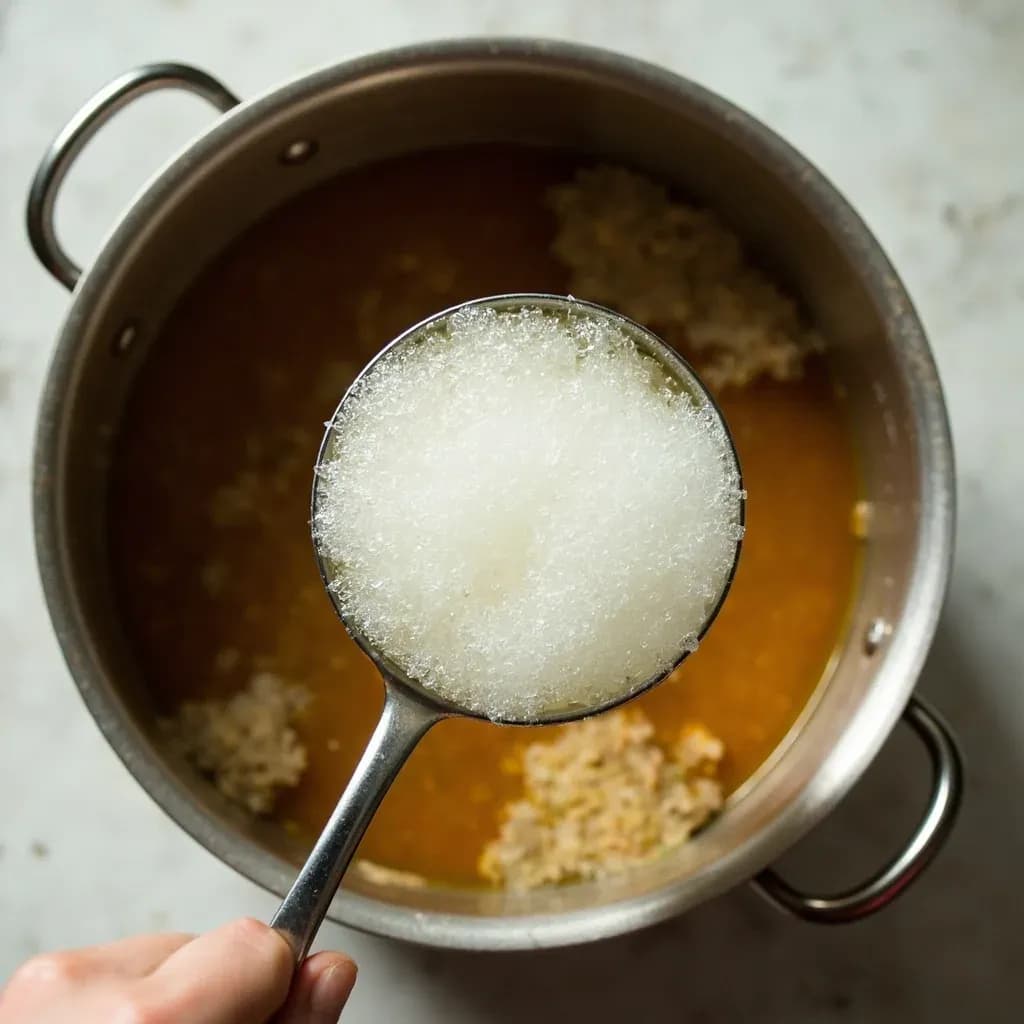
Skimming lifts the grey foam, scum, and rendered fat that rise to the surface of a simmering stock or broth, using a ladle or spoon. Removing these impurities keeps the finished liquid clear, clean-tasting, and free of off flavors. It is done most actively early in the simmer when proteins coagulate, and a bare simmer rather than a rolling boil keeps the broth from clouding.
Skimming is the quiet, unglamorous work that separates a clear, glossy stock from a cloudy, greasy one. As bones, meat, and aromatics simmer, dissolved proteins — mostly albumins — coagulate and rise to the surface as a gray-white foam, while rendered fat pools on top as a golden, translucent layer. Both are drawn off with a flat-edged ladle, fine-mesh skimmer, or similar tool, leaving behind a cleaner-tasting, better-looking liquid that holds reductions, sauces, and clear soups more gracefully.
The technique matters most in the first hour of cooking, when the bulk of the protein scum surfaces, though fat skimming continues throughout the simmer and is often finished cold once the stock has chilled. The pot must be held at a bare simmer, roughly 180–195°F / 82–90°C, because a rolling boil emulsifies fat into the liquid in tiny droplets that stay suspended and cloud the stock permanently. Done patiently, skimming can remove most surface fat before final straining and is the foundation of any clear broth, from a French consommé to a Vietnamese pho.
Skimming is a finishing discipline as much as a cooking step. It partners with a final pass through a chinois or cheesecloth-lined strainer, and in the most demanding applications — clear consommé, jewel-like aspic — it is followed by a separate clarification using an egg-white raft. Even a casual chicken stock, however, is markedly better for ten minutes of patient work at the start of the simmer.
- Difficulty
- Easy
Types & varieties
Lifting the gray-white protein scum that rises during the first stage of simmering
Removing the golden translucent layer of rendered fat, either hot with a ladle or cold once solidified
Pouring a thin stream of cold water or dropping an ice cube on the surface to re-coagulate lingering proteins and congeal fat into a liftable sheet
Dragging a folded paper towel across the surface to absorb fat — a common home shortcut
Pre-blanching bones, discarding the cloudy first water, and starting the stock over to eliminate most impurities before the main simmer
A separate step using an egg-white raft that pulls remaining suspended particles out of an already-skimmed stock
How to do it
- 1
Start cold and bring up slowly
Combine bones, aromatics, and cold water in a wide pot. Bring the liquid up to a bare simmer over medium-low heat; never a rolling boil. A slow climb gives proteins time to coagulate and float to the surface rather than staying suspended in the liquid.
- 2
Skim the first wave of foam
Within the first 10–20 minutes a gray-white foam gathers at the edges and center. Hold a flat-edged ladle or fine-mesh skimmer parallel to the surface and draw it across in one direction, lifting the foam into a discard bowl. Repeat until little new foam appears.
- 3
Manage the simmer
Adjust the burner so the surface barely trembles, with only an occasional bubble breaking through. Too vigorous a simmer breaks fat into tiny droplets that stay suspended and cloud the stock for the rest of the cook.
- 4
Skim intermittently for fat
Over the next 1–2 hours, rendered fat forms a golden layer on top. Use a shallow ladle, a fat-separator pitcher, or simply chill the stock and lift the solidified cap once it has firmed in the refrigerator.
- 5
Re-coagulate stubborn foam with cold water
If foam continues to rise late in the cook, pour 2–3 tablespoons of cold water around the inside edge of the pot. The temperature drop makes remaining proteins coagulate into a fresh raft on top, which is then easy to skim off in one pass.
- 6
Strain and finish
Strain the stock through a fine-mesh strainer, chinois, or cheesecloth-lined colander into a clean container. For consommé, proceed to an egg-white raft clarification. For a regular stock, cool quickly over an ice bath, lift the fat cap, and store.
Foam vs. Fat: Knowing What You're Lifting
The two substances skimming removes look and behave differently, and treating them as one job is the most common home-cook mistake. Protein scum is opaque, gray-white, and flecked, and it appears early and in volume. It should be lifted while the pot is hot and actively simmering, because foam that is left to disperse will settle back into the liquid and undo the work. Fat is translucent and golden, accumulates more gradually, and is far easier to handle once the stock has chilled and the fat has firmed into a solid cap.
- Protein foam: opaque, gray-white, flecked; remove hot, in the first hour
- Rendered fat: translucent, golden; can be removed hot or, more cleanly, after chilling
- A cold-water or ice-cube shock re-coagulates stubborn foam into a fresh raft that is easy to lift in one piece
- Chilling the finished stock lets you peel the entire fat cap off in a single sheet with a knife or your fingers
Equipment and Setup
The right pot and tool change everything. A wide, shallow pot exposes more surface area, so foam and fat collect in thin, liftable layers rather than thick drifts around the edges. A flat-edged ladle or a wide Chinese-style skimmer (sometimes called a spider) is more efficient than a round soup spoon, which tends to dig into the liquid and pull stock up with the scum.
- Wide, shallow pot for thin, easy-to-lift foam layers
- Flat-edged ladle or fine-mesh spider for skimming
- Chinois or cheesecloth-lined strainer for the final polish
- Fat-separator pitcher for hot fat removal without losing stock
- Heatproof bowl or jar for the discarded scum and fat (the fat can be strained and saved)
Common uses
Tips & pitfalls
- Bring the pot up to temperature slowly; a hard boil churns fat and proteins back into the liquid and produces a permanently cloudy stock.
- Skim early and often during the first hour, when the bulk of the foam rises; after that, switch to occasional fat skimming.
- Hold the ladle or skimmer flat and draw it across the surface in one direction rather than poking down into the broth.
- Use the widest, shallowest pot you can so foam collects in a thin, easy-to-lift layer instead of thick drifts around the rim.
- Add a spoonful of cold water to the surface if foam is hard to grab; it encourages particles to clump and rise again as a single raft.
- Chill the finished stock briefly to solidify the fat cap, which can then be peeled off whole — far cleaner than chasing fat across a hot surface.
- Save the skimmed fat after straining; it is excellent for sautéing vegetables, roasting potatoes, or enriching beans.
- For consommé, combine skimming with a classic egg-white raft clarification; skimming alone will not produce a fully clear consommé.
- Avoid over-skimming late in the cook once the liquid is clear; stripping away all fat can leave the mouthfeel thin in stocks meant to be sipped on their own.
Good to know
- Primary purpose
- Removes coagulated proteins (scum) and rendered fat from simmering stocks and broths to improve clarity, color, and flavor
- Composition of foam
- Mostly albumins and other proteins released from bones, meat, and connective tissue during the first simmer
- Heat requirement
- Bare simmer, 180–195°F / 82–90°C; a rolling boil emulsifies fat into the liquid and clouds the stock permanently
- When foam appears
- Within the first 10–30 minutes of simmering, tapering off after 1–2 hours
- Best equipment
- Flat-edged ladle, fine-mesh skimmer (spider), shallow wide pot, chinois, and optionally a fat-separator pitcher
- Time required
- Active skimming during the first 30–60 minutes, then intermittent attention through the cook
- French term
- Écumer (to skim); écumoire is the skimmer itself
- Yield effect
- Proper skimming can remove 80–100% of surface fat before final straining, and visibly improves clarity
Also called
skimming · degreasing
Dishes that rely on it

Related

Boil
Cook in vigorously bubbling liquid at full rolling heat

Simmer
Hold liquid at a gentle shimmer for tender, unhurried cooking

Poach
Cook gently in barely-trembling liquid for silky, tender results

Steam
Cook in rising vapor to keep color, nutrients, and shape intact

Blanch
Plunge briefly in boiling water, then shock cold to lock color

Braise
Sear, then cook slow in a little liquid until fall-apart tender

Stew
Simmer bite-sized pieces fully submerged into a rich, unified pot

Sous-Vide
Seal and cook in precise warm water for edge-to-edge doneness