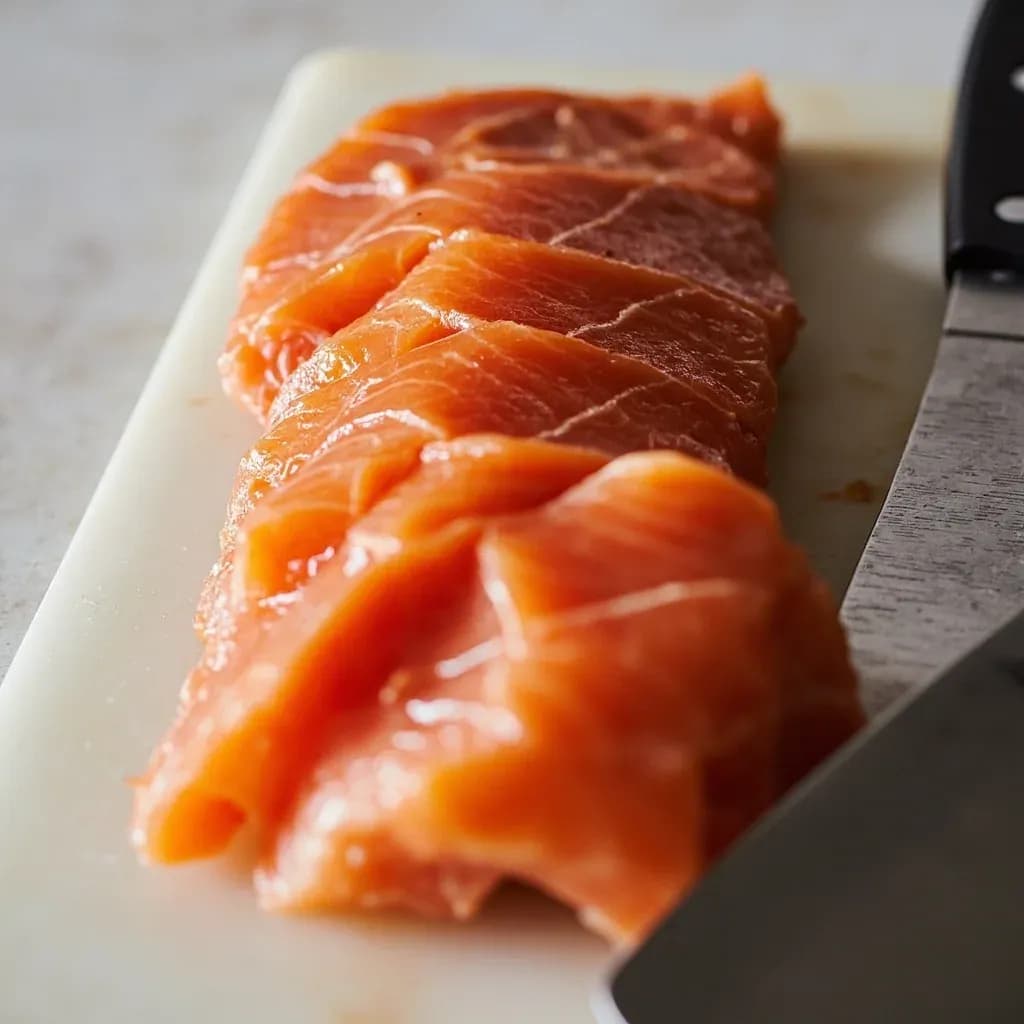
Knife Skills
Steaking (Cross-Cutting)
Cutting a large fish or roast crosswise through the bone into thick portioned steaks.
Steaking cuts a whole round fish or a large roast crosswise, straight through the spine or bone, into thick cross-section portions. Unlike filleting, the bone is left in, which keeps the portion intact and adds flavor and moisture during cooking. It is used on fish like salmon, swordfish, and tuna, and typically calls for a heavy knife or cleaver to cleanly part the backbone.
Steaking, in the butchery sense, is the act of slicing a bone-in primal or whole fish crosswise into uniform portions — each cut passing straight through the central bone so that the finished piece carries a cross-section of vertebra, rib, or loin bone. It is the technique that turns a whole tuna into a stack of round steaks, or a standing rib roast into a row of bone-in ribeyes. Done well, the slices are of equal thickness, the bone is cleanly fractured rather than shattered, and the surrounding flesh or meat is left with a tidy, bruise-free edge.
The defining characteristic — leaving the bone inside the portion — is what separates steaking from filleting (which removes bone entirely) and from portioning a boneless primal. Keeping the bone is not just decorative: it acts as a structural anchor during high-heat cooking, prevents the flesh from flaking apart when flipped on a grill, contributes marrow and collagen to the pan juices, and gives the cook a natural handle for plating and eating. The trade-off is that every cut must meet the bone squarely, which requires a heavier tool and a steadier hand than boneless portioning.
- Difficulty
- Medium
Types & varieties
Cross-cutting a gutted, scaled whole fish through the vertebral column. Produces round or oval steaks with the spine visible in cross-section; classic for tuna, swordfish, salmon, and halibut.
Cutting between the ribs of a bone-in primal — ribeye, pork loin, veal rib, lamb — to produce bone-in chops or steaks with the rib bone running through one side.
Steaks cut at roughly 2 in (5 cm) or more, often called a double-cut or extra-thick chop. Slower to cook through but forgiving over high heat because the interior stays moist while the exterior develops a deep crust.
A thinner cross-section of a small fish such as trout; the French term distinguishes a slim slice from a true 'steak' cut on a large round fish.
How to do it
- 1
Chill and prepare the item
If working with fish, gut, scale, and rinse it, then chill until very firm — 15 to 30 minutes in the freezer, or several hours well-chilled in the refrigerator. For roasts, leave the bone-in primal cold and pat it dry. Cold tissue slices cleaner through bone and sheds less liquid as you cut.
- 2
Identify the bone line
Lay the fish or roast on a stable, non-slip board (a damp towel under the board keeps it from skating). For a fish, locate the dorsal line where the vertebral column runs from head to tail. For a roast, identify the rib bones or the feather bones of the loin. Mark portion width by eye or with a small nick — typically 1 to 1.5 in for fish, 1 to 2 in for meat.
- 3
Set up the knife and grip
Use a heavy chef's knife (8 to 10 in), a Chinese-style cleaver, or a butcher's knife. Grip the handle firmly with the dominant hand; place the non-cutting hand in a claw grip or rest it on the far end of the fish to steady it. The blade must be sharp — a dull edge glances off bone and is the most common cause of slips.
- 4
Position the blade perpendicular to the bone
Hold the knife straight up and down so the edge meets the bone at roughly 90°. Any tilt will cause the cut to drift off the portion mark as it passes through the dense center, leaving you with wedges rather than rounds.
- 5
Cut with a controlled sawing motion
Apply steady downward pressure while drawing the blade back and forth — let the edge do the work, not your body weight. For fish, a single firm pass through the vertebra is usually enough. For meat with rib bones, you may need to cut from both sides of the bone and meet in the middle.
- 6
Finish dense bone with a saw if needed
If the blade stalls on a thick rib or vertebra — typical with mature beef, pork, or veal — switch to a butcher's saw, or finish the cut with a cleaver tapped with a wooden mallet. Forcing a knife through is the fastest way to chip an edge or lose control.
- 7
Trim and re-chill the steaks
Snip away any stray pin bones, fin fragments, or ragged edges with kitchen shears. Pat the steaks dry and return them to the refrigerator on a tray, uncovered if you want to dry the surface further. Dry fish or meat sears better and holds together on the grill.
Why Cut Through Bone?
Bone is not an obstacle to work around — it is the reason to steak. The vertebra or rib running through each portion does four jobs at once: it reinforces the flesh so a tuna round or veal chop can be flipped on a hot grill without falling apart; it contributes gelatin and marrow to the cooking liquid, which deepens sauce and pan drippings; it gives the cook and the diner a natural handle for plating and eating; and it signals the cut's identity on the plate, where a clean cross-section of bone reads as confident butchery. The exception is small, delicate fish — trout, smelt, small mackerel — where the vertebra is too fine to matter and a cross-section is properly called a tranche rather than a steak.
- Bone acts as a structural anchor during high-heat cooking
- Marrow and collagen from the bone enrich pan juices and sauces
- The exposed bone gives a clean, recognizable presentation
- Steaking standardizes cook time across a batch of evenly sized portions
Common uses
Tips & pitfalls
- Chill the fish or roast until very firm before cutting — cold tissue resists tearing and gives cleaner edges through bone.
- Use a knife you are prepared to dedicate to bone work: a heavy chef's knife, a Chinese-style cleaver for fish, or a butcher's knife. A thin slicing knife will skate off bone and is dangerous here.
- Saw through the bone rather than chopping straight down with body weight — forced pressure chips blades and causes slips.
- For very thick or dense bones (mature beef, pork, veal), score along the cut line with a boning knife first, then finish with a cleaver or butcher's saw.
- Keep the non-cutting hand in a claw grip well clear of the line of cut; bone can deflect the blade sideways.
- Wipe the blade between cuts — bone dust, blood, and oil reduce friction and obscure your sightline.
- If cutting a long fish, work from head to tail and recheck the line between cuts so portions don't taper unevenly.
- Portion fish before cooking. Overcooked fish is fragile and will fall apart at the bone when handled.
Good to know
- Category
- Knife Skills / Portioning
- Cut direction
- Crosswise, perpendicular to the spine or central bone
- Typical thickness
- 1–1.5 in (2.5–4 cm) for fish; 1–2 in (2.5–5 cm) for meat
- Key tool
- Heavy chef's knife, cleaver, or butcher's saw for dense bone
- Skill level
- Intermediate — requires controlled force through bone
- Preserves
- Central vertebra or rib bone for presentation, handling, and flavor
- Common fish used
- Tuna, swordfish, salmon, halibut, mahi-mahi, large cod
- Common meat used
- Bone-in ribeye, pork loin, veal rib, lamb
Also called
Steaking (Cross-Cutting) · Fish Steak Cutting · Cross-Cutting · Steak Cutting
Related

Chop
Cut into rough, irregular pieces — the everyday workhorse cut

Dice
Cut into uniform cubes for even cooking and a tidy look

Mince
Cut as fine as possible so flavor melts evenly into the dish

Slice
Cut into even, flat pieces for consistent cooking and presentation

Julienne
Cut into thin matchsticks for fast cooking and elegant garnish

Brunoise
Cut into tiny, precise cubes — the finest dice in the kitchen

Chiffonade
Roll and slice leafy greens into delicate ribbons

Batonnet
Cut into tidy sticks, thicker than julienne — think classic fries