Water & Steam
Steaming in Leaves (Hervir Hallacas)
Boiling or steaming food parcels wrapped in plant leaves so they cook moist and infused with aroma.
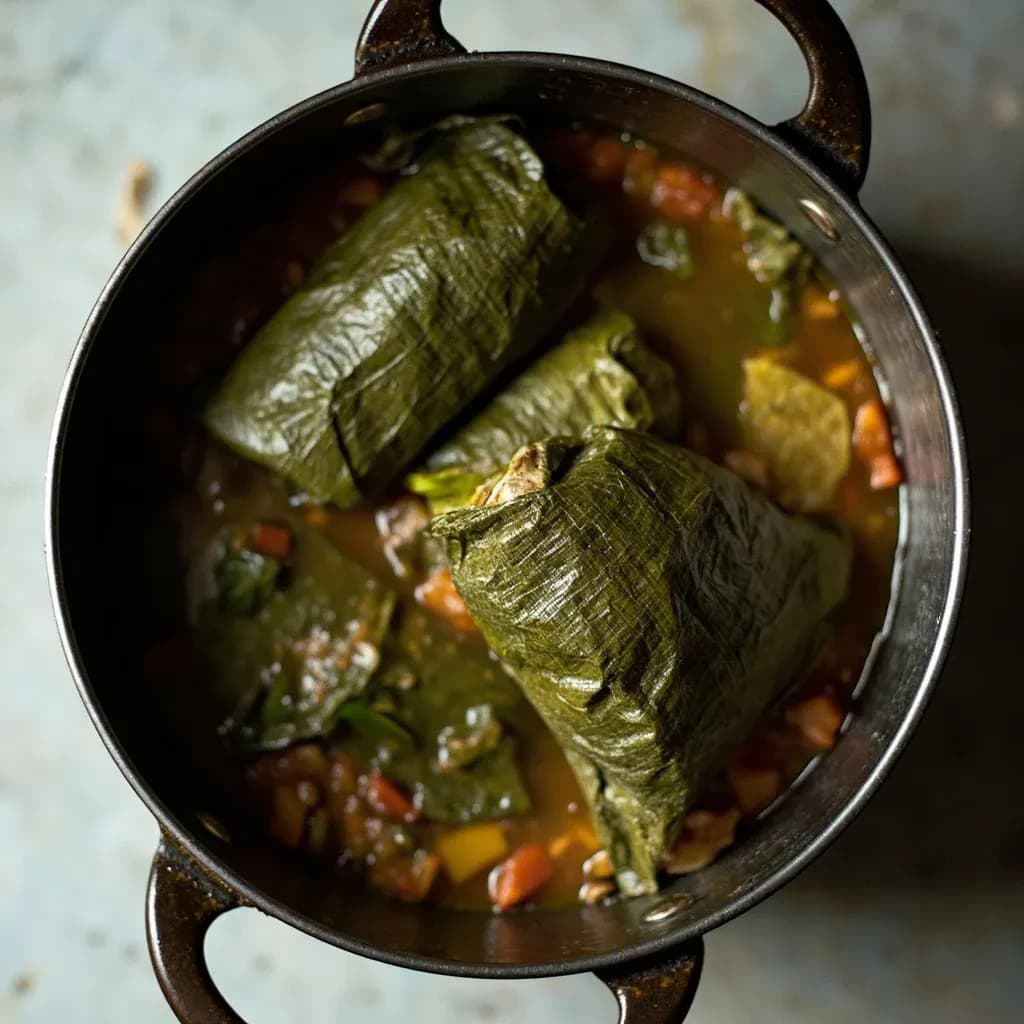
This technique wraps a filling, such as the cornmeal-and-stew hallaca, in plantain or banana leaves, ties the parcels, and boils or steams them until cooked through. The leaves hold the parcel together, keep it moist, and lend a subtle vegetal aroma to the contents. It is central to dishes like Venezuelan hallacas and tamales, where the wrapping is both the cooking vessel and part of the flavor.
Hervir hallacas — literally "boiling hallacas" — is the gentle, submerged-boil cooking stage that finishes a stuffed masa parcel wrapped in plantain or banana leaves. The technique is the closing act of a much older Andean and Caribbean ritual: a thin, seasoned corn dough (masa) is spread on a leaf, topped with a savory or sweet filling, folded into a flat envelope, tied, and then cooked in plenty of lightly salted water for roughly an hour. The leaf is not just packaging; it is part of the cooking medium, releasing a faint grassy perfume and trapping the filling's steam so the masa sets soft, moist, and tender rather than drying out or browning as it would in an oven or pan.
The method matters because masa is unforgiving. Too much direct heat hardens the outer layer before the center cooks through; too little leaves a gummy, raw-tasting core. A steady, fully submerged boil distributes heat evenly on every face of the bundle while the leaf keeps water away from the dough itself, essentially turning each parcel into its own little steamer. The result is a pillow of corn with a fully cooked, tender interior and a wrapper that peels away clean — the textural signature of a properly boiled hallaca or its regional cousins.
In practice, the cook's real work happens before the pot: softening the leaves so they don't crack, portioning the masa and filling so the bundle holds its shape, and tying tightly enough to seal but loosely enough that the dough can expand. Once the bundles are in the water, the technique is forgiving — a steady medium boil, a timer, and a short rest are usually all that stands between a good hallaca and a great one.
- Difficulty
- Medium
Types & varieties
The classic Christmas parcel: plantain leaf over a corn-husk lining, filled with a beef-and-pork guiso sofrito of olives, capers, raisins, onions, and annatto-colored broth.
Valle del Cauca and Eje Cafetero version; often a simpler stew filling, with sweet variants made with guava paste and cheese.
Highland Andean take, traditionally tied with piola or pita and frequently steamed in a steamer rather than boiled.
South-Andean cousin of fresh-ground sweet corn wrapped in corn husks, boiled or steamed by the same principle.
Caribbean relative using a masa of green banana, yautía, and potato wrapped in banana leaves, boiled in the same manner.
Other Latin American leaf-wrapped corn parcels that share this submerged-boil finishing technique.
How to do it
- 1
Soften and trim the leaves
Pass each plantain leaf over a gas flame or dip it in a pan of hot water until it turns bright green and pliable, about 10–20 seconds per side. Pat dry. Lay the leaf shiny side up and slice the stiff central rib flush with a paring knife so the leaf lies flat. Cut a roughly 15 cm square of corn husk and lay it on top of the leaf as a second layer.
- 2
Portion the masa
Place 3–4 tablespoons of seasoned corn dough in the center of the husk-and-leaf stack. Press it outward with a spoon dipped in water or oil to form a thin, even rectangle about 12 × 10 cm, leaving a 2 cm border on all sides.
- 3
Add the filling
Spoon 1–2 tablespoons of cooled filling (in Venezuela, a beef-pork guiso with olives, capers, raisins, and sofrito) in a strip down the center of the flattened masa. Keep the filling off the borders or it will leak into the water during boiling.
- 4
Fold the parcel
Fold the long sides of the plantain leaf over the masa so they overlap in the middle. Fold the short ends in like an envelope, then roll the whole bundle snugly in the same direction as the long seam. The result should be a flat, tight rectangle with no exposed masa.
- 5
Tie the bundle
Wrap cotton kitchen twine around the bundle once lengthwise and once crosswise, finishing with a secure knot on top. Leave a long tail to use as a handle for lifting the bundle out of the pot. Repeat with the remaining masa and filling.
- 6
Boil in salted water
Fill a wide stockpot with enough lightly salted water to cover the bundles by at least 5 cm and bring it to a full rolling boil. Lower the bundles in, weight them with a heat-safe plate if they float, and return the pot to a steady medium boil. Cook 50–75 minutes, depending on size — a vigorous boil will tear the leaves.
- 7
Rest and serve
Lift the bundles out by their string handles and set them on a tray. Cover with a clean kitchen towel and rest 10–15 minutes so the masa finishes setting and the leaf releases more easily. Unwrap at the table and serve hot, traditionally with pan de jamón, ensalada de gallina, or a spoonful of ají.
Why a Boil, Not a Steamer?
In Venezuela the bundles are traditionally lowered into a wide stockpot of bubbling water rather than set on a rack over it. The submerged boil evens out the temperature differential that plagues a vertical steamer, where the top parcels cook faster than the bottom ones. Because each hallaca is sealed in its own leaf, the water never actually touches the masa — it heats the leaf, the leaf steams the interior. The result is uniform doneness across a full pot of parcels, which is critical when a single household may be cooking several dozen at once during the December season.
The Role of the Leaf
Plantain and banana leaves are doing three jobs at once: they are a waterproof wrapper, a flavoring agent, and a structural form. A raw leaf is stiff and brittle and will crack the moment you try to fold it, which is why cooks pass it briefly over a flame or dip it in hot water to make it pliable. Once softened, the leaf becomes a moisture barrier, a gentle steam chamber, and an aromatic layer that lends the masa a faint vegetal perfume you can smell the moment the bundle is opened. A torn leaf lets water into the masa and lets the filling leak out, so leaf preparation is not a cosmetic step.
Common uses
Tips & pitfalls
- Briefly pass plantain leaves over an open flame or dip them in hot water for 10–20 seconds before assembly; stiff leaves crack under folding and let water in.
- Trim the central rib of each plantain leaf flush with a knife so the bundle lies flat and ties evenly without a lumpy edge.
- Always double-wrap with a corn-husk square inside the plantain leaf — it prevents tears and adds a subtle corn aroma to the masa.
- Portion by feel: about 3–4 tablespoons masa and 1–2 tablespoons filling per bundle; overstuffed parcels burst open in the boil.
- Tie with a cross-knot plus a long loop handle so bundles can be lifted out cleanly and the twine doesn't crush the masa.
- Bring the water to a full rolling boil BEFORE lowering the bundles, then keep it at a steady medium boil — too vigorous and the leaves tear, too cool and the masa stays gummy.
- Don't pierce the bundles to test them; if you must probe, aim for a side seam, not the top, and trust the clock (50–75 minutes) over guesswork.
- Let cooked bundles rest 10–15 minutes in a covered pot before unwrapping — the masa finishes setting and the leaf peels away more cleanly.
- Save the cooking water for soups, beans, or rice; it picks up a light vegetal note from the leaves that is genuinely useful.
- Freeze cooked bundles in their leaves, then thaw and re-steam to serve; microwaving makes the masa tough and rubbery.
Good to know
- Spanish name
- Hervir hallacas (boiling hallacas)
- Primary origin
- Venezuela, with parallel traditions in Colombia, Ecuador, Bolivia, and the Caribbean coast
- Wrapping leaf
- Plantain leaves (hojas de plátano); banana leaves work as a substitute
- Secondary wrap
- Corn husks (hojas de mazorca), layered inside the plantain leaf to prevent tears and add flavor
- Tying material
- Cotton kitchen twine or natural-fiber string
- Cooking medium
- Abundant lightly salted boiling water, fully submerging the bundles
- Cooking time
- 50–75 minutes once the water returns to a boil, depending on bundle size
- Target internal temperature
- 75–80 °C / 165–175 °F at the center of the masa
- Shelf life after cooking
- 3–4 days refrigerated or up to 2 months frozen, leaves kept on
- Occasion
- Christmas and New Year table, especially in Venezuela; commonly a family-group preparation
Also called
hervir hallacas · leaf-wrapped steaming · boiling hallacas
Dishes that rely on it
Related

Boil
Cook in vigorously bubbling liquid at full rolling heat

Simmer
Hold liquid at a gentle shimmer for tender, unhurried cooking

Poach
Cook gently in barely-trembling liquid for silky, tender results

Steam
Cook in rising vapor to keep color, nutrients, and shape intact

Blanch
Plunge briefly in boiling water, then shock cold to lock color

Braise
Sear, then cook slow in a little liquid until fall-apart tender

Stew
Simmer bite-sized pieces fully submerged into a rich, unified pot

Sous-Vide
Seal and cook in precise warm water for edge-to-edge doneness