Prep & Assembly
Seasoning Sushi Rice
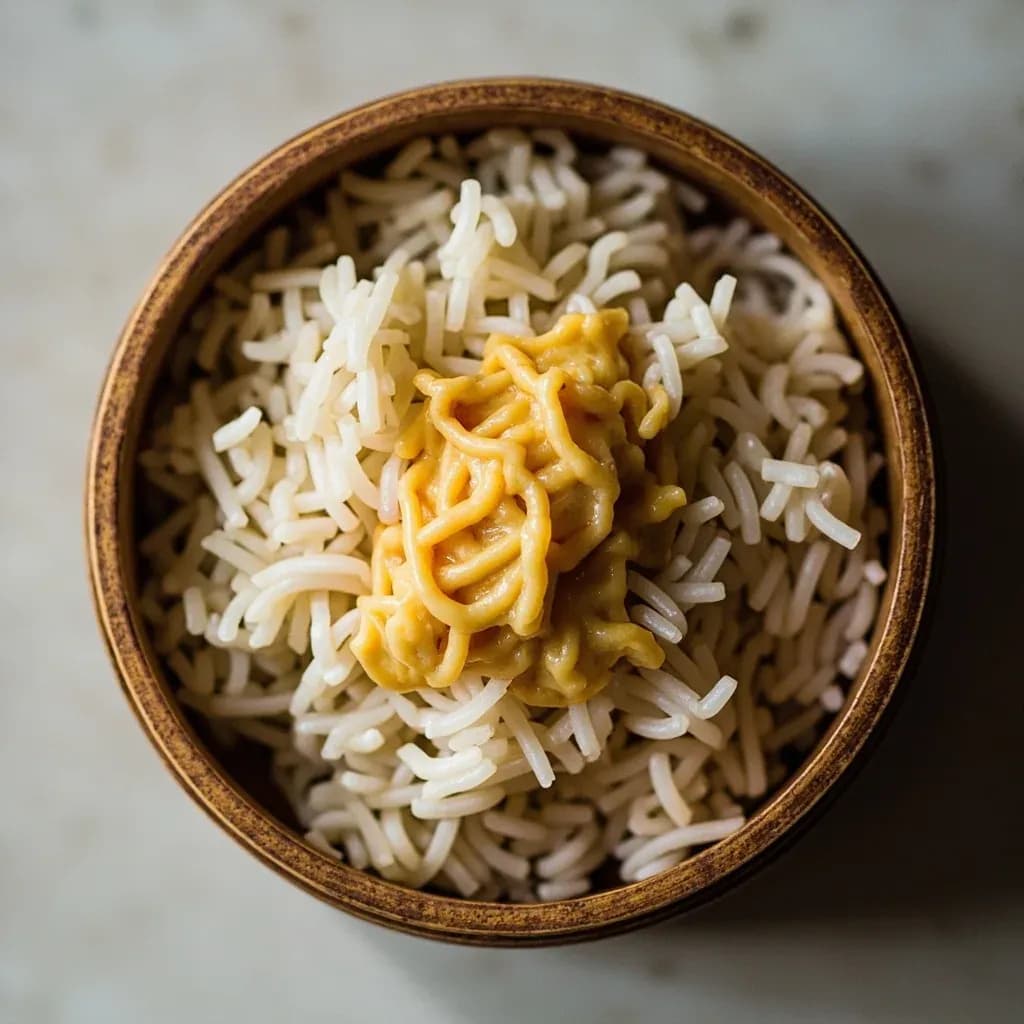
Folding a vinegar, sugar, and salt mixture through hot rice to make shari.
Seasoning sushi rice cuts a warm dressing of rice vinegar, sugar, and salt through just-cooked rice with a slicing-and-folding motion while fanning it to cool, producing glossy, lightly tangy shari. The folding seasons the grains without mashing them, and fanning sets a slight sheen and removes excess steam. The finished rice should be at body temperature, seasoned, and just sticky enough to mold.
Seasoning sushi rice — turning plain steamed Japonica into shari — is the quiet foundation of nearly every style of Japanese sushi. The technique is deceptively simple: a warm dressing of rice vinegar, sugar, and salt is folded through hot cooked rice so each grain is evenly coated, glossy, and just sticky enough to hold a shape without turning to paste. Done well, the rice is the seasoning's equal partner with the fish or vegetable on top; done poorly, it collapses the dish regardless of what sits on it.
The dressing works because the rice is still hot and cooked a touch firmer than usual when it is applied. Steam carries off excess moisture while the warm grains absorb the vinegar solution quickly and evenly, which is why seasoned rice is glossy rather than soggy. The cut-and-fold motion with a flat paddle, paired with fanning, is what preserves the integrity of each grain and gives shari its characteristic sheen. A hangiri (wooden tub) helps because porous cypress wicks surface moisture that a metal or plastic bowl would trap.
Mastering the seasoning comes down to timing, temperature, and restraint. Most home cooks under-salt (the rice tastes flat under fish) or over-wet the grains (they smear like oatmeal), and almost everyone works the rice too aggressively. Once you understand that you are dressing, not mixing, the rest is repetition.
- Difficulty
- Medium
Types & varieties
Slightly more salt and a sharper, tangier profile; the Tokyo standard
Sweeter, with more sugar and a milder acidity; common around Osaka
Vinegar infused with a strip of dried kombu for umami depth; strained before use
Part of the sugar replaced with mirin for rounder sweetness and a softer gloss
Modern variation with a small amount of yuzu, sudachi, or lemon juice for aroma
Slightly more liquid and a touch more sugar to balance the bran; uses short-grain brown rice
How to do it
- 1
Cook and rest the rice
Rinse short-grain Japanese rice in several changes of water until it runs nearly clear, then drain. Cook with a slightly firmer ratio than usual (about 1 : 1.1 rice to water by volume) so the grains hold up under the dressing. Cover and rest 10 minutes so moisture equalizes.
- 2
Prepare the sushi-zu
Combine rice vinegar, sugar, and salt in a small saucepan with an optional 5 cm strip of kombu. Warm gently over low heat, swirling, just until the sugar and salt fully dissolve — do not boil. Lift out the kombu and keep the dressing warm.
- 3
Transfer to a hangiri or wide bowl
Tip the hot rice into a wooden hangiri, or a wide non-reactive glass or stainless bowl. Do not pack it; keep the grains loose and exposed.
- 4
Pour and cut the dressing in
Drizzle the warm sushi-zu slowly around the inside rim of the bowl, a little at a time, rather than pooling it in the center. With a shamoji, slice vertically through the rice, sweep under, and fold it over. Cut and fold — never stir or press.
- 5
Fan and fold to a gloss
Fan the rice continuously with a hand fan or piece of cardboard while you work. Keep cutting, folding, and fanning for 2–3 minutes until every grain is evenly coated, the surface looks glossy, and excess moisture has evaporated.
- 6
Cool and cover
Continue folding briefly until the rice has cooled to about body temperature (≈ 35 °C / 95 °F) and is no longer steaming. Drape a dry, lint-free cloth or the hangiri lid over the top — not a tight-fitting lid. Use within 1–2 hours; do not refrigerate.
The texture you're aiming for
Properly seasoned shari should look like wet, polished pebbles: each grain is distinct and visible, the surface glossy but not wet, and a small clump pressed between your fingers holds its shape and then breaks apart cleanly. If it smears like oatmeal, the rice has been overworked, over-wet, or both. If grains slide off each other completely, the dressing was too thin or the rice was too cool when seasoned. Tasting a cooled pinch before assembling is the only reliable check — you want a clean salt-sweet-acid balance with a quiet, rice-vinegar finish that does not shout over the topping.
Scaling and timing
Work in batches no larger than about 4 cups of cooked rice at a time. Larger piles cool unevenly in the center, meaning outer grains are already past body temperature while the interior is still too hot and steamy to fold. Scale the dressing linearly: for every cup of uncooked rice, the 4:2:1 ratio holds. Keep cooked rice covered with a damp cloth between batches so it does not crust, and re-cover the finished shari the same way. Seasoned rice holds well at room temperature for 1–2 hours; after that it dries, dulls, and should not be revived with more vinegar.
Common uses
Tips & pitfalls
- Cook the rice a touch firmer than package directions; seasoned rice needs to hold its shape, not turn to porridge.
- Always dissolve the sugar and salt in the vinegar over gentle heat first — sprinkling dry crystals over hot rice will not distribute evenly and can leave gritty pockets.
- Pour the sushi-zu around the inside wall of the hangiri, not directly onto the rice, to avoid puddles that soak and break the grains.
- Use a cut-and-fold motion with the shamoji; stirring or mashing smears the starch and turns shari into a paste.
- Fan while you fold — moving air drives off surface moisture and is what gives seasoned rice its characteristic sheen.
- Dress the rice while it is still very hot so grains absorb the vinegar evenly; rice that has cooled past warm will sit on the surface and taste sharp outside, flat within.
- Season conservatively; you can always finish with a splash more vinegar, but excess salt cannot be removed.
- Cover finished shari with a damp (not wet) cloth — a tight lid traps steam and makes the top layer gummy, while a cloth keeps the surface workable for 1–2 hours.
- Never refrigerate seasoned rice; chill kills the gloss, hardens the grains, and dulls the vinegar.
- If you can, use a hangiri — the wood wicks surface moisture and noticeably improves sheen compared with plastic or metal.
Good to know
- Japanese name (rice)
- Shari (しゃり); also called sumeshi when the seasoned rice is mixed in
- Japanese name (dressing)
- Sushi-zu or sushi-su — the vinegar, sugar, and salt mixture
- Core ratio (per 1 cup / 200 g uncooked rice)
- ≈ 4 Tbsp rice vinegar, 2 Tbsp sugar, 1 tsp salt (≈ 60 ml / 24 g / 6 g)
- Best rice
- Short- or medium-grain Japonica (Koshihikari, Calrose, or rice labelled sushi rice)
- Yield
- 1 cup uncooked rice yields ~3 cups cooked — enough for 3–4 rolls or 12–15 nigiri
- Active time
- 5–8 minutes of seasoning after the rice has cooked and rested 10 minutes
- Target temperature
- Cool to body temperature (~35 °C / 95 °F) before shaping
- Traditional tools
- Hangiri (cypress tub) and shamoji (flat rice paddle)
- Origin
- Edo-period Japan, c. 1820s, alongside Hanaya Yohei's hand-pressed nigiri
Also called
Seasoning Sushi Rice · Shari Making · Sushi Rice Dressing
Related

Whisk
Beat ingredients smooth and aerated with a looping wire motion

Sift
Pass dry ingredients through mesh to aerate and remove lumps

Strain
Pour through mesh to separate solids from liquid for a smooth result

Filter
Pass liquid through fine material to clarify out the smallest particles

Rice
Press cooked potatoes through small holes for fluffy, lump-free texture

Mash
Crush soft cooked food into a rustic, creamy purée

Grind
Crush food into a coarse to fine texture, from spices to meat

Grate
Shred food into fine bits against a sharp-toothed surface