Transform & Preserve
Texturizing / Restructuring
Binding small pieces of food into a new uniform shape with binders or transglutaminase.
Texturizing, or restructuring, reassembles trimmings or small pieces into a cohesive new form using binders such as transglutaminase, alginate, or protein gels. It is used to make uniform fish portions, meat rolls, and plant-based products with consistent cooking behavior. The technique reduces waste while delivering a predictable bite and shape.
Texturizing, also called restructuring, is the craft of taking small or irregular pieces of protein — trim, off-cuts, slices, or minced flesh — and reassembling them into a new shape that holds together as a single piece. The cook's toolset runs from classical binders (egg, gelatin, starch) that hold particles in a molded mass, to enzymatic bonding with transglutaminase, which fuses muscle proteins directly into a continuous, whole-muscle-like piece. The result can be a uniform steak rebuilt from scraps, a terrine that slices clean, or a geometric mosaic of chicken or fish that holds its shape under the heat of a pan.
The technique matters for three reasons: economy, presentation, and control. Trim that would otherwise be ground or stewed becomes a sellable portion; thin or fragile proteins that would fall apart on the pass become easy to handle; and the cook can engineer a finished texture and shape that no single primal would naturally yield. The modern enzymatic method, built on microbial transglutaminase commercialized by Ajinomoto in the late 1980s and 1990s, gave the technique a new power — pieces can be joined so cleanly that the seam is invisible after cooking, and the bond actually strengthens with heat.
Behavior depends on the binder. Egg and starch hold a forcemeat together by forming a set matrix around the particles; gelatin does the same via a protein gel that sets on chilling; agar produces a firmer, vegan-friendly gel that sets at room temperature once cooled. Transglutaminase is different: it catalyzes a covalent bond between glutamine and lysine residues on neighboring proteins, fusing surfaces at the molecular level rather than merely gluing them. That is why TG-bonded pieces can be sliced like a single muscle, while egg-bound forcemeats slice as a textured loaf. The two lineages — traditional binders and enzymatic restructuring — are often lumped together as "texturizing," but they produce different end results and the cook should know which tool to reach for.
- Difficulty
- Hard
Types & varieties
Enzymatic; bonds protein-to-protein directly. Sold as powder (RM for red meat, WM for poultry/fish, GS for general use) or in sheet form.
Traditional protein-based binder; bloomed and dissolved in warm liquid; sets on chilling. Standard for forcemeats and terrines.
Vegan-friendly polysaccharide; must be boiled to activate; sets firmly at room temperature once cooled. Common in vegetable restructurings.
Spherification-style technique; pieces are set in a calcium bath after a sodium alginate coating. Used in modernist plated presentations.
Classical method for pâtés, terrines, and Chinese-style binding; binds but does not truly fuse proteins into a single piece.
No binder; uses a chamber vacuum to press pieces together with residual surface moisture. Mild bond, mostly a presentation aid.
Proteins are washed, ground to a paste, and reshaped with salt-soluble myosin. The basis for crab-stick analogue, fish balls, and kamaboko.
How to do it
- 1
Select and trim the protein
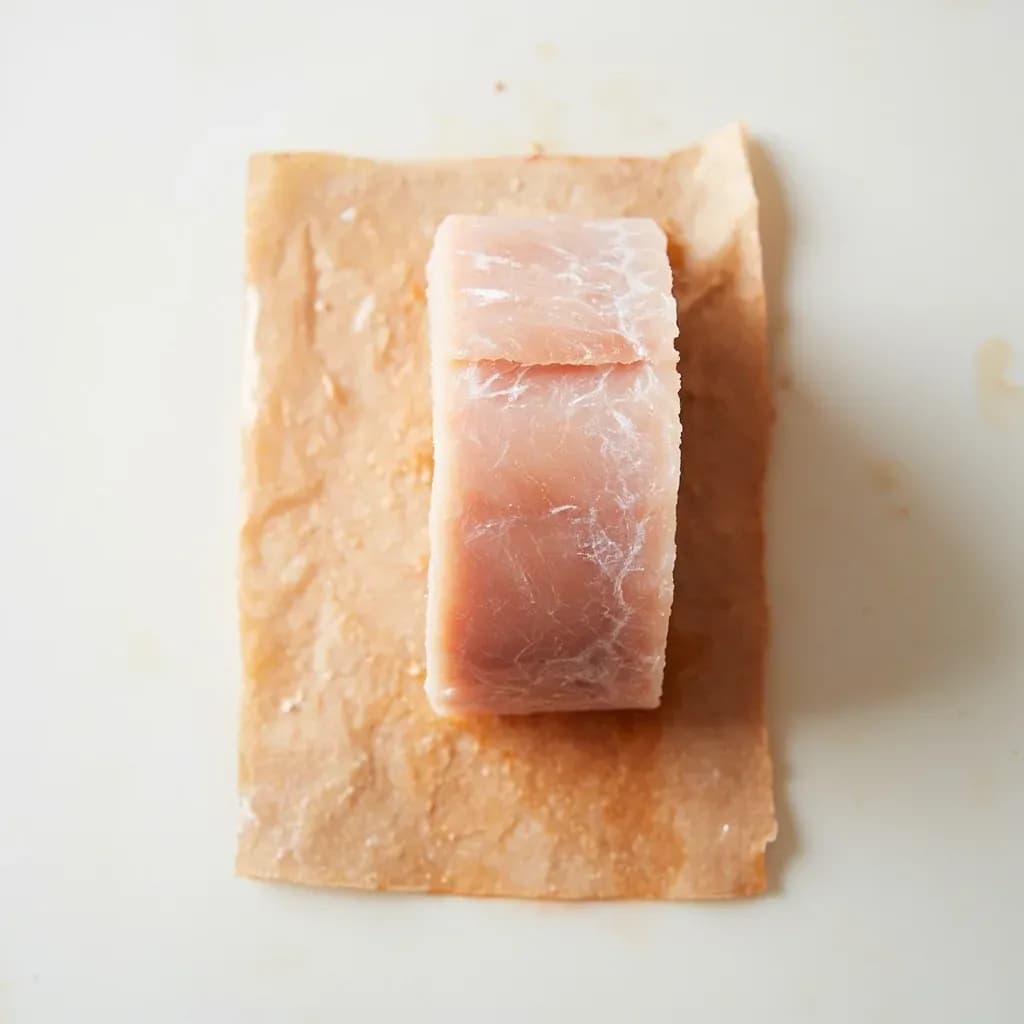
Choose pieces of similar density and color. Trim all silver skin, sinew, and visible fat, since these do not bond. Cut bonding faces flat and square so the pieces meet without gaps.
- 2
Dry, then lightly moisten the surfaces
Pat the bonding faces dry with a clean towel, then mist or brush them with a thin film of cold water. The surface should be damp, not wet — TG needs moisture to activate, but excess water dilutes it.
- 3
Dust with transglutaminase
Using a small fine-mesh sieve or dry brush, dust a thin, even layer of TG (about 0.5–1% of the protein weight) over each bonding face. Both faces get TG. Work quickly and keep the powder dry.
- 4
Press the pieces together
Bring the dusted faces into firm contact, pressing out any trapped air. Rewrap with plastic wrap, then compress the piece between two sheet pans with a light weight, or vacuum-seal at a low setting (5–7 cmHg).
- 5
Refrigerate to cure
Hold at 0–4°C for 12–24 hours. During this time the enzyme cross-links the surface proteins into a continuous gel. The longer the rest, the stronger the bond.
- 6
Unwrap, portion, and cook
Remove the wrap. Cook by your chosen method, but make sure the internal temperature reaches at least 50–55°C (120–130°F) so the bond is fully set. Rest briefly, then slice cleanly with a sharp knife or slicer.
Choosing a binder
The binder you pick determines the finished texture as much as the protein itself. Reach for TG when you want an invisible seam and a whole-muscle slice; reach for gelatin, egg, or starch when you want a molded loaf with a uniform, slightly coarse interior. Agar is the vegan route, with a cleaner bite than gelatin. Surimi-style washing is reserved for fish pastes that need to be reshaped entirely. Alginate–calcium is a presentation tool, not a structural one.
- Invisible bond, whole-muscle look → transglutaminase.
- Molded shape with classic charcuterie texture → gelatin, egg, starch, or agar.
- Smooth paste reshaped into balls, sticks, or logs → surimi-style washing.
- Plating-only adhesion, no real structural need → vacuum compression.
Traditional precedents
Long before transglutaminase, cooks were already texturizing. French charcuterie built galantines, ballotines, and terrines from layered or ground proteins bound with egg and aspic. In China, the Suzhou-Wenzhou tradition of concealed-slice cuisine reassembled meats into intricate shapes by hand. In Japan, surimi production — washing minced fish to concentrate myosin, then setting it with salt and heat — produced kamaboko and, later, the crab-stick analogue. Modern enzymatic restructuring is a faster, cleaner descendant of all three.
Common uses
Tips & pitfalls
- Cut bonding surfaces flat and even — flat-to-flat contact is the single biggest factor in a strong bond.
- Trim silver skin and excess fat; fat layers will not bond and create weak points in the finished piece.
- Pat surfaces dry, then lightly moisten — TG needs a thin film of water to activate, but a soaking wet surface dilutes the enzyme.
- Apply TG as a fine dust with a small sieve or brush, not a thick layer; excess powder does not improve the bond and can leave a gummy seam.
- Salt and strong acids (vinegar, citrus, wine) inhibit TG — apply them after the bond has set, or use unsalted brines when bonding.
- Rest in the refrigerator for 12–24 hours before cooking; pulling early is the most common cause of pieces falling apart on the pass.
- Cook to at least 50–55°C (120–130°F) internal to fully set the bond; pulling too early can cause the piece to separate when sliced.
- Don't expect TG to fuse pure plant proteins (tofu, seitan) — it works on animal muscle proteins, not isolated plant proteins.
Good to know
- Primary binders
- Transglutaminase (TG); gelatin; agar; sodium alginate with calcium chloride; egg yolk/white; starches (corn, tapioca); hydrocolloid gums.
- Required rest time (TG)
- 12–24 hours under refrigeration; a longer rest yields a stronger bond before cooking.
- Typical dose (TG)
- 0.5–1% of the weight of the protein being bonded; applied as a fine dust, not mixed in.
- Working and setting temperature
- Bond forms best at 0–10°C; setting is complete once the internal temperature reaches ~50–55°C (120–130°F) during cooking.
- What TG bonds — and doesn't
- Works on animal muscle proteins rich in myosin; fat layers, silver skin, and pure plant proteins (tofu, seitan) bond poorly or not at all.
- Salt and acid interaction
- Salt and strong acids slow the TG reaction; season bonding surfaces only after the bond has set.
- Origin of enzymatic method
- Microbial transglutaminase was isolated and commercialized by Ajinomoto in Japan in the late 1980s/1990s.
Also called
Restructuring · Reforming
Related

Confit
Cook slowly submerged in fat for silky tenderness and keeping

Cure
Draw out moisture with salt and time to preserve and concentrate

Pickle
Steep in acidic brine for bright, tangy, crunchy preservation

Ferment
Let friendly microbes transform food into tangy, complex flavor

Marinate
Soak in a seasoned mix to flavor and tenderize before cooking

Brine
Soak in salt water so meat stays juicy and seasoned throughout

Dehydrate
Slowly dry out moisture to concentrate flavor and extend shelf life

Cold-Smoke
Perfume cured food with smoke without cooking it through