Transform & Preserve
Whirlpooling (Trub Separation)
Stirring hot wort into a vortex so spent hops and protein settle into a cone for clean separation.
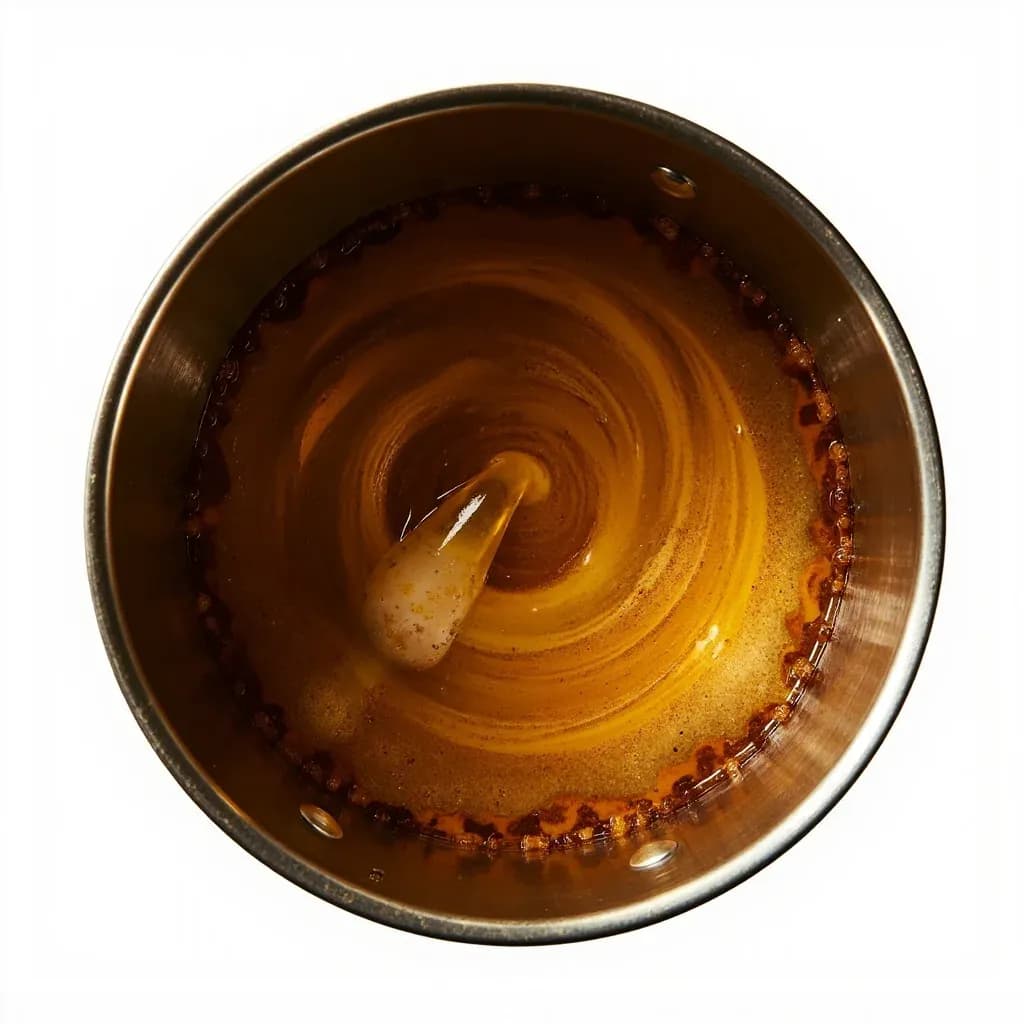
Whirlpooling spins finished wort into a rapid vortex so centrifugal force pulls the solid trub, spent hops and coagulated proteins, into a tidy cone at the kettle's center. After a settling rest, the clear wort can be drawn off from the edge, leaving the sediment behind. It produces a cleaner, brighter wort before fermentation.
Whirlpooling is a hot-side separation step taken at the end of the brew, after the boil is finished and before the wort is chilled and pitched. By spinning the kettle's contents in a steady, smooth vortex and then leaving them undisturbed, the brewer exploits the rotating flow to herd suspended solids — coagulated malt proteins, hop polyphenols, fatty acids, and bits of hop and grain matter collectively called hot-break trub — into a tight cone at the center of the kettle floor. The clear wort that remains around the perimeter is drawn off for cooling and fermentation, leaving the cone behind. In practice the technique compresses what would otherwise be a slow overnight settling into a fifteen-minute window, and it does so without chemicals, filters, or extra vessels.
The value of whirlpooling is felt downstream as much as at the kettle. A light trub load means a plate or counter-flow chiller stays clean and chills quickly; the fermenter fills with bright wort rather than gray sludge; yeast cells spend their first hours converting sugar instead of clumping around denatured protein; and finished beer is less likely to carry the astringent, papery off-flavors that polyphenol and lipid drag can produce. Combined with a hop stand, the same quiet rest doubles as a final aroma extraction, which is why nearly every modern brewery runs some version of the technique.
What the brewer actually observes is simple: a smooth, paraboloid depression in the wort that runs from the wall of the kettle to a center point, held for a minute or so, then left strictly alone. Success reads as a sharply defined cone of green-brown sludge on the kettle floor after the rest, surrounded by noticeably clearer wort. Failure usually announces itself as cloudy wort in the fermenter, the result of stirring too long, stirring too hard, or pulling from the wrong part of the kettle.
- Difficulty
- Medium
Types & varieties
Done with a sanitized spoon or mash paddle; the traditional homebrew method. Low cost, modest trub compaction.
Tangential return from the wort pump spins the kettle contents. Strong, repeatable vortex; standard in modern breweries.
A fixed or rotating in-kettle fixture fed by the pump; creates an automatic, even rotation without manual input.
Aroma hops added at flame-out steep in the hot, moving wort (often 15–30 minutes) before the separation rest; combines extraction with trub drop.
Wort circulates from kettle through a heat exchanger and back, with the pump output angled to set the kettle spinning.
How to do it
- 1
Cut the boil and shut off heat
End the timed boil — including any final bittering hop additions — and remove or kill the heat source. Let the surface turbulence die down completely before you touch the wort; a rolling boil will tear the vortex apart and re-aerate the liquid.
- 2
Add whirlpool hop additions (optional)
If you are running a hop stand for aroma, drop your low-alpha, high-oil hops in now. They will steep in the hot wort during the rest that follows, extracting oils without the harshness of a full boil.
- 3
Establish the vortex
Using a sanitized paddle, spoon, or the wort pump returning through a tangential port, stir the wort in one consistent direction until a smooth, steady vortex forms from the wall to the center. Thirty to ninety seconds is usually enough. The surface should be calm and rotating, not splashing; if you see bubbles or a violent core, you are whipping in air.
- 4
Rest undisturbed
Leave the kettle alone for 10–20 minutes. The trub will settle into a compact cone at the center of the kettle floor. A loose lid is fine if your kettle has one — heat retention is welcome, but the wort must not simmer.
- 5
Draw clear wort from the edge
Begin the transfer from the side of the kettle — through a racking arm, a tilted siphon, or a side outlet — taking wort from the outer ring, well away from the central trub cone. Stop when the liquid level approaches the cone and leave the last liter or two behind.
- 6
Chill and pitch
Send the clarified wort through your chiller into the fermenter. A lighter trub load means faster chill times, less hop debris in the fermenter, and cleaner yeast performance through the first 24 hours.
Common confusion: whirlpool vs. HopBack
Both are post-boil, kettle-area operations and both involve hops, so they get conflated in shop talk. The distinction matters. A whirlpool is a separation step: a moving body of wort is brought to rest so gravity and centrifugal force can drop trub. A HopBack is a filtration and aromatization vessel: wort is actively pushed through a packed bed of fresh aroma hops, which traps particulates while extracting volatile oils. The two can be chained — whirlpool first to drop most of the trub, then a HopBack on the way to the chiller for the final hop character — but neither replaces the other.
Why a rest beats extended stirring
It is tempting to keep the wort spinning for the whole separation period, on the assumption that more rotation means more compaction. In practice the opposite is true. Once the vortex is established, the trub cone has already begun to form on the kettle floor; additional spinning mainly drives dissolved oxygen into the hot wort (a serious oxidation risk) and slowly drags trub back into suspension from the cone's edges. A short, decisive spin followed by a quiet rest is mechanically cleaner and chemically safer.
Common uses
Tips & pitfalls
- Start the stir only after the boil is fully cut and the surface is calm — a rolling boil will shred the vortex and re-aerate the wort.
- Stir for 60–90 seconds, then walk away. Extended spinning does not compact the cone further; it only adds dissolved oxygen.
- Keep the vortex steady and smooth, not violent. If you see bubbles or splashing at the core, you are whipping in air.
- Wait the full rest — impatience is the single most common reason wort ends up cloudy in the fermenter.
- Pull wort from the kettle's edge (a racking arm or a tilted siphon) rather than the center, where the trub cone sits.
- If you whirlpool with hop additions, dose after the vortex is established so the hops ride the current and disperse evenly rather than sitting on top.
- Chill from the side of the kettle, not through a central pickup, or fit a hop blocker or false-bottom screen to keep debris out of the chiller.
- Sanitize anything that touches the hot wort — paddle, pump, arm, racking cane. The wort is sanitizing itself with heat, but the tools are not.
Good to know
- Purpose
- Separates hot-break trub (coagulated proteins, hop polyphenols, fatty acids, and vegetable matter) from finished wort before cooling and fermentation.
- Underlying physics
- Centrifugal force drives denser suspended particles toward the center of the vortex, where they settle into a compact cone on the kettle floor, leaving the outer ring of wort relatively clear.
- Typical wort temperature
- ~80–95 °C (175–205 °F) — hot enough to remain sanitized during the rest, cool enough to avoid a re-boil that would resuspend the trub.
- Rest time
- 10–20 minutes; many pro breweries hold 15 minutes. Longer holds yield a tighter, drier cone.
- Stir duration
- 30 seconds to 2 minutes of active spinning is enough to establish the vortex; extended agitation only re-incorporates oxygen and trub.
- Trub composition
- ~95% protein (mostly from malt) with hop polyphenols, lipids, and small amounts of grain dust and hop vegetative matter.
- Wort draw point
- Pulled from the side or low edge of the kettle, opposite the outlet, to avoid the central trub cone.
- Sanitation note
- The wort is self-sanitizing at these temperatures, but paddles, pumps, arms, and racking canes are not — anything that touches the hot wort must be sanitized.
Also called
Whirlpooling · Trub Separation · Whirlpool
Related

Confit
Cook slowly submerged in fat for silky tenderness and keeping

Cure
Draw out moisture with salt and time to preserve and concentrate

Pickle
Steep in acidic brine for bright, tangy, crunchy preservation

Ferment
Let friendly microbes transform food into tangy, complex flavor

Marinate
Soak in a seasoned mix to flavor and tenderize before cooking

Brine
Soak in salt water so meat stays juicy and seasoned throughout

Dehydrate
Slowly dry out moisture to concentrate flavor and extend shelf life

Cold-Smoke
Perfume cured food with smoke without cooking it through