Southern Europe
Lucanian (Basilicata)
Also: Cucina Lucana, Basilicata cuisine, Cucina della Lucania
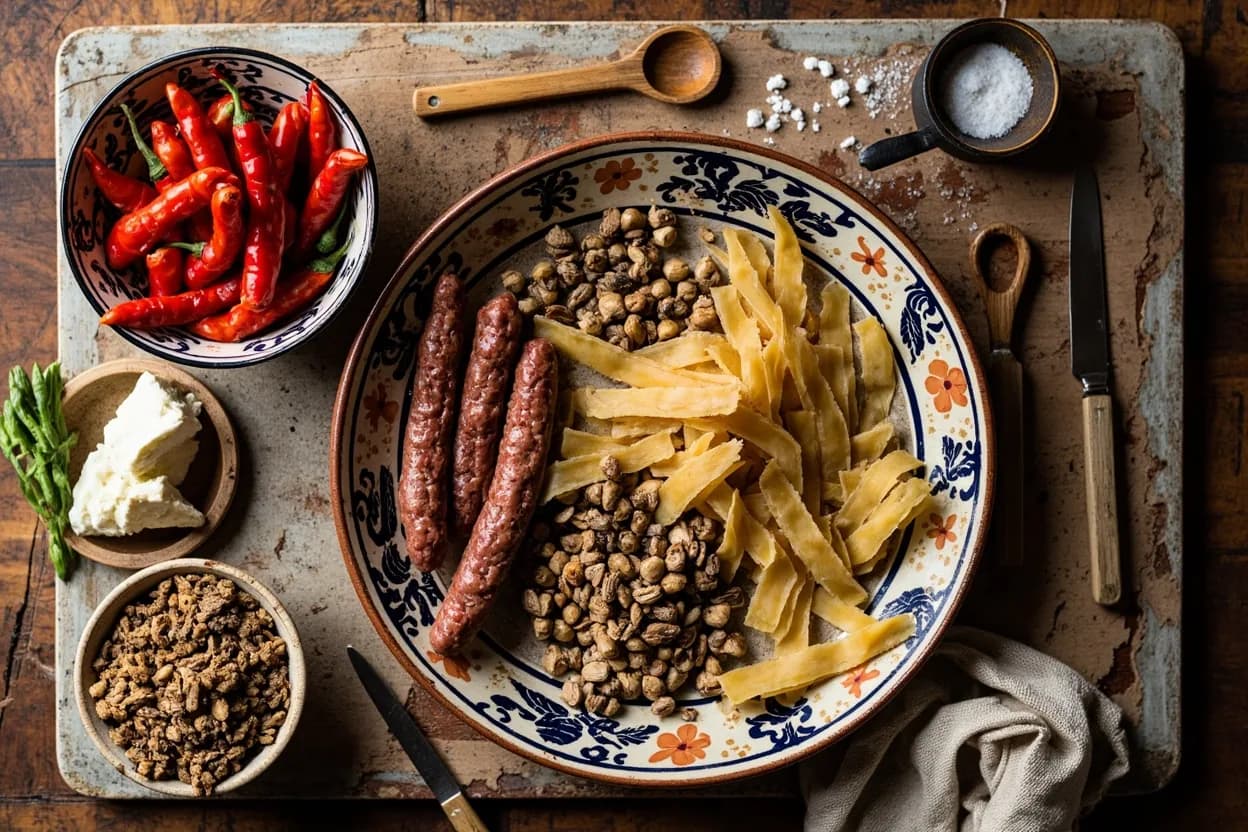
One of Italy's starkest and most ancient cooking traditions: crusco sweet peppers, the original Lucanica sausage, hand-torn lagane pasta with chickpeas, and an elemental mountain table shaped by centuries of isolation.
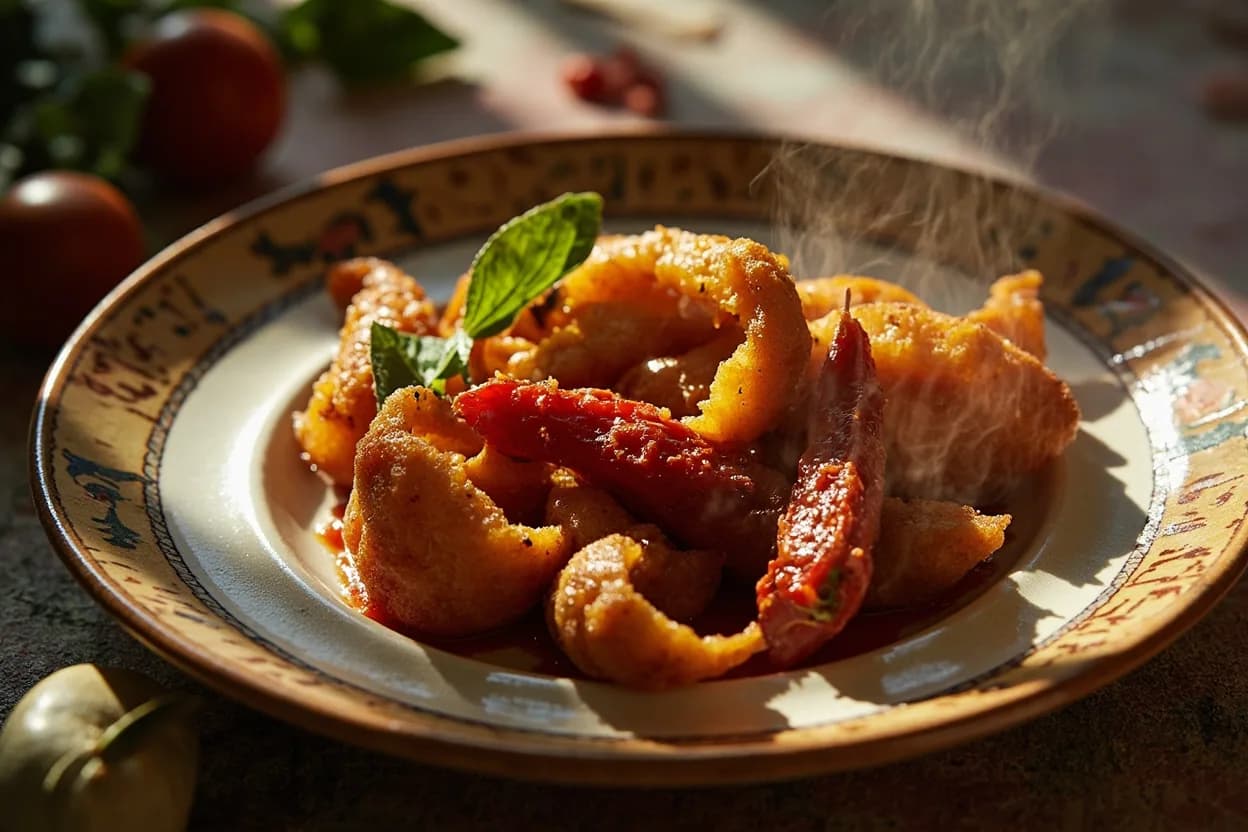
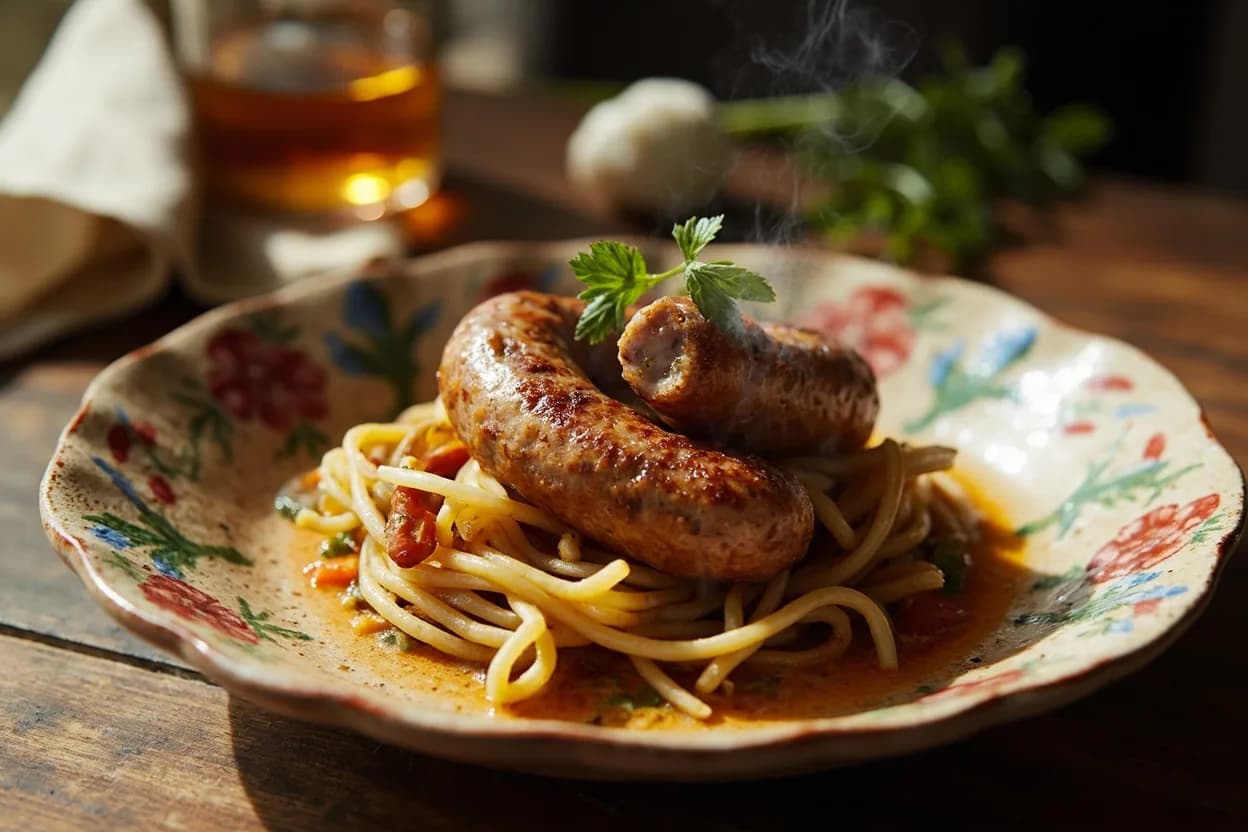
Lucanian cuisine is the food of Basilicata, Italy's smallest and most mountainous southern region — pinched between Campania, Calabria, Apulia, and a narrow strip of Tyrrhenian coast — and it stands apart from all of them. Its cooking is elemental: few ingredients, extreme technique, and a fiery intensity that traces to the peppers of Senise (peperoni cruschi, Capsicum annuum), which are sun-dried until brittle, then flash-fried in olive oil to produce a sweet, crackling condiment unlike any other Italian chili preparation. Basilicata lacks Campania's volcanic fertility and Apulia's coastal abundance; instead it draws on legumes, ancient grains (senatore Cappelli wheat), mountain pork (the Lucanica sausage that gave its name to all Italian sausage), sheep's milk ricotta, and the bitter herbs of its limestone ridges.
The flavour base
Peperoni cruschi fried in olive oil (the defining flavour signature), lard and pork fat rendered from Lucanica-type sausage, and the earthy backbone of dried chickpeas and fave (broad beans) cooked down to porridge.
Pantry staples
Key ingredients
Signature techniques
Signature dishes
Lucanian (Basilicata) on the table
At the table
Meals in Basilicata are structured around a single substantial primo — almost invariably pasta or legumes — with meat as a secondary element or feast-day treat rather than a daily one. Pork is preserved in all forms (sausage, capocollo, lard) and deployed across the year. Vegetables are treated with equal dignity to meat: fried peperoni cruschi can constitute an entire secondo. Bread is the oldest constant: hard-wheat loaves from Matera (Pane di Matera IGP) bake in stone-floor ovens and last up to a week.
History & context
Lucania — the region's ancient name, used until Mussolini renamed it Basilicata in 1932 in honour of Byzantine administrative precedent — is one of the oldest continuously inhabited areas of Italy. Greek colonists settled Metaponto and Heraclea in the eighth century BCE and left an agricultural legacy of wheat, olive oil, and wine. The Romans drew lucanica sausage directly from local Lucanian pig-herders: every Roman cookbook from Apicius onward mentions it. Centuries of feudal isolation under Norman, Hohenstaufen, Aragonese, and Bourbon rule kept Basilicata among Italy's poorest regions. Carlo Levi's memoir Cristo si è fermato a Eboli (1945) gave the world an unflinching portrait of a mid-century Lucanian village entirely outside the reach of modernity. Matera, the region's most famous city, inhabited continuously in its Sassi cave dwellings since the Palaeolithic, became a UNESCO World Heritage Site in 1993 and European Capital of Culture in 2019, sparking renewed global interest in Lucanian food culture.
Regional variations
- Matera and the Murge plateau
Bread culture is paramount (Pane di Matera IGP); crapiata grain-and-legume potage is the city's ceremonial dish; lamb and pecorino from Moliterno.
- Senise and the Sinni valley
Peperoni cruschi origin; the sweetest and most aromatic dried peppers in Italy; pork salumi are the economic engine.
- Vulture highlands
Aglianico del Vulture DOCG wine-country; cooking integrates wine in braised meats; wild mushrooms and chestnuts in autumn.
- Tyrrhenian coast (Maratea)
Narrow coastal strip; fish stews, sea urchin, and red tuna preserved in olive oil; more Calabrian influence.
Related cuisines
Southern neighbour sharing peperoncino intensity, Nduja-style pork preservation, and elemental shepherd cooking.
- Apulian
Eastern neighbour; fave e cicorie (bean and chicory porridge) is a shared staple; both use durum wheat pasta with legumes.
Northern neighbour sharing Lucanica sausage lineage and some pasta traditions; Campania is markedly richer in fresh produce.
- Ancient Roman
Lucanica sausage is documented in Apicius and Varro as a Lucanian product imported to Rome — one of the clearest direct lines from antiquity to modern Italian cooking.
References
- 1.Christ Stopped at Eboli, Carlo Levi (1945; English trans. 1947, Farrar, Straus and Giroux)
- 2.Italian Regional Cooking, Ada Boni (1969)
- 3.La Cucina Lucana, Teodoro Carbone (De Luca Editori, 1990)
- 4.Il Cucchiaio d'Argento (The Silver Spoon), Editoriale Domus, 8th ed.
- 5.Apicius, De Re Coquinaria (1st–4th century CE; Flower & Rosenbaum trans., 1958)
Confidence: high
Notes
The original sausage
The word 'lucanica' — used in Latin by Apicius, Varro, and Cicero — is the etymological root of Italian 'salsiccia lucana' and arguably of Portuguese 'linguiça,' Spanish 'longaniza,' and even the Venetian 'lugànega.' Roman legions spread the Lucanian pork-and-spice sausage recipe across the empire; Basilicata can legitimately claim to have seasoned the Western world.
Peperoni cruschi: sweet fire
Peperoni di Senise IGP are a low-water, thick-walled variety of Capsicum annuum dried on long strings (serte) in the Agri and Sinni valleys. Flash-fried in olive oil for 15–20 seconds, they shatter into glass-like chips with a sweet, almost raisin-like intensity and zero residual heat. They are crumbled over pasta, eggs, salt cod, and bread — one of the most distinctive ingredients in Italian regional cooking.