East Asia
Teochew (Chaozhou)
Also: Chaoshan Cuisine, Chiu Chow Cuisine, Teochiu Cuisine, 潮州菜
The most restrained and cerebral of China's seafood cuisines — a tradition of unadorned freshness, cold-crab artistry, master-stock braising, and the refined congee table that fed the Chinese diaspora across Southeast Asia.
Teochew cuisine is the culinary tradition of the Chaoshan region of eastern Guangdong province, spoken in Teochew (Chaozhou) dialect by people who form one of the most commercially successful and far-flung Chinese diaspora communities in the world. The cuisine is built on a philosophy of minimal intervention with maximum-quality ingredients: it prizes the natural sweetness of seafood and poultry above all, and its most iconic preparations — raw cold crab, clear broth fish soup, steamed fish — require almost no seasoning to succeed. Where Cantonese cooking is rich and versatile, and Shanghainese is sweet and glossy, Teochew is austere and pure. The cold congee table, the preservation traditions (cured radish, fish sauce, salted vegetables), and the tea ceremony (gong fu cha, which originated in Chaozhou) are all equally central to the cuisine's identity.
The flavour base
The natural sweetness of the ingredients themselves — fresh seafood, good pork — supported by house lu (master stock kept alive for years, spiced with soy, star anise, and cinnamon) and the acid counterpoint of preserved vegetables and fish sauce.
Pantry staples
Key ingredients
Signature techniques
Signature dishes
Teochew (Chaozhou) on the table


At the table
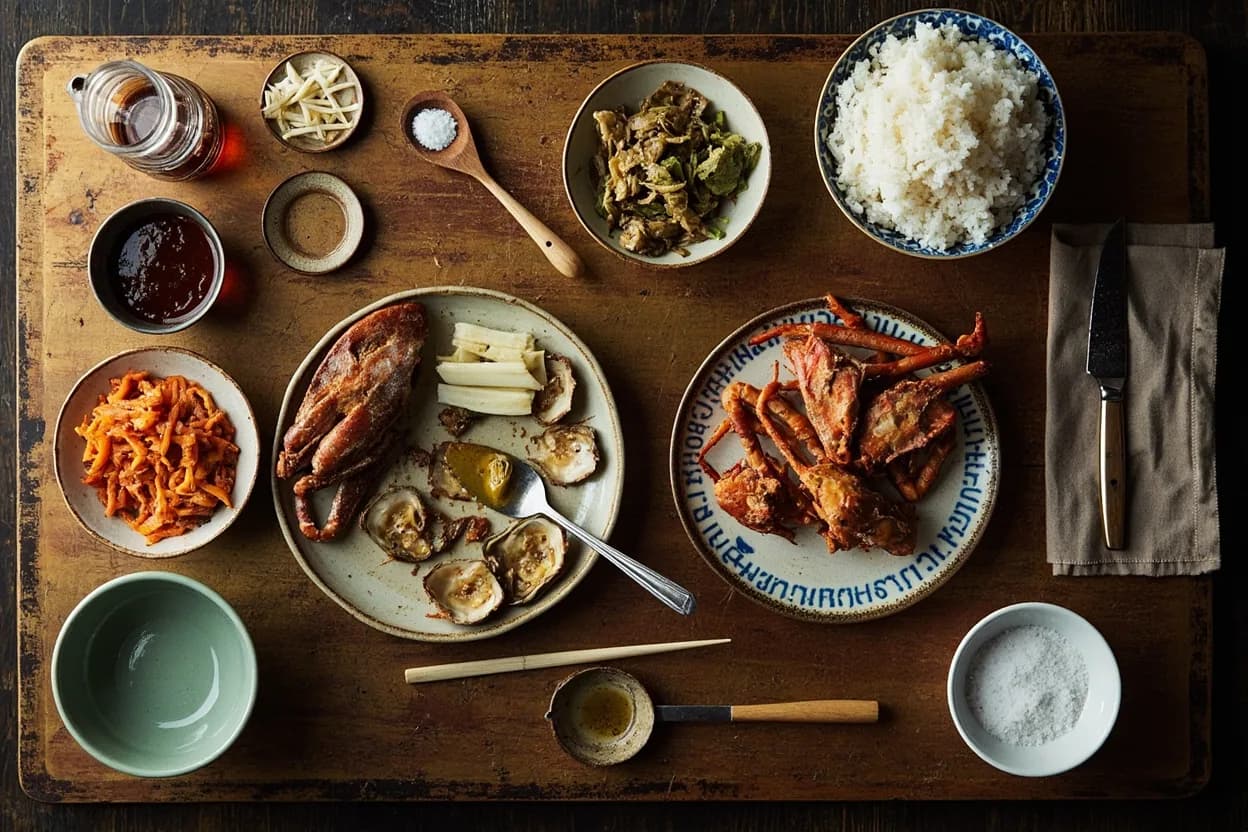
A Teochew meal's organizing logic is the congee table (bai mi fan / mi zhou with accompanying dishes). Plain white congee or watery rice is the neutral base around which small, intensely flavored cold dishes — preserved vegetables, marinated seafood, braised offal — are arranged. Main dishes are light and seafood-forward. The meal ends, or is punctuated throughout, with multiple rounds of strong Wulong tea (dan cong or tie guan yin) from miniature gong fu cha sets — Chaozhou is considered the birthplace of this tea ceremony.
History & context
The Chaoshan region of eastern Guangdong occupies a narrow coastal plain backed by mountains, which historically made it densely populated and resource-scarce. This ecology drove the development of preservation techniques (fish sauce, salted vegetables, pickled radish) and a cuisine of maximum flavor extraction from modest raw materials. Between the 18th and 20th centuries, Teochew people emigrated in massive numbers to Southeast Asia — particularly Thailand, Cambodia, Vietnam, Malaysia, and Indonesia — where they became dominant in commerce and trade. Teochew culinary culture shaped significant elements of the food cultures of Bangkok (where Teochew is still spoken in many commercial families), Phnom Penh, and Singapore. The master-stock braising tradition (lu shui) spread to Cantonese and Hokkien diaspora communities and is now associated with Chinese cooking broadly. Chaozhou is also the undisputed ancestral home of gong fu cha, the concentrated tea-tasting practice that later evolved into Japanese tea ceremony traditions.
Regional variations
- Shantou (Swatow)
The port city's version is more seafood-intensive and slightly more influenced by Cantonese commercial cooking; famous for its fish balls and noodle soups.
- Chaozhou City proper
The most traditional and conservative version; strictest adherence to clear-steam and cold preparations; home of the finest lu shui goose restaurants.
- Thai Teochew (Bangkok)
Significant adaptation using Thai herbs, palm sugar, and local seafood while preserving the congee table and lu wei braising; pad see ew and other Thai-Chinese dishes trace here.
- Singapore Teochew
Merged with Hokkien and Cantonese streams; popiah, chai tow kway (carrot cake), and bak chor mee all carry Teochew DNA in Singapore's hawker tradition.
Related cuisines
Shares the freshness philosophy and Guangdong province origin; Cantonese cooking is richer, more wok-forward, and more diverse; both traditions are central to Yum Cha dim sum culture.
- Fujian (Hokkien)
Near-parallel seafood and preservation traditions; both cuisines drove Southeast Asian diaspora Chinese food cultures; Hokkien uses more red fermented tofu where Teochew uses fish sauce.
- Thai Chinese
Teochew is the dominant Chinese culinary heritage in Thailand; Thai-Chinese cooking is a direct evolution of Teochew techniques applied to Southeast Asian ingredients.
- Vietnamese Chinese (Người Hoa)
The Chaoshan diaspora in Cholon (Ho Chi Minh City's Chinatown) shaped Vietnamese-Chinese food; braised goose, congee, and fish ball soup are shared vernacular dishes.
Canonical recipes
The dishes that define Teochew (Chaozhou), documented in the Canon.
References
- 1.The Food of China — E.N. Anderson (Yale University Press, 1988)
- 2.Cradle of Flavor — James Oseland (W.W. Norton, 2006) — Teochew diaspora in Southeast Asia
- 3.Chinese Regional Cuisine (Guangdong Volume) — China Commerce Press, 2004
- 4.Chaozhou Cuisine — Chaozhou Municipal Bureau of Culture, 2012
Confidence: high
Notes
Raw crab as prestige
The Teochew raw blood crab (sheng xie or 'drunken crab') is one of the most polarizing and prestigious preparations in Chinese cuisine. Live crabs are cleaned, cut, and marinated in a mixture of soy sauce, Shaoxing wine, garlic, and aromatics for hours — the resulting dish is served cold, with the raw crab meat barely set by the marinade. For Teochew diners, the dish is the clearest expression of the cuisine's founding principle: the ingredient must be so pristine that cooking would diminish it.
Gong fu cha and the Teochew meal
The gong fu cha tea ceremony, in which small quantities of high-grade Wulong tea are brewed in a tiny clay teapot and served in thimble-sized cups, is not a separate cultural practice in Chaozhou — it is integrated into the meal itself. Rounds of tea punctuate courses, cleanse the palate, and extend the social duration of the meal. The practice spread through the Chinese diaspora and eventually, via Japanese translation, influenced the formal Japanese tea ceremony in structural terms (concentration, vessels, ritual precision).