Natural form
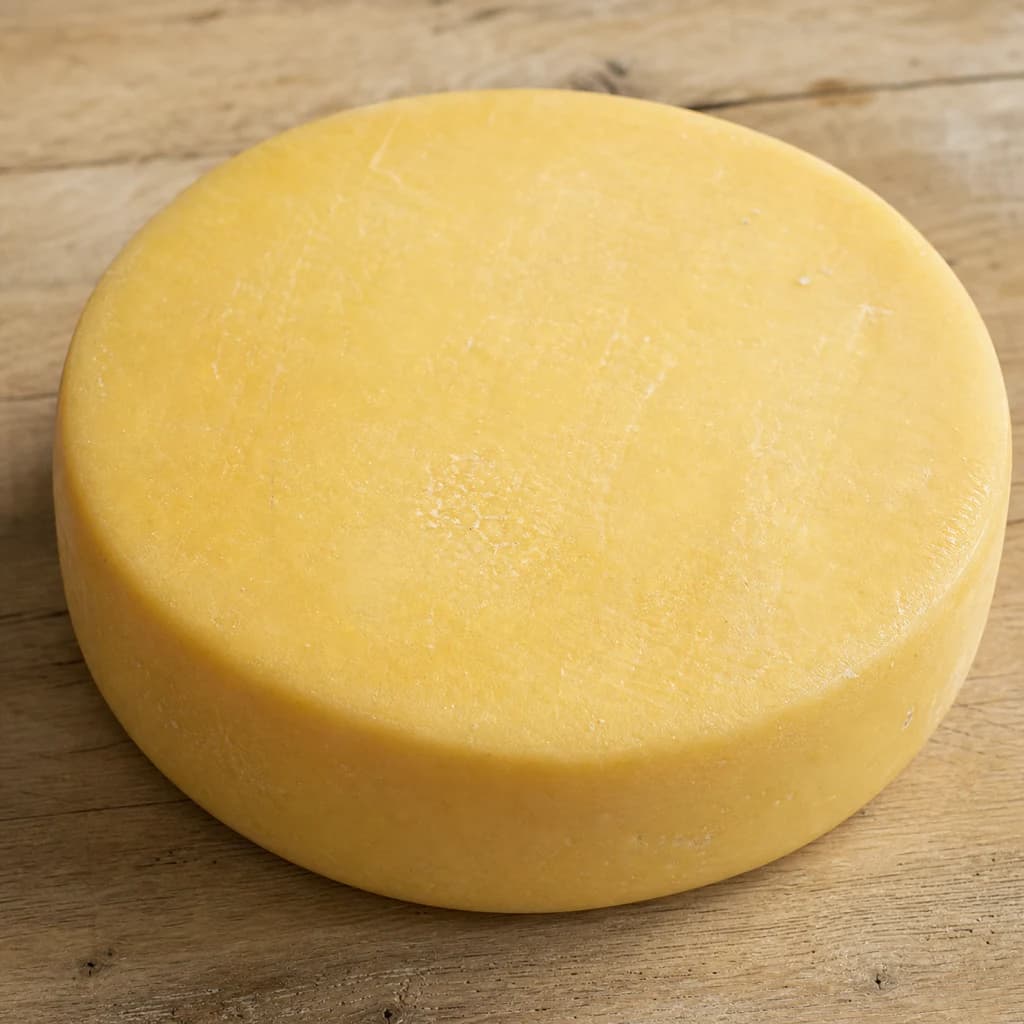
A whole Danbo wheel shows its pale yellow rind and compact semi-hard form.
Establishes the cheese's overall appearance, size, shape, and distinctive pale yellow exterior so readers can recognize it whole.
Dairy & Eggs
Danbo Cheese
Mild, semi-hard Danish cow's-milk cheese with small holes; a classic table cheese.
Danbo is the national cheese of Denmark, a semi-hard, pale yellow cow's-milk cheese with a mild, slightly acidic flavor and small irregular holes. Some versions are flavored with caraway. It is sliced for open-faced sandwiches (smørrebrød) and everyday eating, and melts cleanly.
Danbo is a washed-curd, semi-hard cheese from Denmark, developed in the 19th century and named after the town of Danbo in Jutland. Its production method — using pasteurized cow's milk with a washed-curd technique — gives it a notably smooth, slightly elastic texture and a moisture content that sits comfortably between firm Gruyère-style cheeses and softer options like Havarti. The cheese is typically sold in rectangular blocks or cylindrical rounds, and ranges from vacuum-packed young cheese (4–6 weeks old) to aged pieces with a natural tan rind. What makes Danbo remarkable is its range: young specimens are mild, buttery, and almost creamy, while aged versions develop genuine complexity — nuttier, more assertive, with larger, more irregular holes. Its melt quality is reliable and even, which is why Danish home cooks treat it as an all-purpose cheese. Internationally, Danbo is frequently confused with Norwegian Jarlsberg or Dutch Maasdam, but it is a distinct product with its own character — generally milder and less nutty than Jarlsberg, and made through a different curd-washing process than Dutch cheeses of similar appearance.
- Measured in
- g
- Storage
- Fridge
Allergens
Types & varieties
Plain variety; most common; mild and buttery with small holes; the export standard
Danbo with caraway seeds; the most popular variety in Denmark; caraway adds earthy, slightly citrus notes that amplify the cheese's subtle sweetness
Aged 3+ months; firmer texture, larger holes, more complex and nuttier flavor
Seasoned with chives, dill, or garlic; popular in sandwiches and cold platters
Made from organic milk; flavor profile similar to traditional Danbo
Danbo vs. Its Lookalikes
The most common mistake is confusing Danbo with Jarlsberg or Maasdam. Jarlsberg is Norwegian, has a more pronounced nutty, slightly sweet flavor, larger round holes, and a waxed rind. Maasdam is Dutch, made with a different curd process that produces a more open, holey interior and a slightly tangier flavor. Danbo is milder, smoother in texture, and more neutral — which is precisely why it is so useful in the kitchen. When a recipe calls for Danbo and you cannot find it, reach for a mild young Gouda or a Havarti rather than a more assertive cheese.
- Do not substitute Maasdam one-for-one — its flavor is tangier and it browns differently when melted
- Jarlsberg's wax rind should never be eaten; Danbo's natural rind, when present, is edible but often removed for practical use
- Pre-packaged supermarket Danbo is often younger and milder than what you find at a specialty cheese shop — adjust expectations accordingly
Understanding the Washed-Curd Process
Danbo's smooth, slightly elastic texture is a direct result of its washed-curd production method. During cheesemaking, the curd is rinsed with water after the whey is drained, which washes away some of the lactose and lactic acid. This lowers the curd's acidity, retaining more moisture and producing a softer, more supple texture than cheeses where the curd is left to acidify fully in its own whey. The result is a cheese that melts evenly without turning greasy and holds its shape reasonably well when sliced — the practical qualities that make Danbo a workhorse in Danish kitchens.
- Washed-curd cheeses generally have better melt quality than non-washed-curd cheeses of similar firmness
- The washing step also contributes to Danbo's mild flavor — less acid means less sharpness
Common uses
Tips & pitfalls
- Let Danbo come to room temperature (20–30 minutes) before serving or cooking — cold cheese will not melt evenly and its flavor stays muted
- When slicing for open-faced sandwiches, cut 3–5mm thick — too thin and the cheese tears on dense rye bread, too thick and it overwhelms the topping
- For melting in sauces or gratins, use moderate heat and stir occasionally — Danbo melts evenly but can turn rubbery if heated too aggressively or too long
- When buying, select pieces with uniform pale-yellow color; avoid blocks with gray edges, excessive surface moisture, or a dried-out appearance
- Buy from retailers with good turnover — pre-packaged supermarket blocks are often very young and less flavorful than cuts from a wheel
- Caraway Danbo (med kommen) is the most authentic Danish choice for traditional smørrebrød; plain Danbo is better for melting tasks
- Avoid low-fat or "light" Danbo — the reduced fat drastically alters both texture and flavor, making it grainy and flat
- Do not confuse Danbo with Jarlsberg (Norwegian, nuttier, larger holes) or Dutch Maasdam (tangier, different curd process) — they look similar but behave differently in recipes
Nutrition
Energy
1628 kJ · per 100 g
Where the calories come from
Protein
25.6g
51% DV
Carbs
1.6g
1% DV
Fat
31.1g
40% DV
Fiber
0g
0% DV
Sugars
1.6g
of which
Sodium
800mg
35% DV
Source · USDA FoodData Central · approx. Cheese, fontina
View on FDC →In the shops
Matched grocery products
No matched grocery products for Danbo Cheese yet.
Good to know
- Origin
- Denmark, 19th century; named for the town of Danbo in Jutland
- Milk Type
- Cow's milk, typically pasteurized
- Fat Content
- 27–45% fat in dry matter, varying by producer
- Aging Time
- Young: 4–6 weeks; Aged (Modnet): 3–6 months
- Texture
- Semi-hard, smooth, slightly elastic; small to medium irregular holes
- Rind
- Natural tan rind when aged; often sold vacuum-packed without rind
- Shape
- Rectangular blocks (~2 kg) or cylindrical rounds
- Flavor Profile
- Mild, buttery, slightly sweet when young; nuttier and more pronounced with age
- Classification
- Semi-hard table cheese; washed-curd style
- Storage
- Refrigerate at 4–6°C, sealed; use within 2–3 weeks of opening
Substitutes
- Havarti — Danish cheese with similar mild, buttery flavor and excellent melting; slightly more creamy in texture
- Young Gouda — Mild Dutch cheese; similar texture and melting quality; slightly nuttier flavor develops with age
- Esrom — Traditional Danish cheese; slightly stronger flavor but good melt; a close relative in character
- Port Salut — French cheese with similar smooth texture and mild flavor; melts well and has comparable versatility
Pairs with
Related

Whole Milk
Rich, full-fat milk for drinking, coffee, sauces, and baking
Butter
Golden fat for searing, baking, and finishing a sauce
Yogurt
Tangy, creamy culture for breakfast, sauces, and marinades
Cheddar Cheese
Sharp, melty cheese for sandwiches, gratins, and grating
Skim Milk
Fat-free milk for lighter drinking, coffee, and cooking
Heavy Cream
Rich cream that whips, enriches sauces, and sets ganache

Sour Cream
Tangy, thick cream for dolloping, baking, and dips
Mozzarella
Soft, milky cheese that melts into stretchy pizza pulls