Sauces & Pastes
Dashi
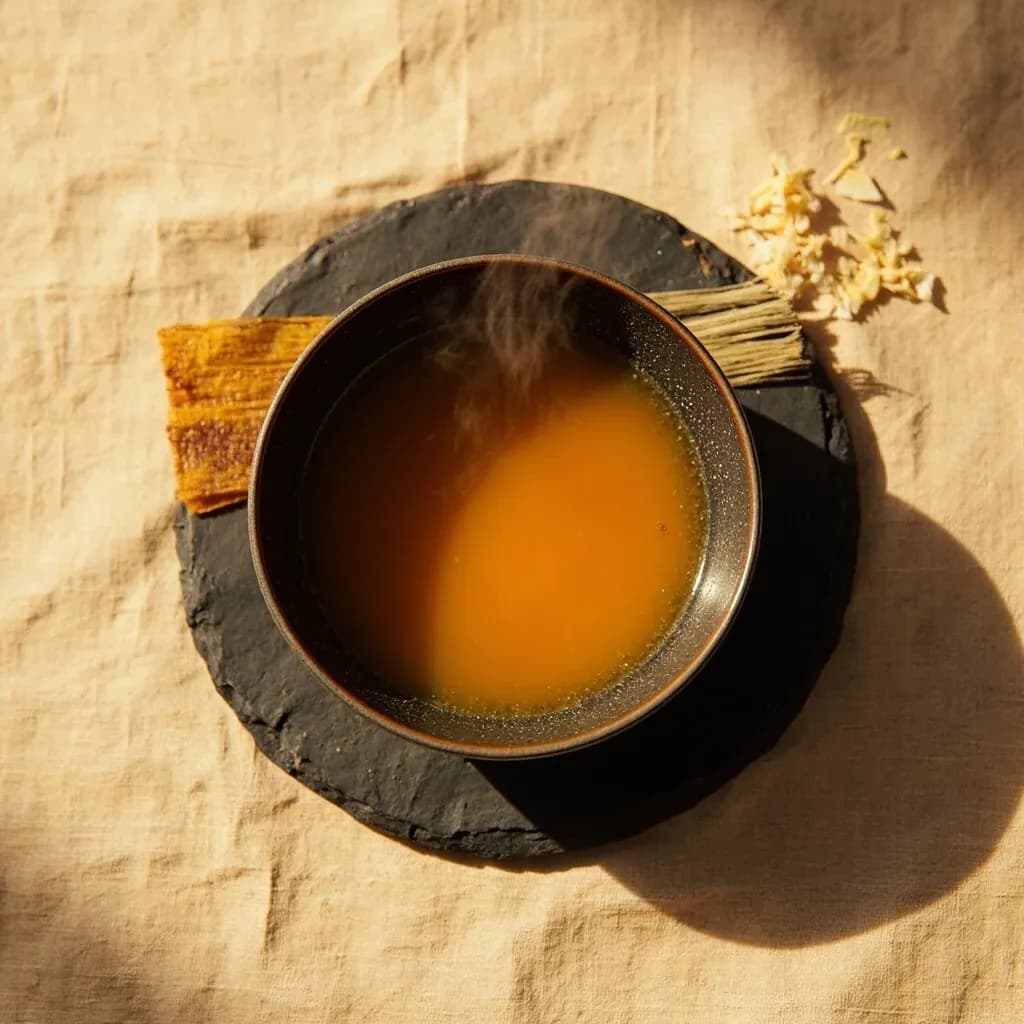
Quick kombu-and-bonito stock that is the umami foundation of miso soup and simmered dishes; steep just below a boil and strain promptly to keep it clean and never bitter.
Dashi is the clear, light stock at the heart of washoku, drawn from kombu (edible kelp) and/or katsuobushi (dried, fermented, smoked bonito flakes) to supply the glutamate and inosinic acid that define Japanese umami. It is not a seasoning in its own right but a neutral building block — a liquid you finish with soy sauce, miso, or mirin depending on the dish. Without dashi behind it, miso soup reads flat, nimono feels dull, and chawanmushi never coheres into a savory custard.
Two extraction principles govern the cook. Kombu is steeped gently below the boil — around 60–65 °C / 140–150 °F — so its glutamate leaches out cleanly, without the bitter tannins and slimy mucilage that a rolling boil would draw from the seaweed. Katsuobushi is steeped only briefly in water that has just come off the heat, for two or three minutes, so the flakes surrender inosinic acid without stewing into a cloudy, fishy liquid. When kombu and katsuobushi are combined into awase dashi, the umami is more than additive: glutamate and inosinate reinforce each other, and the stock tastes rounder and deeper than either base alone.
The first steep is ichiban dashi, the aromatic extraction reserved for clear soups, chawanmushi, and refined nimono. The same kombu and katsuobushi, simmered again in fresh water, give niban dashi — lighter, quieter, and the everyday workhorse for miso soup. Beyond the kombu-and-bonito canon, niboshi (dried sardines) and dried shiitake broaden the palette, while instant granules fill in when time is short.
- Measured in
- ml
- Storage
- Refrigerate
Allergens
Find it in
Types & varieties
First extraction from kombu and/or katsuobushi — the most aromatic, used for clear soups, chawanmushi, and refined nimono
Second extraction from the same kombu and katsuobushi simmered in fresh water; lighter and quieter, used for miso soup and everyday cooking
Kombu alone; vegetarian, with a soft, briny sweetness and the foundation of shōjin ryōri
Bonito flakes alone; deeper, smokier, more meaty umami
The everyday default: kombu and katsuobushi together, leveraging glutamate-plus-inosinate synergy
Made from dried small sardines; assertive, slightly marine, common in Kansai and Tōkai home cooking
Cold-soaked dried shiitake; rich in guanylate and often combined with kombu for a fuller vegetarian stock
Sake lees simmered with kombu and katsuobushi; cloudy, gently alcoholic, used in winter hot pots
Why awase dashi tastes more than the sum of its parts
The standard stock is kombu plus katsuobushi, but the reason is not simply 'two ingredients, more flavor.' The two bases contribute different umami nucleotides — kombu gives glutamic acid, katsuobushi gives inosinic acid — and the human palate registers the combination as several times more savory than either alone. This is the same synergy behind Western combinations like Parmesan with anchovy, or tomato with aged cheese: complementary nucleotides stack. Dried shiitake adds guanylate to the picture, which is why a kombu-and-shiitake vegetarian dashi can rival a meat-based one.
- Glutamate (kombu) supplies the clean, sea-sweet base
- Inosinate (katsuobushi, niboshi) supplies the deeper, meaty note
- Guanylate (dried shiitake) amplifies both when added to the pot
- Awase dashi at roughly 10 g kombu and 20 g katsuobushi per liter is the textbook balance
Ichiban and niban: getting two stocks from one set of ingredients
A single batch of kombu and katsuobushi is meant to be used twice. The first steep — ichiban dashi — is short and gentle: it pulls the most aromatic, cleanest flavor, and is reserved for dishes where dashi should be obvious, like a clear suimono or a delicate chawanmushi. The second steep — niban dashi — simmers the same kombu and katsuobushi in fresh water for a few minutes, yielding a lighter, more muted stock that is perfectly suited to miso soup and everyday nimono, where it will be blended with other strong seasonings. Throwing the ingredients away after ichiban is one of the most common wastes in a Japanese home kitchen.
- Ichiban: cold water to kombu, heat gently, remove at 60–65 °C, add katsuobushi off heat for 2–3 minutes, strain without pressing
- Niban: return the same kombu and katsuobushi to a fresh pot of water, bring to a brief simmer for 4–5 minutes, then strain
- Use ichiban for clear soups, chawanmushi, refined nimono, and any dish where dashi is a featured flavor
- Use niban for miso soup, hot pots, and simmered dishes seasoned with miso or strong soy
Common uses
Tips & pitfalls
- Wipe kombu with a barely damp cloth and do not rinse it — the white powder on the surface is umami-rich glutamate that you want to keep.
- For the cleanest kombu dashi, cold-soak the kombu in the refrigerator for 4–12 hours instead of heating it.
- Pull the kombu the instant small bubbles gather at the edges of the pot; boiling it releases bitter tannins and turns the stock slimy.
- After removing the kombu, slide the pot off the heat before adding the katsuobushi; let the flakes steep 2–3 minutes without stirring so the liquid stays clear.
- Strain the katsuobushi as the flakes begin to sink. Squeezing them through a sieve forces out bitter compounds and clouds the dashi.
- For a perfectly clear stock, line a fine-mesh strainer with a coffee filter or a double layer of cheesecloth rather than pressing the solids.
- Reuse the spent kombu and katsuobushi to make a lighter niban dashi in fresh water — do not discard them after the first steep.
- Season at the end only after tasting; dashi itself is unseasoned and is meant to be built into with soy sauce, mirin, or miso depending on the dish.
- If you only have hard tap water, filter it first; calcium and magnesium mute the umami and can make kombu taste chalky.
Nutrition
Nutrition
No USDA FoodData Central match for Dashi yet. We surface a per-100 g profile once a generic whole-food entry is matched and verified.
In the shops
Matched grocery products
No matched grocery products for Dashi yet.
Good to know
- Origin
- Japan; kombu-based stock is the oldest, tied to shōjin ryōri (Buddhist temple cooking) from the Asian continent, while katsuobushi-based stock spread widely from the Edo period onward
- Primary components
- Kombu (edible kelp) and katsuobushi (dried, fermented, smoked bonito flakes); niboshi and dried shiitake are common secondary bases
- Umami sources
- Glutamate from kombu, inosinic acid from katsuobushi or niboshi, and guanylate from dried shiitake — together they create a synergistic umami greater than any alone
- Pronunciation
- DAH-shee
- Standard ratio
- 10 g kombu and 20 g katsuobushi per 1 L water for a balanced awase dashi, yielding roughly 1 L of stock
- Steeping temperature
- Kombu steeped at 60–65 °C / 140–150 °F; katsuobushi steeped off the heat for 2–3 minutes
- Total time
- 20–30 minutes for ichiban dashi; cold steeps of 4–12 hours work for kombu alone
- Difficulty
- Easy
- Common forms
- Freshly made stock, frozen concentrate, granulated or powdered instant dashi, and liquid concentrate
- Water preference
- Soft or filtered water gives the cleanest result; very hard water mutes umami and can make kombu feel chalky
- Storage
- Up to 3 days refrigerated in a sealed container; freezes well for 2–3 weeks
Substitutes
- Instant dashi granules (hondashi) — The closest convenient substitute; dissolve about 1 teaspoon per cup of hot water. Faster but flatter in aroma and slightly sweeter than fresh dashi
- Dried shiitake soaking liquid — The standard vegetarian substitute; rich in guanylate and works well in place of kombu dashi, though it is more woody than briny
- Light anchovy stock — Closest Western analogue; assertive and fishy, so use lightly and balance with a strip of kombu or a bay leaf if possible
- Mild vegetable stock — Acceptable as a background for vegetarian dishes but lacks glutamate — fortify with dried shiitake and a small splash of soy if you want true dashi depth
- Dried shrimp infusion — A rough stand-in for niboshi dashi; briefly steep about 10 g dried shrimp in 1 L of hot water, then strain
Also called
bonito stock · Japanese soup stock · kombu dashi
Appears in these dishes

Related
Soy Sauce
Salty, savory umami base for stir-fries and marinades
Hot Sauce
Tangy, fiery splash for eggs, tacos, and anything dull
Tomato Sauce
Simmered tomato base for pasta, pizza, and braises

Barbecue Sauce
Smoky-sweet sauce for grilling, glazing, and dipping
Pesto
Vibrant basil-and-pine-nut sauce for pasta and beyond

Fish Sauce
Funky, salty essence that brings deep umami to SE Asian dishes
Worcestershire Sauce
Tangy, savory umami splash for marinades, stews, and Caesar

Sriracha
Garlicky chili sauce with sweet heat for drizzling and dipping