Sauces & Pastes
Mirin
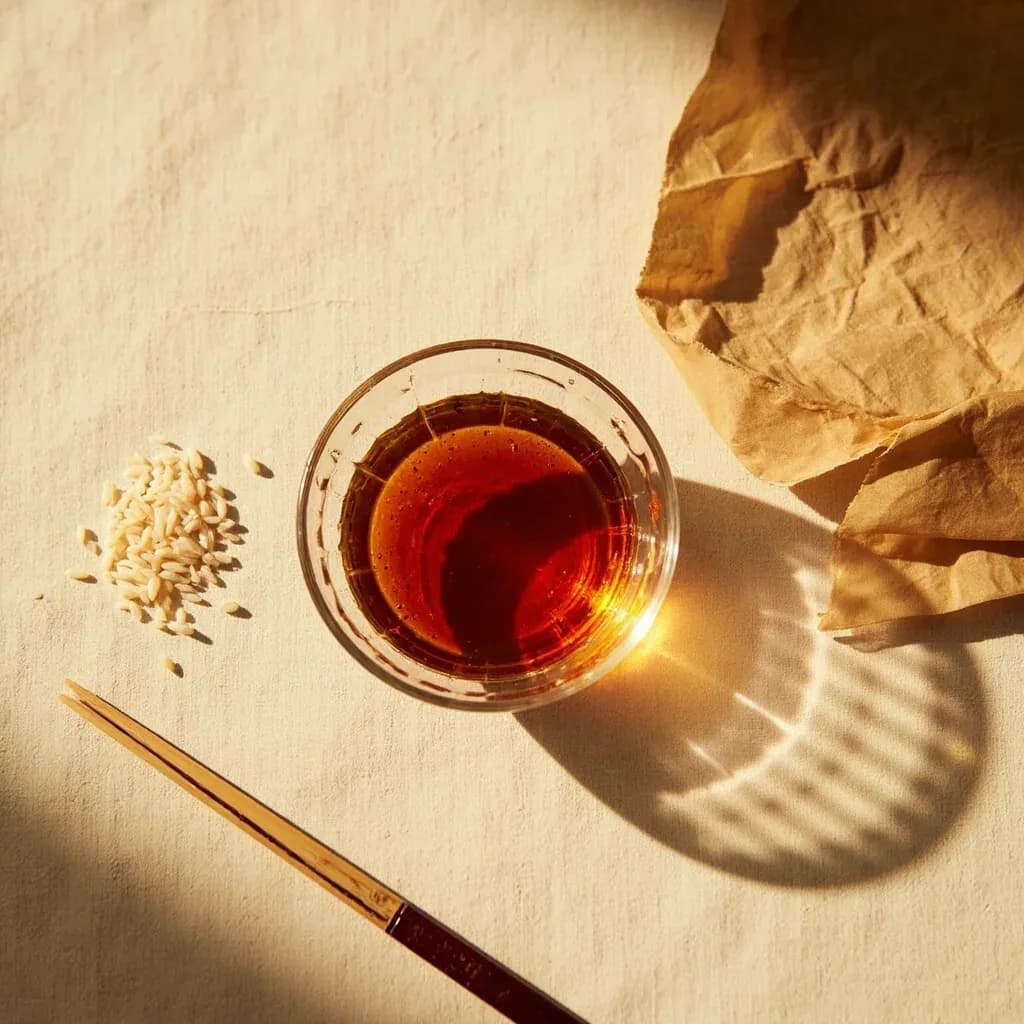
Sweet, low-alcohol rice wine that adds gloss and gentle sweetness to teriyaki, glazes, and simmered dishes; simmer briefly to cook off the alcohol and concentrate its shine.
Mirin is a Japanese rice seasoning with a split personality: simultaneously sweet, alcoholic, and faintly umami, achieved by letting steamed glutinous rice ferment with rice koji (Aspergillus oryzae) and a splash of shochu or sake. Unlike sugar syrups or sweetened sake, mirin is made by parallel fermentation — koji converts rice starch into glucose at the same time yeast produces alcohol — which is why a properly brewed hon-mirin carries both round sweetness and a soft, savory depth. That balance is the reason a spoonful in a simmering pot of daikon, or a final reduction brushed onto grilled fish, produces a flavor that sugar alone cannot replicate.
In the pan, mirin does work that ordinary sweeteners cannot. Its glucose and amino acids generate the lacquered, jewel-like gloss Japanese cooks call teri, the visual signature of teriyaki, sukiyaki, and unagi. Its alcohol carries aromatic compounds into food and helps proteins stay tender, while its mild acidity brightens salty or smoky ingredients without making them taste sharp. Treated with a little care — added late, reduced gently — it turns broths and glazes from merely sweet to deeply seasoned.
Outside Japan the word "mirin" on a label can mean very different things. A brewed hon-mirin (本みりん) is an alcoholic seasoning, about 12–14% ABV and 40–50% sugar with no added salt. Aji-mirin, the bottle most Western supermarkets actually stock, is a non-alcoholic condiment built on glucose syrup with 1–2% added salt. They behave differently in a recipe, and the distinction is worth learning before you start adjusting seasoning.
- Measured in
- ml
- Storage
- Pantry
Find it in
Suits
Types & varieties
The traditional brewed product: glutinous rice, koji, and shochu aged together. ~12–14% alcohol, ~40–50% sugar, no added salt. The most complex flavor and the glossiest reductions; the version a recipe means when it says 'mirin.'
Mirin-style seasoning built from glucose syrup, rice, and shochu with 1–2% added salt (and sometimes MSG or amino acids). Little to no alcohol. The most common supermarket bottle in Japan and abroad; taste before adding extra salt or soy, since the sodium concentrates as the liquid reduces.
Brewed mirin-style product with reduced alcohol (often around 1%) and slightly higher sweetness; a middle ground between hon-mirin and aji-mirin.
Modern export SKUs labeled simply 'Mirin' or 'Aji-Mirin' vary widely. Some are hon-mirin, some are salted seasoning. Avoid products that list only corn syrup, water, and salt with no fermentation step.
Why hon-mirin and sake are not the same thing
Both are fermented from rice, and both contain alcohol, but their flavor and function diverge sharply. In sake, yeast ferments almost all of the sugar into alcohol, leaving a dry, aromatic wine. In hon-mirin, koji works in parallel with the yeast, converting rice starch into glucose faster than the yeast can consume it. The result is a liquid that is sweet and alcoholic at once, with the gentle umami that koji reliably produces. That is why a splash of sake in a glaze tastes boozy and thin, while a splash of mirin tastes round, glossy, and complete. If you reach for a substitute, you are usually trying to recreate this sweet-umami-alcohol triangle, not just the sweetness.
- Koji-derived glucose gives mirin its body; sake's sugar is consumed during fermentation.
- The alcohol in mirin (12–14%) is a flavor carrier, not the main event.
- Hon-mirin reduces to a syrupy, lacquer-like glaze; sake reduces to a thinner, sharper one.
Reading the bottle
In Japan the labeling rules are strict, but in export markets they are not. A few minutes with the ingredient list saves a recipe:
- Hon-mirin: ingredients list rice, koji, and shochu (or sake); no added salt; ABV on the label.
- Aji-mirin: ingredients list glucose syrup or high-fructose corn syrup, rice, salt, and often shochu; ABV under 1% or zero.
- If sugar appears before rice, or salt appears at all, you are holding a seasoning, not a brewed mirin.
Common uses
Tips & pitfalls
- Add mirin toward the end of simmering. Long boiling drives off alcohol and volatile aroma; for teriyaki, reduce the sauce only until it turns syrupy and lacquer-like, not until it smells of caramelized sugar.
- Never sear hon-mirin over high heat at the start of cooking — its high glucose content scorches almost instantly. Bloom it briefly with the other liquids, or add it once the pan has cooled slightly.
- When using aji-mirin, taste before adding extra salt or soy sauce; the 1–2% added salt will concentrate noticeably as the liquid reduces.
- The signature teri shine comes from glucose and amino acids, not fat. Reduce mirin with dashi, soy, and sake until glossy and spoon-coating, then brush onto hot-off-the-grill food for restaurant-style lacquer.
- A splash in vegetable steaming water (with a little soy) gives a subtle sheen and sweetness to greens like spinach (ohitashi) and komatsuna without dulling their color.
- For sushi rice, mirin can replace part of the sugar, but it adds moisture — reduce the rice vinegar slightly or use a touch less cooking water so the rice seasons cleanly.
- Hon-mirin keeps well after opening for months refrigerated with the cap tight; aji-mirin is even more forgiving because of its added salt.
- When a recipe says 'mirin' in a Western cookbook, assume hon-mirin unless the bottle is specifically labeled aji-mirin — and adjust salt accordingly.
Nutrition
Nutrition
No USDA FoodData Central match for Mirin yet. We surface a per-100 g profile once a generic whole-food entry is matched and verified.
In the shops
Matched grocery products
No matched grocery products for Mirin yet.
Good to know
- Origin
- Japan; documented as a distinct seasoning since the Muromachi period (1336–1573) and central to Edo-period home cooking.
- Japanese name
- 味醂 (みりん); hon-mirin (本みりん) for the brewed type, aji-mirin (味醂風調味料) for the salted seasoning.
- Composition
- Steamed glutinous rice (mochigome), rice koji, and shochu or sake, aged together for one to three months or longer.
- Alcohol (hon-mirin)
- Approximately 12–14% ABV — legally classified as a brewed seasoning, not a beverage, in Japan.
- Sugar (hon-mirin)
- Roughly 40–50%, almost all glucose produced by koji, not added crystalline sugar.
- Sodium
- Negligible in hon-mirin; aji-mirin typically carries 1–2% added salt, which keeps it from being classified as an alcoholic beverage under Japanese liquor-tax law.
- Pronunciation
- MEER-in, with a long 'ee'.
- Storage
- Unopened, hon-mirin is shelf-stable for years in a cool, dark cupboard. Once opened, refrigerate for best flavor, especially hon-mirin; aji-mirin keeps well at room temperature.
Substitutes
- Sake + sugar — Per 1 tablespoon hon-mirin, use 1 tablespoon sake plus 1–2 teaspoons sugar. The closest match for sweetness, acidity, and alcohol-driven aroma; works in teriyaki, glazes, and nimono.
- Dry sherry + sugar — Substitute 1:1 for hon-mirin with about 1 teaspoon sugar per tablespoon. Use an unsalted dry sherry — cooking sherry is salted and will throw off the seasoning.
- Dry white wine + sugar — A neutral dry white with 1 teaspoon sugar per tablespoon. Lacks koji-derived umami but works in glazes and quick pan sauces.
- Sweet Marsala — Naturally sweet and low-acid, so reduce any added sugar in the recipe by half. Not ideal when a clean, light sweetness is wanted.
- Chinese mijiu (sweet rice wine) — Approximate match — milder and slightly less sweet than hon-mirin; add a pinch of sugar if needed.
- Non-alcoholic option — 2 teaspoons sugar dissolved in 1 tablespoon water with a few drops of rice vinegar. Prevents burning and adds sweetness, but lacks the umami depth of brewed mirin.
Pairs with
Also called
sweet rice wine · hon-mirin
Appears in these dishes
Related
Soy Sauce
Salty, savory umami base for stir-fries and marinades
Hot Sauce
Tangy, fiery splash for eggs, tacos, and anything dull
Tomato Sauce
Simmered tomato base for pasta, pizza, and braises
Barbecue Sauce
Smoky-sweet sauce for grilling, glazing, and dipping
Pesto
Vibrant basil-and-pine-nut sauce for pasta and beyond

Fish Sauce
Funky, salty essence that brings deep umami to SE Asian dishes
Worcestershire Sauce
Tangy, savory umami splash for marinades, stews, and Caesar

Sriracha
Garlicky chili sauce with sweet heat for drizzling and dipping