Proteins
Dungeness Crab
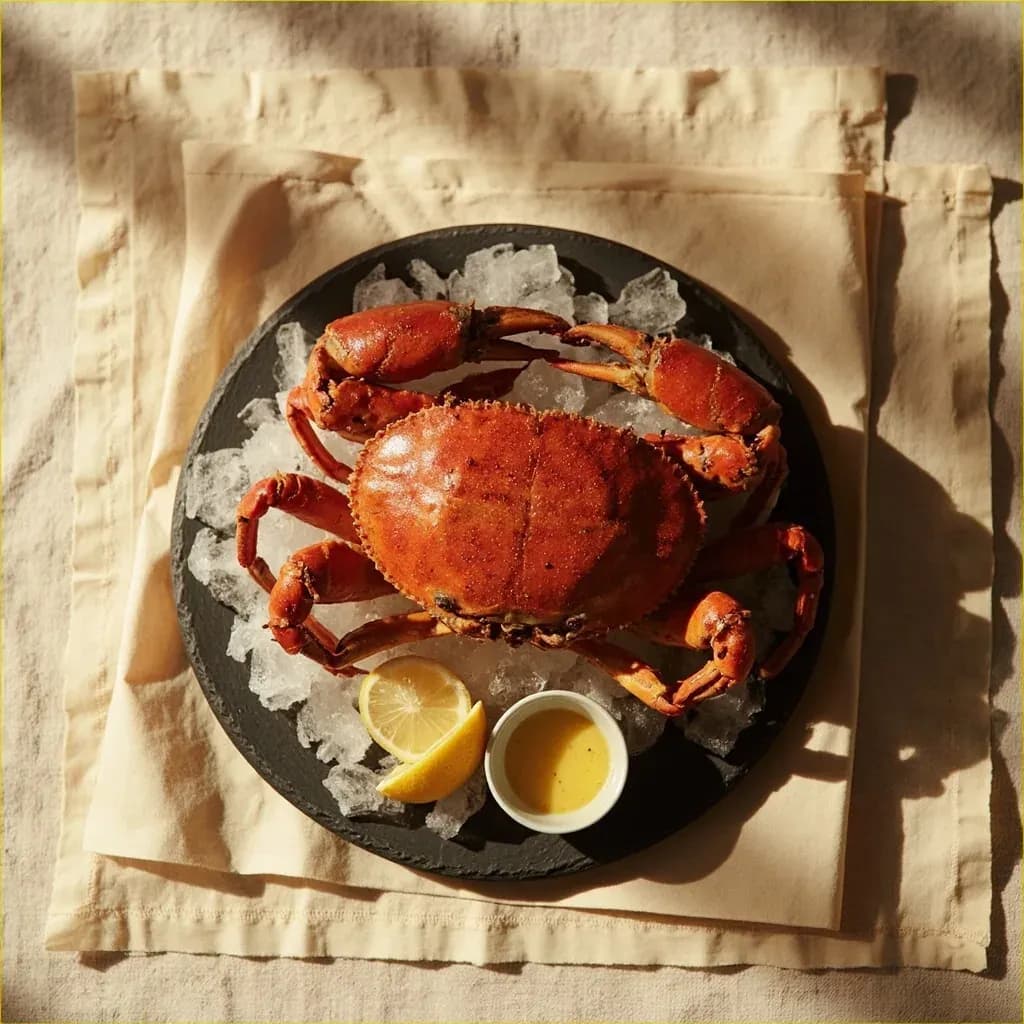
Large Pacific crab with sweet, tender white meat in generous quantity; usually sold whole and cooked, then steamed or cracked for picking. Mild and clean-tasting.
Dungeness crab (Metacarcinus magister, formerly Cancer magister) is the dominant commercial crab of the U.S. West Coast and the benchmark by which other Pacific crabs are judged. A wide, oval-shelled animal with stout claws and eight walking legs, it reaches market size at 1.5 to 2.5 pounds, with jumbos running 3 pounds and up. The meat is sweet, clean, and slightly briny, with a firmer bite than blue crab and a meatier yield than king or snow crab. The flavor is restrained on purpose: the crab wants steam, butter, lemon, and a sharp knife far more than a heavy sauce.
The body holds the largest share of meat, especially the two shoulder muscles flanking the small internal cartilage plate; the legs and claws supply the rest, and a careful picker recovers roughly a quarter of the live weight. Many crabs at retail have already been cooked at the dock and need only gentle reheating, but the best eating starts with a live crab that goes into the pot within hours of leaving the water. The cracked shells are not waste — simmered briefly in water they quietly lift chowders, bisques, risotto, and pasta sauces. Skip the feathery gills (the "dead man's fingers"), the mouth parts, and the small hard disc inside the body. The yellowish hepatopancreas, often called crab butter or mustard, is prized in home kitchens but concentrates domoic acid during toxic algal blooms, so check your state health advisory before eating it.
The fishery is genuinely seasonal: state-managed closures run through the summer molt, when shells are soft and yield is low, so Dungeness is at its best from late fall through spring. The species is not farmed at scale, which means supply, size, and price all move with the season and the weather.
- Measured in
- g
- Storage
- Refrigerate
Allergens
Find it in
Types & varieties
Standard market form with full, firm shells and the best meat-to-weight ratio; the bulk of landings.
Recently molted; the shell is paper-soft. Brief window during the molt, with lower yield and a more watery texture.
Affordable; lighter bodies but proportionally more leg meat.
The most common size at retail and restaurant markets.
Heaviest bodies; premium pricing, often featured whole.
Rare; sold whole by the piece and usually shared.
Cooked, hand-picked body and leg meat, sold fresh or frozen in tubs; convenient for crab cakes, salads, and pastas.
Frozen or fresh, often pre-cut; convenient for grilling and broiling.
Anatomy: the parts that matter
The two shoulder muscles inside the body are the prize — large, sweet, and almost always the best bite on the crab. Leg and claw meat is firmer and slightly more briny, and stands up well to heat, which is why picked leg meat is the standard for crab cakes. Skip the feathery gills (the "dead man's fingers") along the sides of the body, the small hard cartilage plate inside, and the mouth parts at the front; all three are bitter, gritty, or both. The yellowish-brown hepatopancreas, often called crab butter or mustard, is rich and intensely flavored and is traditional in many West Coast preparations, but it concentrates domoic acid during toxic algal blooms. Check your state health advisory (issued by CDPH, OHA, or WDOH as 'crab viscera' or 'crab butter' warnings for specific coastal sections and dates) before eating it.
The shell cycle: hard, soft, and why the season closes
Dungeness grow by molting — shedding the old shell and pumping themselves up before the new one hardens. For a short window, usually summer, much of the population is soft-shell, with low meat yield, watery texture, and fragile animals that do not survive handling. State fisheries close the season through this period to protect the population and let the new shells fill in, and the bulk of landings in the cooler months are hard-shell with the best yield. A few soft-shells do reach market and are eaten whole, shell and all, much like soft-shell blue crab, but expect noticeably less meat and a wetter bite. When buying, a hard-shell crab should feel heavy for its size and resist a thumbnail pressed into a leg joint.
Shell stock
Crab shells are a free flavor layer. Crack the bodies and claws, rinse briefly to remove loose debris, and toast them in a dry pot or in a little oil until fragrant and just starting to color. Cover with cold water, add a roughly chopped onion, a few ribs of celery, a bay leaf, and a splash of white wine, and simmer 30 to 45 minutes. Strain and use the stock as the base for cioppino, chowder, bisque, risotto, or any pasta sauce calling for seafood stock. It keeps three months frozen and will quietly improve nearly any seafood dish in the meantime.
Common uses
Tips & pitfalls
- Buy live whenever possible — the meat of a dead crab degrades fast and turns mushy or ammoniated within hours of death.
- Steam rather than boil when you have a choice; the meat stays in contact with fewer water-soluble flavor compounds and the pot is not full of leached-out juices.
- Time the cook from the moment the pot returns to a full boil, not from when the crab goes in: about 15 minutes for a 1.5 lb crab, 20 minutes for 2 lb and up.
- Pull the crab the instant the shell is uniformly bright orange and a leg joint snaps free cleanly; the line between tender and rubbery is short.
- Chill the cooked crab briefly before picking — the meat releases more cleanly from a cold shell, and the body is easier to halve cleanly.
- Save every cracked shell and any drained cooking liquid; even a short simmer with a handful of shells adds real depth to chowder, bisque, or risotto stock.
- Skip the gills ("dead man's fingers"), the mouth parts, and the small hard cartilage plate inside the body — they are bitter or gritty and have no place in the dish.
- If the cooking water smells strongly of iodine or ammonia, the crab was already past its prime — discard it and start over.
Nutrition
Energy
360 kJ · per 100 g
Where the calories come from
Protein
17.4g
35% DV
Carbs
0.7g
0% DV
Fat
1g
1% DV
Fiber
0g
0% DV
Sodium
295mg
13% DV
Source · USDA FoodData Central · Crustaceans, crab, dungeness, raw
View on FDC →In the shops
Matched grocery products
No matched grocery products for Dungeness Crab yet.
Good to know
- Scientific name
- Metacarcinus magister (formerly Cancer magister)
- Range
- Eastern Pacific, Aleutian Islands south to Baja California Sur; commercial fishery centered in Washington, Oregon, and California
- Market size
- Most crabs 1.5–2.5 lb (0.7–1.1 kg); jumbos 3 lb (1.4 kg) and up
- Meat yield
- Roughly 20–25% of live weight as picked meat, with the body holding the largest share
- Season
- Generally late fall through spring; closed during the summer molt when shells are soft and yield is low
- Doneness
- Internal temperature 145°F (63°C); shell turns uniformly bright orange-red, usually 15–20 minutes in a hard boil or full steam
- Live storage
- Cool (40–50°F / 4–10°C), damp, shaded, with wet newspaper or burlap; do not submerge in fresh water; cook within 24 hours
- Cooked storage
- Whole cooked crab 2–3 days refrigerated on a covered tray; picked meat 2–3 days refrigerated or 2–3 months frozen
Substitutes
- King crab legs — Firmer, larger, and more expensive; a good fit for leg-meat presentations like garlic-butter clusters, but body-meat dishes behave differently.
- Snow crab — More delicate and slightly sweeter, with thinner shells; works in salads, pasta, and stir-fries. Leg clusters are usually all that is sold.
- Blue crab (picked meat) — Sweeter and more delicate; more work to pick but a classic substitute for crab cakes and cold salads.
- Jonah crab — East Coast counterpart in size and flavor; increasingly available picked and frozen. A good all-purpose substitute.
- Stone crab claws — Sweet, firm, slightly briny; excellent for cold presentations and cracking, but only the claws are sold.
- Brown crab (live, Europe) — The closest international cousin — large, meaty, with a similar sweet profile. Often sold live in the UK and Europe.
- Lobster meat — Sweet and firm, but pricier and richer; works in pasta, risotto, and gratins. Use less because the flavor is richer.
- Surimi / imitation crab — Budget option for salads, dips, and California rolls; not a flavor match, so use only where seasoning carries the dish.
Pairs with
Also called
Dungeness · Metacarcinus magister · Pacific crab
