Proteins
Snow Crab
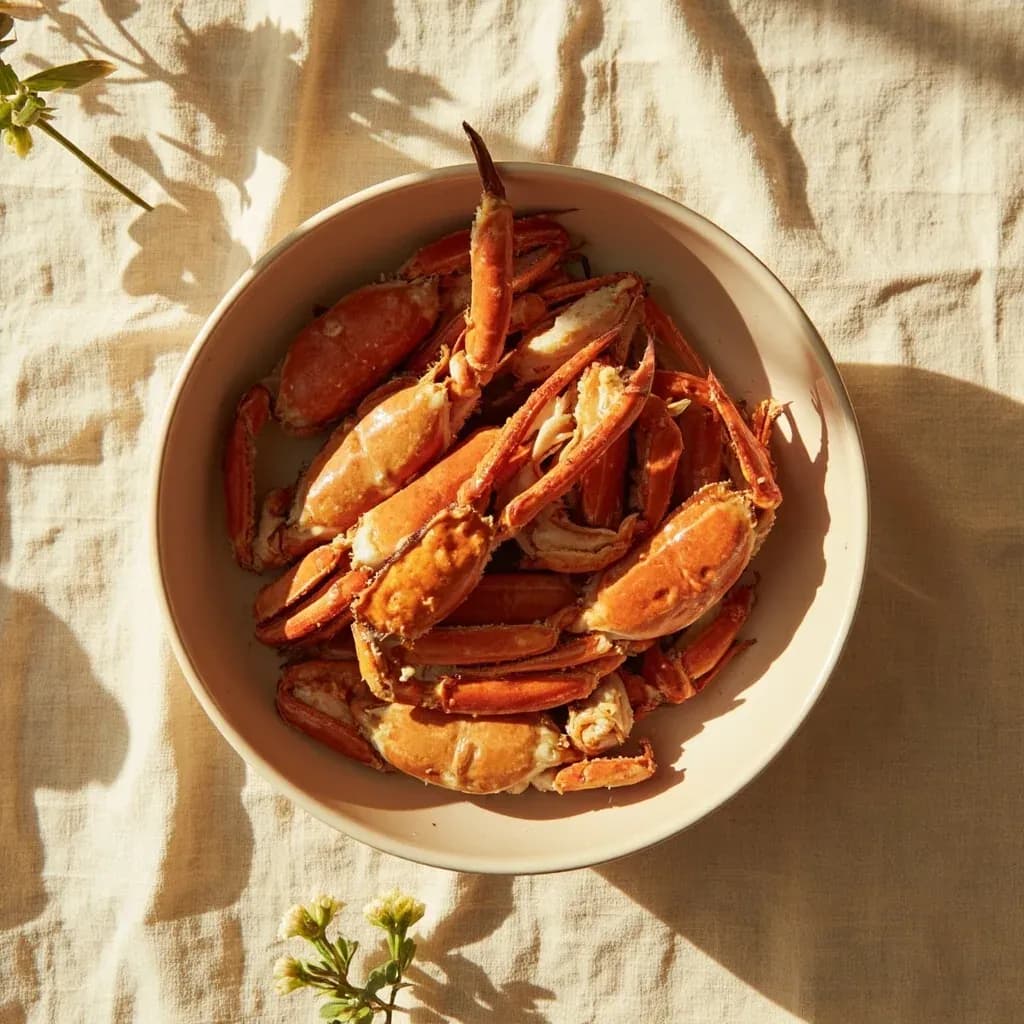
Long-legged crab with sweet, fibrous, easy-to-pull meat. Sold as clusters; steam or boil and serve with drawn butter, or pick for cakes and rolls.
Snow crab (primarily Chionoecetes opilio, with the closely related tanner, C. bairdi, often sold under the same name) is a cold-water crab harvested from the continental shelves of the North Pacific and Northwest Atlantic. The legs — long, spindly, and dramatically more abundant than the body — are the entire reason the fishery exists; a whole snow crab is mostly shell, and a cooked cluster is mostly leg. What cooks love is the meat itself: pale, faintly pink, mildly sweet, and built in long fibers that pull cleanly from the shell with almost no effort. It is one of the sweetest and most approachable of the large crabs, and considerably more affordable than king crab or lobster.
The single most important thing to know about snow crab is that almost every cluster you buy has already been fully cooked on the processing boat within hours of harvest, then frozen at sea. Your job in the kitchen is not to cook it but to reheat it gently and pick it well. Steam or boil it just until the shells are hot and the meat is warmed through, and stop there; every extra minute tightens the proteins, squeezes out moisture, and turns that clean, sweet flavor into something rubbery and dull.
Because the meat is already cooked, fibrous, and fairly lean, snow crab shines in applications where its texture is the point: pulled into salads, layered into rolls, lightly bound into cakes, dropped into chilled seafood platters, or simply cracked and eaten with butter. It does less well in long braises, where the strands fall apart. The shells — and there are a lot of them — are too valuable to throw away; a brief simmer produces a clean, sweet stock that anchors chowders, risottos, and Asian-style broths.
- Measured in
- g
- Storage
- Refrigerate
Allergens
Find it in
Types & varieties
Chionoecetes opilio — the classic snow crab. Slimmer legs, very sweet, slightly more delicate meat. Midwinter season.
Chionoecetes bairdi — meatier claws and shoulders, often sold interchangeably as 'snow crab.' Slightly later season than opilio.
Full leg-plus-shoulder sections, graded by weight per piece (5–8 oz up to 12 oz+).
Just the joint, no shoulder — common in foodservice for portion control and quick plating.
Sometimes packed separately; the meatiest, most prized pieces with the densest texture.
Pre-cracked lengthwise down the underside — ready to grill, sauté, or plate without further cracking.
Hand-picked leg meat, fully cooked, shelf-stable. Good for dips, cakes, and salads where shape doesn't matter.
Buying and Storage
Buy frozen unless you have a trusted live source. Look for clusters with tight, intact shells and legs that haven't blackened or dried at the tips — a sign of freezer burn or age. The package should feel solidly frozen, with no free liquid inside (which signals a thaw/refreeze). Most clusters are graded by weight per piece, not by count; an 8–10 oz cluster is a generous single portion, while 5–8 oz pieces work well for shared platters. Keep them in the coldest part of the freezer and use within six months for best texture; properly stored, they'll go to twelve months, but the meat gradually loses its sweetness past that.
Reheating Without Ruining It
The two routes — steaming and boiling — work equally well; steaming has a slight edge because the meat doesn't sit in water. Salt the cooking water heavily (about 2 tablespoons of sea salt per quart) to mimic ocean salinity and reinforce the crab's natural brininess. A thawed cluster needs only 5–8 minutes; from frozen, 8–10. Pull the moment the shells are too hot to handle comfortably and the meat at the joint feels just-warm. Rest the cluster for a minute before cracking — the carryover heat finishes the job and lets the juices redistribute.
Picking the Meat
Pick crab while it is still slightly warm; the meat releases from the membrane far more cleanly than when fully chilled. For legs, snip the underside of each segment with kitchen shears, then push the meat out from the small end with your thumb or a chopstick — it slides out in a single intact piece, which is exactly the look you want for salads and rolls. For claws and shoulders, crack under a damp kitchen towel (the dampness keeps shell shards from flying) and tease the meat free with a pick or the tip of a paring knife. Save every piece of shell for stock.
Common uses
Tips & pitfalls
- Treat nearly all retail clusters as already cooked — reheat gently, do not cook through, or the meat turns rubbery and the sweetness flattens.
- Steam over heavily salted water (about 2 tablespoons sea salt per quart) so the crab absorbs a little brininess as it warms.
- Thaw overnight in the refrigerator for the best texture; in a hurry, run the sealed bag under cold running water rather than microwaving.
- Skewer clusters end-to-end before serving — they sit flat, handle cleanly at the table, and look like a restaurant job.
- Crack claws and joints under a damp kitchen towel to keep shell shards contained and your counters clean.
- Pick the meat while it is still slightly warm; it releases from the membrane much more cleanly than when fully chilled.
- For crab cakes, drain the picked meat well on paper towels and bind it lightly — too much binder is the single most common mistake and turns delicate crab into a bready puck.
- Don't drown reheated crab in butter before tasting it; assess the sweetness on its own first, then add fat.
- If the package smells ammoniated or the meat is gray and mushy, throw it out — these are signs of thaw/refreeze or age.
Nutrition
Energy
377 kJ · per 100 g
Where the calories come from
Protein
18.5g
37% DV
Carbs
0g
0% DV
Fat
1.2g
2% DV
Fiber
0g
0% DV
Sodium
539mg
23% DV
Source · USDA FoodData Central · Crustaceans, crab, queen, raw
View on FDC →In the shops
Matched grocery products
No matched grocery products for Snow Crab yet.
Good to know
- Species
- Chionoecetes opilio (true snow crab); C. bairdi (tanner) sold interchangeably in many markets
- Range
- North Pacific and Northwest Atlantic — Alaska, British Columbia, Russia, Japan, Eastern Canada, Greenland
- Forms sold
- Live (rare in retail), cooked-frozen clusters, frozen leg sections, pasteurized canned meat
- Cluster grading
- Typically 5–8 oz, 8–10 oz, 10–12 oz, and 12 oz and up
- Yield
- Roughly 25% meat to shell from whole clusters; claws give the densest pieces
- Cooked at sea
- Most retail clusters are fully cooked and frozen within hours of harvest — reheat only
- Reheat time
- About 5–8 minutes steaming for thawed clusters; 8–10 minutes from frozen
- Frozen shelf life
- Around 6 months for best quality; 9–12 months acceptable
- Season
- Alaska fishery October–January; Canadian seasons vary by zone
- Major producers
- Canada, Russia, United States (Alaska), and Norway
Substitutes
- Dungeness crab — Sweeter, meatier body meat; works for whole-crab presentations but costlier and harder to find whole.
- King crab — Richer, fatter claw meat; premium one-for-one swap for clusters, significantly more expensive.
- Blue crab — Sweeter, much smaller pieces; good in cakes, salads, and stuffings but not as a cluster substitute.
- Lobster — Luxury swap — tails give a similar sweet, fibrous meat in a different shape.
- Imitation crab (surimi) — Budget option for salads, rangoons, and dips; lacks real crab texture and flavor.
- Pasteurized canned crab — Substitution for picked meat in cooked applications like cakes, dips, and casseroles.
Pairs with
Also called
queen crab · opilio crab · spider crab
