Herbs
Flat-Leaf (Italian) Parsley
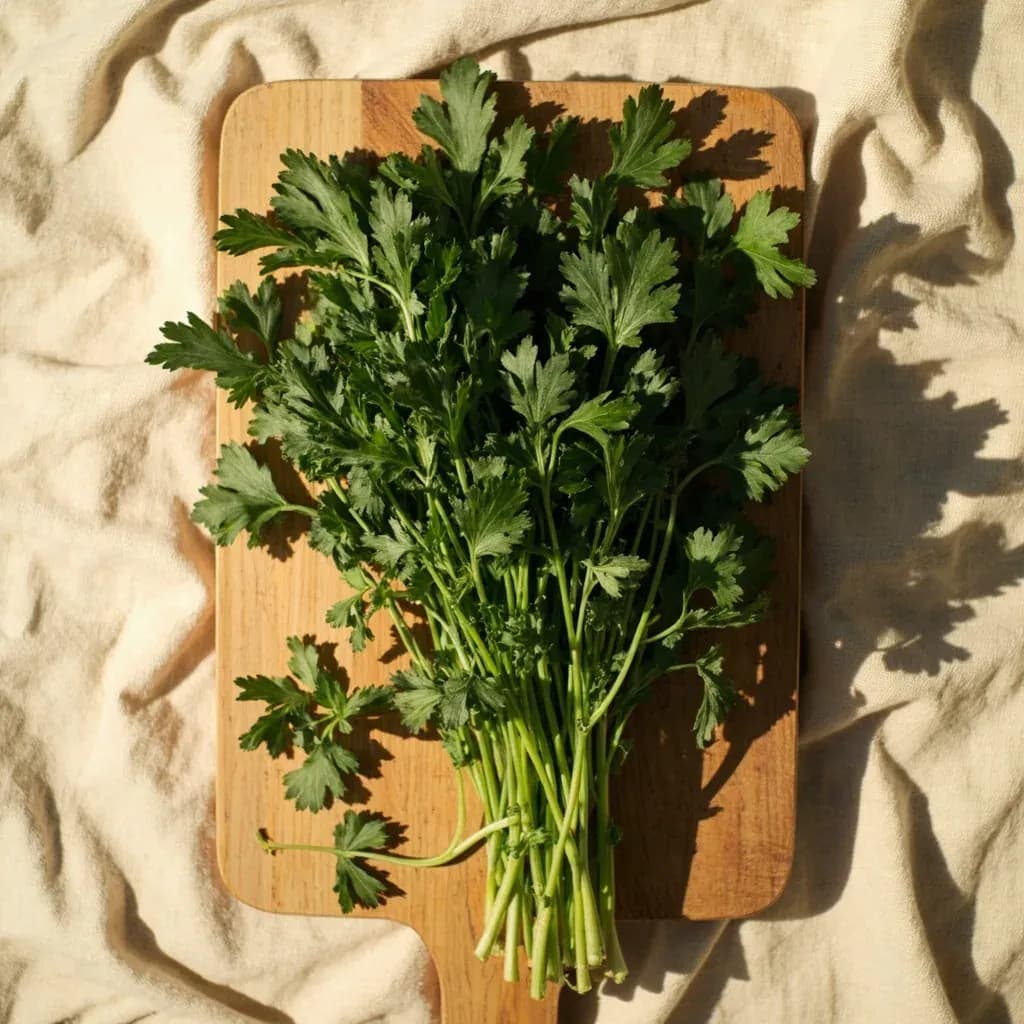
Flat serrated leaves with a cleaner, more robust flavor than curly parsley; the cooking parsley that holds up to heat in sofrito, gremolata, and tabbouleh.
Flat-leaf parsley (Petroselinum crispum var. neapolitanum) is the cooking parsley of the Mediterranean and the Levant — a biennial in the carrot family grown for its broad, serrated, dark-green leaflets and pale, fibrous stems. Where curly parsley earns its keep as a garnish and plate-framer, flat-leaf is the parsley you actually eat: its flavor is cleaner, more resinous, and distinctly grassy with a faint celery-carrot undertow from the same family oils (myristicin, apiole) that scent celery, lovage, and carrot tops. Chefs reach for it not just because the leaves are easier to chop evenly, but because the flavor survives a brief sauté and still reads as parsley at the table.
In the pan, flat-leaf behaves like a green vegetable more than a delicate herb. Add it too early and it fades to a hay-like whisper; add it in the last minute of cooking, or off the heat, and its volatile oils stay bright. The stems are not waste — they hold their flavor through long simmering and are the preferred parsley component for stocks, court bouillon, braising liquid, and the bouquet garni. Flat-leaf also holds its own in raw preparations (tabbouleh, salsa verde, chimichurri) where curly would feel decorative rather than central.
It is the workhorse herb in Italian, French, Spanish, Portuguese, Greek, Middle Eastern, and Argentinian kitchens, and the universal finishing herb for anything that benefits from garlic, lemon, or good olive oil on its way to the plate. The whole plant earns its place in a cook's kitchen: leaves for finishing, stems for simmering, and a single plant left to flower for the beneficial insects and the next season's seed.
- Measured in
- g
- Storage
- Fridge
Find it in
Suits
Types & varieties
Large, broad, deep-green leaves; the standard market-garden cultivar and the most widely grown flat-leaf type in Italy and the U.S.
The unnamed but consistent flat-leaf parsley sold in supermarket bunches; vigorous and noticeably more heat-tolerant than curly.
Compact plants with very dark, smooth-edged leaves; favored for hydroponic and indoor production.
Older open-pollinated strain with intense color and slightly smaller leaves than Giant of Italy; favored by some cooks for its concentrated flavor.
Petroselinum crispum var. tuberosum, grown for its parsnip-like taproot; the leaves are usable parsley, but the root is the point.
Not a true parsley (Cryptotaenia japonica) but used similarly as a finishing herb in East Asian cooking, with a comparable grassy bite and a hint of its own.
Leaves vs. Stems: Use Both
The stems of flat-leaf parsley carry substantial aromatic oil and stand up to long cooking far better than the leaves. Save them for stocks, court bouillon, braising liquids, and the bouquet garni, where they contribute flavor over hours without breaking down into the limp, dark strings that overcooked leaves turn into. The leaves are reserved for finishing — added in the last minute of cooking or off the heat — so the volatile oils are still on the plate when it reaches the table.
- Stems: stocks, court bouillon, braising liquid, bouquet garni.
- Leaves: finish sautés, pasta, grilled fish and meats, raw sauces, salads, garnishes.
- A common kitchen habit of stripping leaves and discarding stems wastes a meaningful portion of the plant's flavor.
Fresh vs. Dried
Dried flat-leaf parsley is a commodity used in food manufacturing and in stocks, where it plays a quiet background role. It is a poor substitute for fresh in any preparation where parsley is the lead flavor (gremolata, tabbouleh, salsa verde) — the bright top notes evaporate on drying, leaving a hay-like, dusty version of the herb. For year-round parsley flavor, freeze the leaves: chop and freeze in olive oil in ice-cube trays, or blanch for 10 seconds, shock in ice water, squeeze dry, and freeze flat in a zip bag.
- Use dried parsley only as a background aromatic in stocks, braises, and stuffings.
- Frozen parsley cubes (in oil) drop directly into sautés, soups, and pasta sauces in winter.
- Blanch-and-freeze preserves color better than raw freezing.
Flat-Leaf vs. Curly
The two are botanical variants of the same species, but they cook and behave differently. Curly parsley's ruffled leaves trap water in their pockets (diluting sauces, splattering in hot fat) and carry a milder, slightly mustier flavor; flat-leaf has clean, flat surfaces that wash and chop predictably, and a more pronounced grassy-resinous character. The choice is not aesthetic — flat-leaf is the parsley you cook with, curly is the parsley you frame the plate with.
- Flat-leaf: cook with it, chop it, eat it. Curly: garnish with it, chop it finely for a texture contrast in cold salads.
- In a tight squeeze, curly works in cooked dishes if you use it by volume and add it late — but the flavor gap is real.
- Most bunches labeled simply 'parsley' in Mediterranean markets are flat-leaf; confirm by leaf shape (flat, serrated) rather than the label.
Common uses
Tips & pitfalls
- Use flat-leaf, not curly, whenever the herb will actually be eaten: the flavor is cleaner and the leaves chop evenly without trapping water in their ruffles.
- Reserve stems for stocks, braising liquid, and bouquet garni — they carry more flavor than many herbs' leaves.
- Add chopped leaves in the last 1–2 minutes of cooking (or off the heat) to preserve their volatile oils; long cooking reduces them to a grassy whisper.
- Wash by swishing in several changes of cold water; flat leaves hide grit at the base of the stems. Spin or pat very dry before chopping — wet herbs dilute sauces and dressings.
- Chop with a sharp knife rather than tearing or using a dull blade; bruised leaves oxidize, darken, and lose aroma within minutes.
- Do not confuse young flat-leaf parsley with cilantro — both are serrated and similar in size. Rub a leaf between your fingers: parsley smells grassy, cilantro smells soapy to many people.
- If growing your own, succession-sow from early spring; flat-leaf is more heat-tolerant than curly but still bolts in midsummer heat. Let one plant flower for beneficial insects and seed.
- Pair parsley with acid (lemon, vinegar) and fat (olive oil, butter) to bring out its chlorophyll-driven flavor; without fat and acid, it reads raw and grassy.
Nutrition
Energy
151 kJ · per 100 g
Where the calories come from
Protein
3g
6% DV
Carbs
6.3g
2% DV
Fat
0.8g
1% DV
Fiber
3.3g
12% DV
Sugars
0.9g
of which
Sodium
56mg
2% DV
Source · USDA FoodData Central · approx. Parsley, fresh
View on FDC →In the shops
Matched grocery products
 €0.85
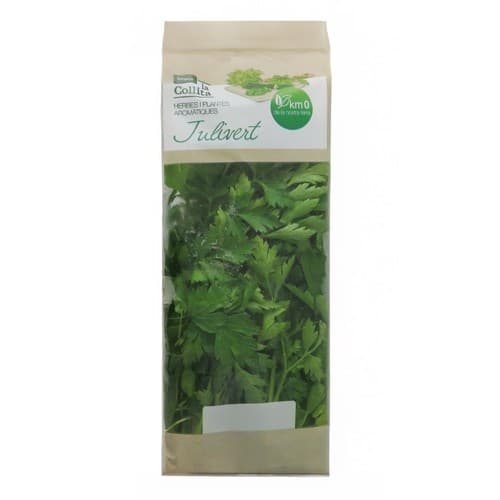
€0.85Fresh Parsley Km0
LA COLLITA · kg · Bonpreu
 €0.89
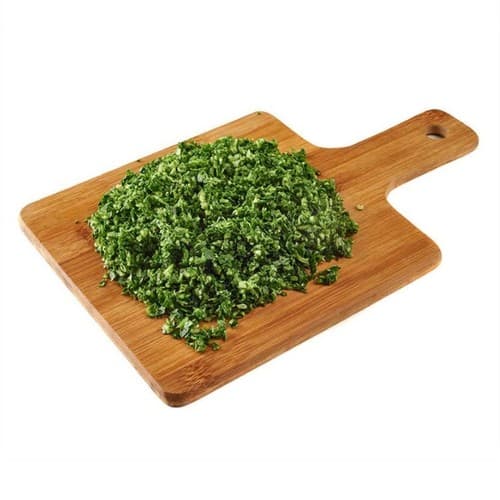
€0.89Chopped Parsley Terrine 100g
LA COLLITA · kg · Bonpreu
Good to know
- Scientific name
- Petroselinum crispum var. neapolitanum (syn. P. hortense)
- Family
- Apiaceae (Umbelliferae) — the carrot/celery family
- Plant type
- Biennial herb, almost always grown as an annual; bolts in midsummer heat
- Flavor
- Clean, grassy, mildly peppery, faintly bitter; stronger and more resinous than curly parsley, with subtle celery-carrot notes
- Storage (fresh)
- Stems in 1 inch of water in the fridge loosely covered, or wrapped in dry paper towel in a zip bag, 7–10 days; do not wash until using
- Storage (long-term)
- Freeze chopped leaves in olive oil in ice-cube trays, or blanch 10 seconds and freeze flat; drying is acceptable for stocks only
- Nutrition note
- Exceptionally high in vitamin K; meaningful vitamin C, vitamin A, iron, and folate
- Toxicity note
- Culinary amounts are safe; the essential oil and seed oil are not — they contain concentrated apiole and myristicin
Substitutes
- Curly parsley — Workable in cooked dishes and as a garnish; milder flavor and a different texture mean using slightly more by volume. Not ideal for chimichurri or tabbouleh, where flat-leaf is central to the character.
- Chervil — Closest match in the French tradition, with a delicate anise note. Best in uncooked or lightly cooked preparations; halve the quantity — it is more delicate than parsley.
- Cilantro — Useful in Mexican, Middle Eastern, or Asian dishes where parsley is finishing a savory preparation, but the flavor is distinctly different. Best as a parsley stand-in in salsa verde-style sauces rather than Italian or French contexts.
- Celery leaves — A genuine substitute in cooked bases (soffritto, stocks) where parsley stems would be used; they share the same family character and stand up to long cooking.
- Fresh oregano — Acceptable in Mediterranean cooked dishes where parsley is one note in a mixture; do not use it as a garnish or finishing herb.
Pairs with
Also called
Italian parsley · flat parsley · perejil · julivert pla