Proteins
King Crab
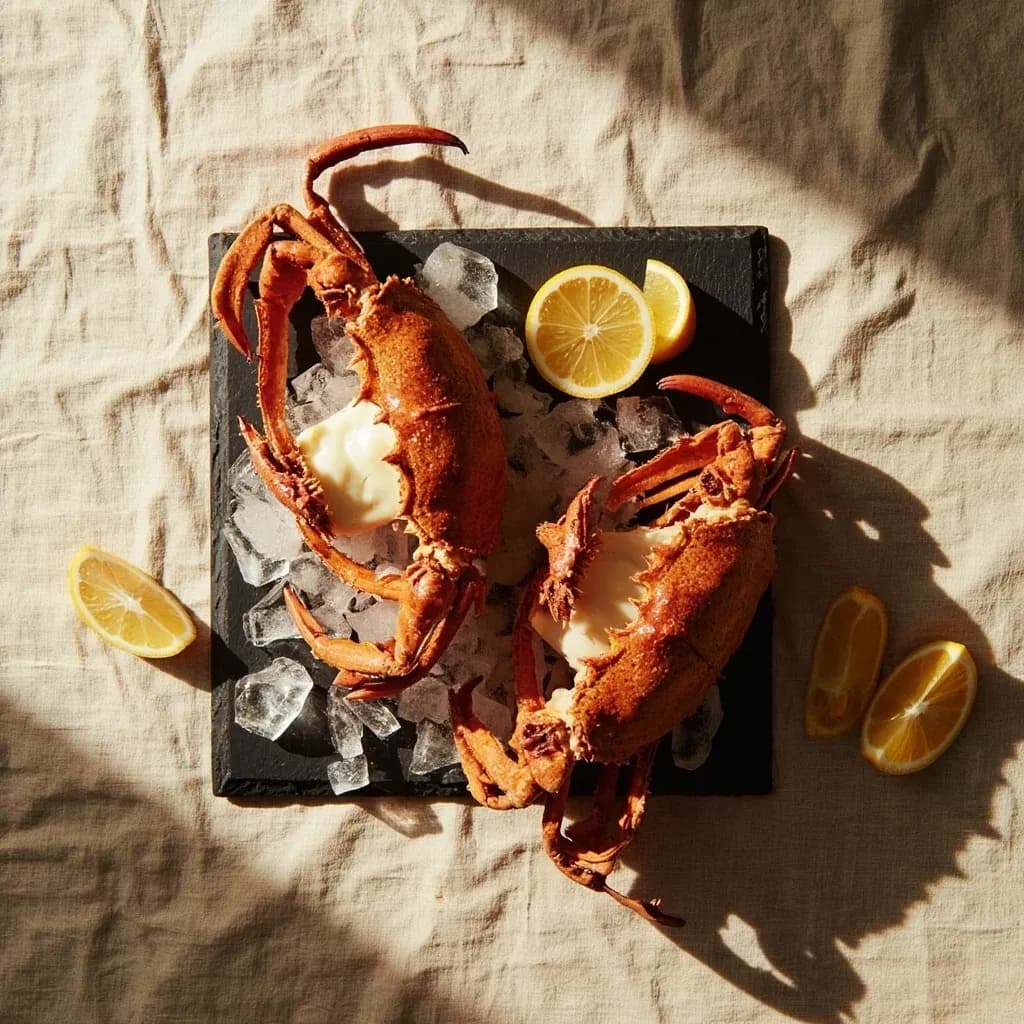
Giant cold-water crab sold as long spiny legs of sweet, firm snowy meat; almost always pre-cooked and frozen, so just steam or warm through and serve with butter.
King crab refers to several large cold-water species of the genus Paralithodes, harvested from the North Pacific — the Bering Sea, the Aleutian chain, the Sea of Okhotsk, and increasingly the Barents Sea. What reaches the market is almost entirely the long, spiny legs and thick claws; the body and shoulder are comparatively small and far less prized. The meat is sweet, mildly briny, and substantial — firmer and meatier than snow crab, less delicate than Dungeness — with long fibers that flake cleanly along the shell when handled well.
The single most important fact for a cook is that virtually every commercial king crab has already been cooked. Boats run steam cookers within hours of hauling the pots, and the cooked legs are then blast-frozen at sea. The product you buy — even the most expensive grades — is a reheat-and-serve ingredient, not a raw one. Treating it like fresh-caught crustacean and cooking it again from raw is the single most common way to ruin a very expensive plate of food.
That reality shapes everything: gentle steaming or a brief warming in a low oven is the entire technique. The leg sections are the prize, prized for their long, snowy fibers; the coarser shoulder meat is best diverted to stocks, bisques, or crab cakes where its texture is masked. Price is steep, but yield is good — a 1.4 kg (3 lb) cluster gives roughly 450–600 g (1–1¼ lb) of meat — and the work at the table (cracking, picking) is part of the appeal.
- Measured in
- g
- Storage
- Freeze
Allergens
Find it in
Types & varieties
The dominant commercial species worldwide; large reddish-brown legs with thick, sweet meat — most of what you'll find at retail
Bering Sea and St. Matthew Island fishery; leg sections a touch smaller and the meat slightly more delicate in flavor
Smaller and less common; mainly Japanese and Korean markets; meat is finer-textured
Japanese winter delicacy prized for claw meat served sashimi-style as kani-sashi
Leg meat vs. shoulder and body meat
A king crab cluster is not all equal. The leg sections — the long, tapering segments with their fans of meat — are the reason you paid the price: sweet, fibrous, photogenic. The shoulder (the chunky section where the legs join the body) is meatier but coarser, with a slightly stronger iodine note. The body cavity itself carries brownish meat and fat that, while flavorful, is best strained into stock rather than plated whole. For cocktails, salads, and pasta where the meat is the star, work from the legs. For bisques, chowders, gratins, and crab cakes, the shoulder and body meat can be put to excellent use — often better than leg meat, since the coarser texture disappears into the sauce or binder.
- Leg meat: longest fibers, sweetest flavor, finest presentation — for steaming, cold service, and sushi
- Shoulder meat: denser, slightly stronger — grate or chop for crab cakes and fillings
- Body meat and fat: high flavor, low prestige — strain into stock or enrich bisques
- A 1.4 kg (3 lb) cluster typically yields about 450–600 g (1–1¼ lb) of total picked meat
Common uses
Tips & pitfalls
- Heat only to warm through — legs are already cooked, so the target internal temperature is 60–65 °C / 140–150 °F; any hotter and the meat turns rubbery
- Steam over lightly salted simmering water (about 1 tbsp sea salt per litre) rather than boiling; direct boiling washes out flavor and leaches salinity
- For frozen clusters, start with the lid off for a couple of minutes to vent the chill, then cover and steam for 10–12 minutes total; thawed legs need only 6–8 minutes
- Let the cluster rest 30 seconds after steaming so the juices redistribute through the fibers rather than pooling on the plate
- Crack shells with a wooden mallet, the back of a heavy chef's knife, or purpose-made crackers — never hack at the joint with a cleaver, which shatters the meat
- Snip the underside of each leg segment with sturdy kitchen shears before cracking; the shell splits cleanly and the meat comes out in one piece
- Hold picked meat in a warm bowl with a spoonful of the steaming liquid and a small pat of butter — it dries out within minutes on a cold plate
- Microwaving whole clusters is a trap — the edges overcook long before the center warms; if pressed, separate the legs and steam in a covered bowl
- Watch for glaze weight: 'glazed' frozen crab carries an ice coating that can add 10–15% to the package weight — rinse briefly and pat dry before steaming so the water doesn't dilute butter sauces
- Dress salads and pasta with crab at the very last moment — acid and salt both draw moisture out of the meat and turn it cottony
- Reserve every shell, including leg tips you've cracked, for stock: roast at 220 °C / 425 °F for 10 minutes, then simmer with onion, fennel, tomato, and a bay leaf for 30–45 minutes
- Buy smaller 3-leg 'splits' for weeknight portions and save full 6–9-leg clusters for platters — pricing per kilogram is usually better on the big clusters, but waste is worse if you overbuy
Nutrition
Energy
351 kJ · per 100 g
Where the calories come from
Protein
18.3g
37% DV
Carbs
0g
0% DV
Fat
0.6g
1% DV
Fiber
0g
0% DV
Sodium
836mg
36% DV
Source · USDA FoodData Central · approx. Crustaceans, crab, alaska king, raw
View on FDC →In the shops
Matched grocery products
No matched grocery products for King Crab yet.
Good to know
- Primary species
- Red King Crab (Paralithodes camtschaticus); also Blue (P. platypus) and Golden/Brown (P. brevipes)
- Habitat
- Cold North Pacific — Bering Sea, Aleutian Islands, Sea of Okhotsk; introduced to Barents Sea
- Largest specimen
- Red King Crab leg span up to ~1.8 m (6 ft); whole-body weight up to ~12.7 kg (28 lb)
- Form sold
- Almost universally pre-cooked on the vessel, blast-frozen at sea, and sold frozen
- Meat yield
- Whole cooked weight yields roughly 25% meat; leg sections yield considerably more
- Storage — frozen
- Keeps 6–12 months sealed in a heavy freezer bag with air pressed out
- Thawing
- Slow thaw in refrigerator 12–24 hours; cold-water bath thaw in 1–2 hours if needed
- Sustainability note
- Alaska Red King Crab is generally well-managed — look for MSC-certified product; Russian and Norwegian Barents Sea stocks vary by year
Substitutes
- Snow Crab — Smaller, more delicate, sweeter and considerably more affordable; works in most hot or cold preparations — the budget default
- Dungeness Crab — Whole-body meat rather than legs; slightly sweeter and more tender; excellent in pasta, gratins, and cocktails
- Maine Lobster — Closest texture-and-sweetness match; substitute 1:1 in luxury applications; significantly more expensive
- Norway Lobster (Langoustine) — Sweet, lean claw-and-tail meat; good in pasta and bisque, though it cannot replicate the long leg-fiber presentation
- Stone Crab Claws — Pre-cooked claw meat, sweet and dense; good for chilled service but lacks the long leg-fiber character
Pairs with
Also called
Alaskan king crab · red king crab · king crab legs · Paralithodes camtschaticus
