Herbs
Makrut Lime Leaf
Glossy double leaf with an intense floral-citrus aroma; bruised or thinly slivered into Thai curries and soups, left whole to infuse then removed before serving.
Makrut lime leaf is the glossy, hourglass-shaped leaf of Citrus hystrix, a small thorny citrus tree native to tropical Southeast Asia and now cultivated from Thailand to Réunion. Despite its modest size — typically 5 to 10 cm long — it carries one of the most distinctive aromas in any cuisine: an intense, almost floral citrus perfume that is rounder and less sharp than the fruit that grows on the same tree. The leaf is the soul of Thai cooking and, in slightly different idioms, of Malaysian, Indonesian, Laotian, Cambodian, and Mascarene Creole food as well.
The signature 'double leaf' shape is not two leaves fused together but a single blade with an almost absent petiole, pinched so tightly in the middle that it looks like two leaves joined at a hinge. That pinched waist is the diagnostic feature a cook should learn to recognize in a market — it's how you tell makrut apart from bay, curry leaf, or any other glossy green leaf on the shelf. The leaf's essential oils (citronellal, limonene, sabinene) are fat-soluble, which is why the leaf sings in coconut-milk curries and broths and why it survives long, slow simmering without losing its character.
In the kitchen, the leaf behaves like a perfume diffuser: a whole, intact leaf releases almost nothing, so cooks bruise, tear, or slice it before adding it to the pot. Added early, it gives a deep, rounded floral base to long-braised curries; added late, it lifts a soup with bright, grassy top notes. The central rib is fibrous and unpleasant to eat, so whole leaves are typically fished out before serving, while slivered leaves are eaten along with the dish.
- Measured in
- g
- Storage
- Refrigerate Fresh Leaves Wrapped, Or Freeze For Long Keeping.
Find it in
Suits
Types & varieties
Smaller, darker leaves with the most concentrated floral aroma; the benchmark for Thai curries and tom yum.
Slightly larger leaves, marginally milder; sold as daun limau purut in markets across the region.
The same species grown in Mauritius and Réunion; freely interchangeable and used in Creole daubes and rougailles.
Foraged type with particularly small, intensely fragrant leaves found in parts of southern Thailand and Malaysia.
The double leaf, explained
The pinched-waist silhouette that defines makrut is one blade, not two. The petiole — the stalk that would normally connect the leaf to the branch — is so compressed it almost disappears, leaving the blade deeply notched at its center. Botanists describe it as a strongly dimidiate or constricted leaf; cooks simply learn to spot the dumbbell shape and use it as a quick authenticity check at the market. Anything labeled 'lime leaf' that lacks that waist is almost certainly bay, curry leaf (Murraya koenigii), or a different citrus.
Why it loves coconut milk
The leaf's signature oils — citronellal, limonene, sabinene — are fat-soluble rather than water-soluble. Coconut milk acts as a solvent, pulling those compounds out of the leaf and carrying them through the sauce. This is why a makrut leaf in a clear broth (tom yum) gives a lighter, more floral lift, while the same leaf in a coconut-milk curry delivers a deeper, rounder perfume. Adding a knob of butter or a splash of cream to a non-coconut dish has a similar, if gentler, effect.
From kaffir to makrut: a note on naming
The English name 'kaffir lime' is still common in older cookbooks and on some grocery shelves, but it is widely regarded as a racial slur in South Africa, where the word 'kaffir' has a long and painful history. Most modern culinary publications and authorities — including major cookbook award juries, leading food newspapers, and Thai cultural organizations — now prefer 'makrut' (from the Thai มะกรูด) or simply 'Thai lime leaf.' Cooks using older recipes can mentally translate the old term without changing anything about the technique.
Buying, storing, and keeping the aroma alive
Buy makrut leaves by the bag at any Asian grocer and freeze them at home — frozen leaves outperform every dried product on the shelf. Choose leaves that are deeply colored, supple, and free of black spots or yellowing; brittleness and brown edges signal lost oils. To store fresh, roll the leaves in a slightly damp paper towel, slip them into a zip-top bag, and refrigerate for up to two weeks. For longer keeping, flash-freeze flat on a tray, then transfer to a freezer bag for three to six months of reliable aroma.
Common uses
Tips & pitfalls
- Always bruise, tear, or sliver the leaf before adding it — an intact leaf barely releases any aroma.
- Add whole leaves early in long-simmered curries so the oils have time to diffuse; add slivered leaves in the last 2–3 minutes for a brighter lift in quick dishes.
- Fish out whole leaves before serving — the central rib and stem are tough and fibrous. Slivered leaves, by contrast, are meant to be eaten.
- Fresh leaves are dramatically superior to dried; if you must use dried, double the quantity and steep longer, and expect a flatter, slightly hay-like perfume.
- Stack leaves, roll them like a cigar, and slice crosswise into hair-thin strips (a chiffonade) for soups and salads where you want the aroma on the tongue and the look on the plate.
- Do not thaw frozen leaves — drop them straight into the pot; they break down just as quickly as fresh.
- Never confuse makrut with curry leaf (Murraya koenigii): they look superficially similar but smell and taste nothing alike, and substituting one for the other will completely change a dish.
- Look for the pinched 'dumbbell' waist to confirm you are buying genuine makrut; smooth-edged oval leaves on the same shelf are usually bay or another citrus.
Nutrition
Nutrition
No USDA FoodData Central match for Makrut Lime Leaf yet. We surface a per-100 g profile once a generic whole-food entry is matched and verified.
In the shops
Matched grocery products
No matched grocery products for Makrut Lime Leaf yet.
Good to know
- Botanical name
- Citrus hystrix (family Rutaceae)
- Common names
- Makrut lime leaf, Thai lime leaf, limau purut (Malay), combava (Réunion)
- Plant part
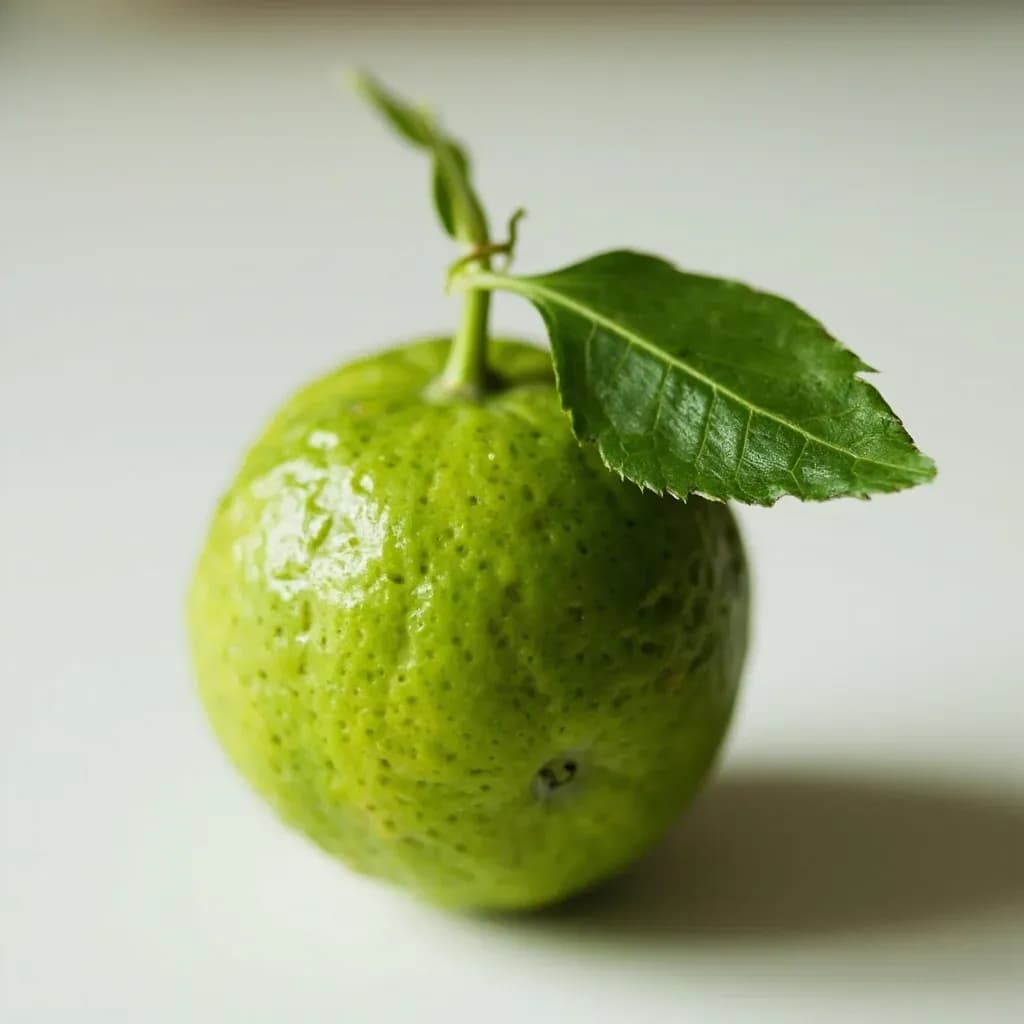
- Leaf of the makrut lime tree (which also bears a bumpy green fruit used for zest)
- Aroma profile
- Floral-citrus with green, faintly bitter notes; rounder and less sharp than the rind of the fruit
- Appearance
- Glossy, dark green, leathery, dumbbell- or hourglass-shaped blade with a tightly pinched waist
- Key aroma compounds
- Citronellal, limonene, and sabinene — fat-soluble and heat-stable
- Fresh storage
- 2 weeks refrigerated in a sealed bag or wrapped in damp paper towel; 3–6 months frozen
- Dried storage
- Up to 1 year airtight and dark, though aroma fades considerably
- Cuisines
- Thai, Laotian, Cambodian, Malaysian, Indonesian, Sri Lankan, Mascarene Creole
Substitutes
- Persian or Key lime zest + bay leaf — The most-cited approximation; the bay contributes herbal body while the zest delivers the citrus top note. Use 1 bay leaf and the zest of half a lime per makrut leaf as a rough starting point.
- Lemongrass + lime zest — Recalls the citrus-floral backbone of Thai soups and curries; works in tom yum-style broths and coconut-milk dishes but is not a 1:1 swap.
- Makrut lime zest (from the fruit) — Same aromatic compounds as the leaf, but more concentrated and faintly bitter; use sparingly, starting with about a quarter teaspoon per leaf called for.
- Combava leaf (from Réunion) — The same species under a different regional name; freely interchangeable when available from Creole or Indian Ocean grocers.
Pairs with
Also called
kaffir lime leaf · makrut leaf · bai makrut · Thai lime leaf