Proteins
Sea Scallop
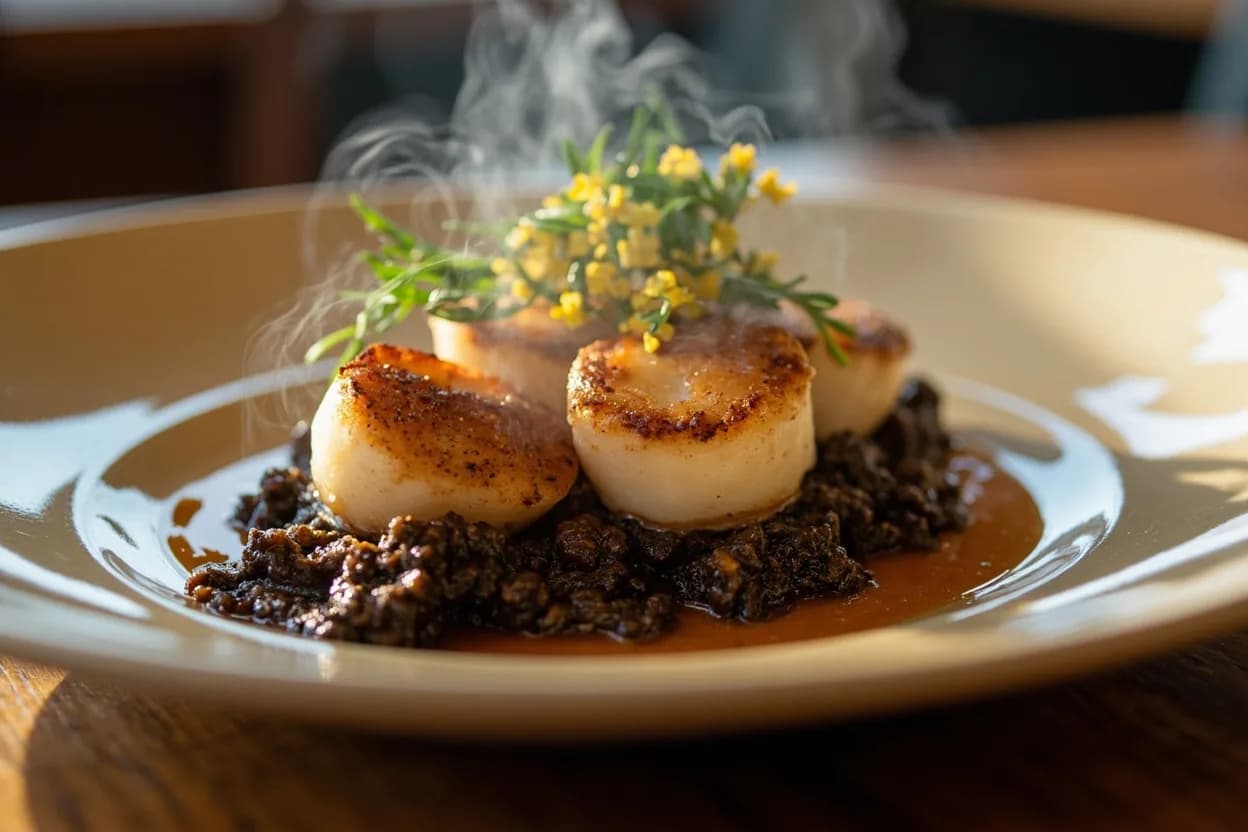
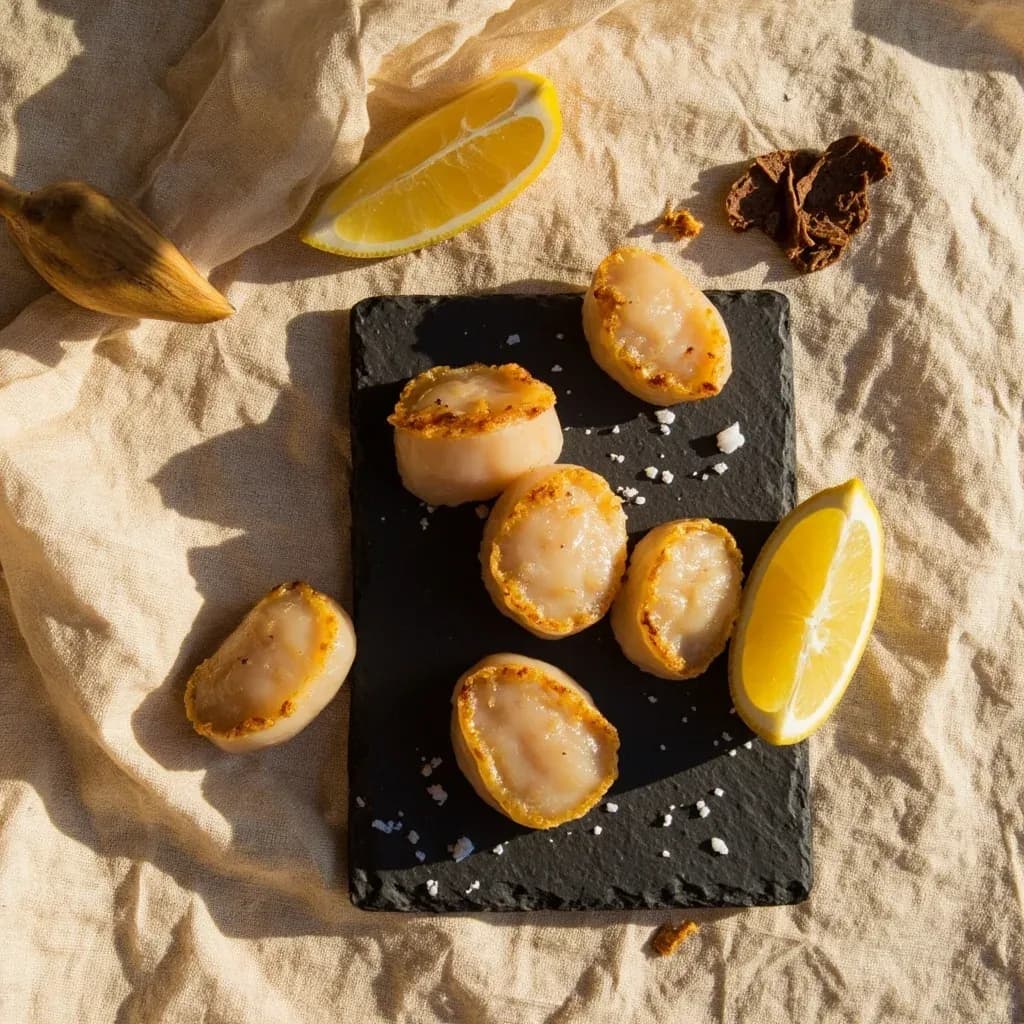
Large, plump scallop with sweet, dense meat; pat dry and sear hard for a caramelized crust and translucent center. Overcooking turns it rubbery in seconds.
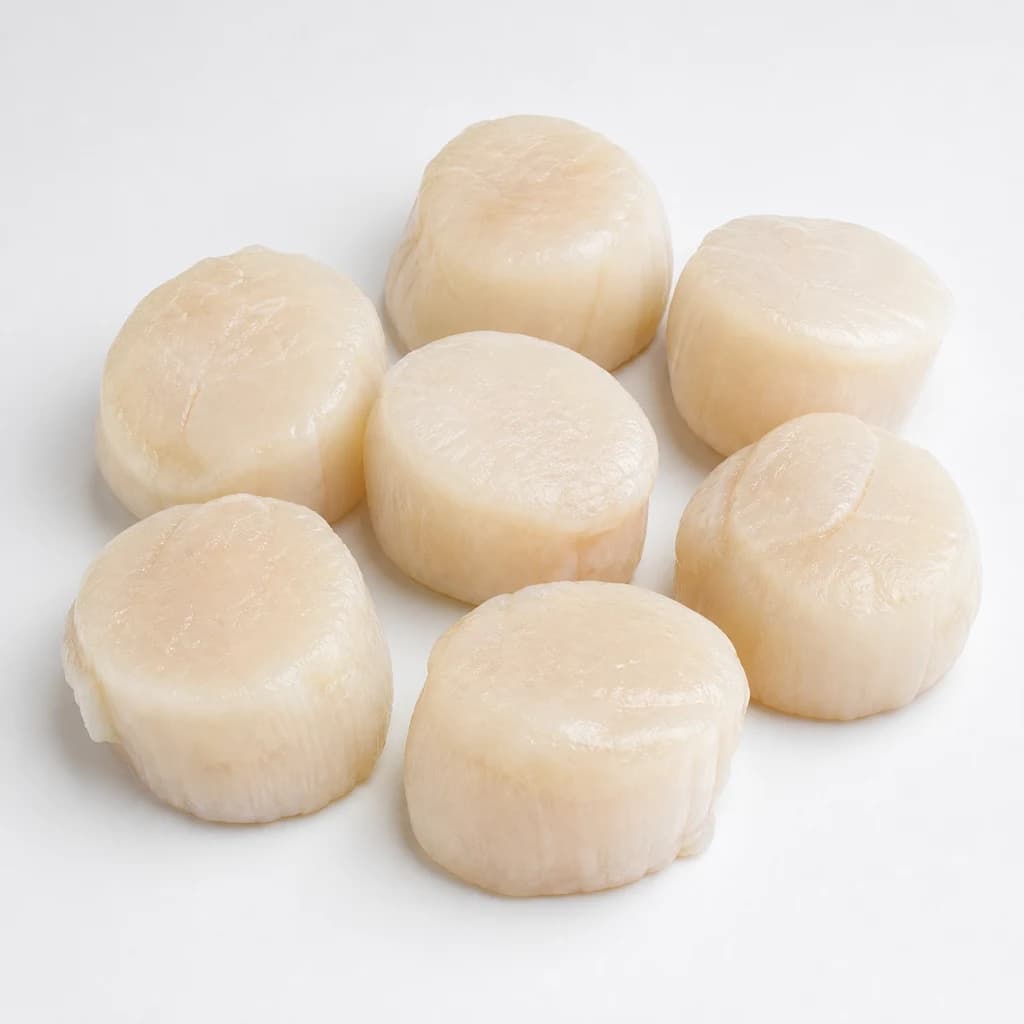
The sea scallop is the adductor muscle of a large saltwater bivalve — in U.S. markets almost always Placopecten magellanicus, harvested cold from the Northwest Atlantic. What arrives in the kitchen is a creamy ivory disk, 1.25 to 2 inches across and roughly an inch thick, prized for a flavor that runs sweet, briny, and faintly mineral, with a dense, almost bouncy bite no other shellfish quite matches. Bay and calico scallops are smaller, more delicate cousins; the sea scallop is the steakhouse workhorse, the one cooks reach for when a caramelized crust and a translucent, custardy center are the point.
What makes the sea scallop both revered and unforgiving is how thin the margin is between perfect and ruined. The protein is dense and mostly water; once overcooking begins, the texture can shift from silky to rubbery in 30 to 60 seconds, with no recovery. Success depends on three things more than any other: starting dry, using very high heat, and pulling the scallop early so carryover heat finishes the center. None of it is difficult; all of it is precise.
Selection is where most home cooks stumble. Sea scallops are sold dry-packed (rinsed in seawater only) or wet-packed (soaked in a sodium tripolyphosphate solution that adds 25–30% water weight). Wet scallops weep milky liquid in the pan and steam instead of sear; for any recipe that calls for a crust, dry-packed is the only choice. Sizing follows a 'U' (under) count per pound — U/10 is roughly three scallops per portion, U/20 is closer to a half-dozen per serving, and either is a perfectly fine restaurant portion.
- Measured in
- g
- Storage
- Refrigerate
Allergens
Find it in
Types & varieties
Rinsed only in seawater, no phosphates; exude little liquid and develop a true Maillard crust — always choose these for searing.
Soaked in sodium tripolyphosphate to add weight; weep a milky liquid in the pan and steam rather than sear. Best for chowders, stir-fries, and pasta.
Hand-collected by divers; almost always dry-packed and extremely fresh; a premium product, especially on the U.S. West Coast.
Caught and landed the same day; dry-packed, very fresh, often labeled with the boat name.
About 3–4 per portion; favored for steakhouse presentations and whole-grilling.
Workhorse size for searing, pasta, and ceviche.
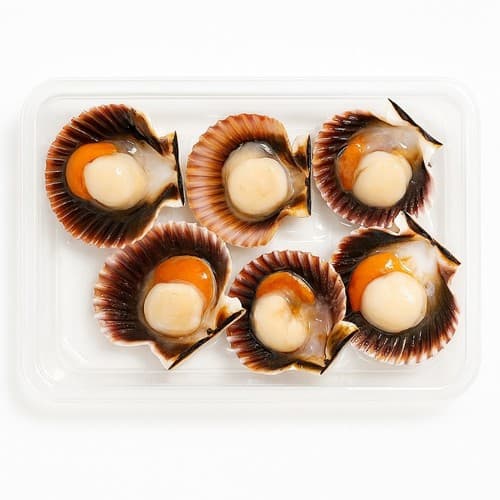
Whole muscle plus the orange-pink roe; sweeter, richer, traditional for Coquilles Saint-Jacques and Italian preparations.
Adductor muscle only; the most common form in U.S. retail.
Patinopecten yessoensis; larger, whiter, often served as sushi, nigiri, or butterflied for grilling.
Zygochlamys patagonica; smaller, very sweet, popular for crudo and sashimi-style service.
The Dry-Pack vs. Wet-Pack Question
Packaging matters more than species in everyday cooking. Wet-packed scallops are soaked in a sodium tripolyphosphate (STPP) solution that the processor uses to extend shelf life and — more importantly, from a profit standpoint — to add 25 to 30% water weight to every pound. The phosphates cause the scallop to absorb and hold that water, which then leaks out the moment the scallop hits a hot pan. The result: the pan temperature plummets, steam replaces sear, and the scallop slowly turns gray and rubbery no matter how hot the heat was to start. There is no rescue at that point.
Dry-packed scallops, by contrast, are rinsed only in seawater, packaged without additives, and lose almost no moisture in the pan. They shrink less, brown more deeply, and taste more of scallop and less of nothing. Most U.S. retailers who deal in serious seafood carry them; a few label them 'chemical-free' or 'diver' instead. Diver and day-boat scallops are, in practice, almost always dry-packed as well, since the small boats don't have the volume or incentive to phosphate-treat.
If only wet-packed is available, rinse the scallops briefly under cold water, dry them very thoroughly, and lean into a recipe that doesn't require a hard crust: a quick stir-fry, a ceviche, a pasta where the sauce is doing the heavy lifting. Accept that browning will be limited and plan around it.
- Phosphate-soaked scallops can carry 25–30% added water weight — read the label as much as the price.
- Diver and day-boat labels almost always imply dry-pack; 'chemical-free' is a code word for the same thing.
- Wet scallops turn milky liquid in the pan; if your scallops are weeping, switch the recipe, not the heat.
Searing for a Crust
Treat a sea scallop the way you'd treat a thin steak: a dry surface, a screaming-hot heavy pan, a neutral oil with a high smoke point, and just enough time for the Maillard reaction to do its work. The single biggest variable is moisture on the surface — even slightly damp scallops will steam before they can brown, and no amount of patience will bring a crust back once steam has won. Pat the scallops dry on paper towels, then leave them uncovered in the refrigerator for 30 to 60 minutes before cooking, and salt them either immediately before the pan or only after the first flip. Salting ahead pulls moisture to the surface and undoes the drying step.
A heavy pan — carbon steel or stainless-clad, not nonstick — holds heat when the scallops hit it. Get the pan genuinely hot, add a thin film of neutral oil, and lay the scallops in with at least an inch of space between them; crowding drops the temperature and the sear goes with it. Resist the urge to peek: a properly dry scallop will release on its own after about 90 seconds. If it sticks, it isn't ready — give it another 20 to 30 seconds. Flip once, add butter and aromatics, baste briefly, then pull the scallops and let them rest for 1 to 2 minutes off the heat. Carryover will bring the center to a warm-translucent finish that no amount of additional pan time can replicate without overcooking.
- Use a heavy pan over high heat; nonstick defeats the crust.
- Leave at least 1 in (2.5 cm) between scallops — crowding is the silent killer of a hard sear.
- Don't salt ahead; salt just before cooking or only after the first flip.
Common uses
Tips & pitfalls
- Buy dry-packed (no STPP) whenever you intend to sear — wet scallops will only steam in the pan.
- Pull off the small rectangular side muscle (the 'foot') before cooking; it's noticeably tougher than the rest of the muscle.
- Pat scallops dry and let them rest uncovered on a paper-towel-lined tray in the fridge for 30–60 minutes; surface dryness is the single biggest factor in a clean crust.
- Sear 90 seconds per side, then rest off-heat for 1–2 minutes — carryover heat brings the center to a warm-translucent finish without overcooking.
- Resist the flip: let the scallop release on its own before turning; if it sticks, give it another 20–30 seconds.
- Undercook rather than overcook: once a scallop turns fully opaque and firms up, it has gone past ideal — there is no recovery from rubbery.
- Don't crowd the pan — leave at least 1 in between scallops or the temperature drops and the crust fails.
- For ceviche, cure in citrus for 8–12 minutes, not hours — acids 'cook' the exterior quickly and prolonged exposure turns the texture mushy.
- Save the trimmed side muscles, skirts, and shells to make a quick court-bouillon or fish fumet.
Nutrition
Nutrition
No USDA FoodData Central match for Sea Scallop yet. We surface a per-100 g profile once a generic whole-food entry is matched and verified.
In the shops
Matched grocery products
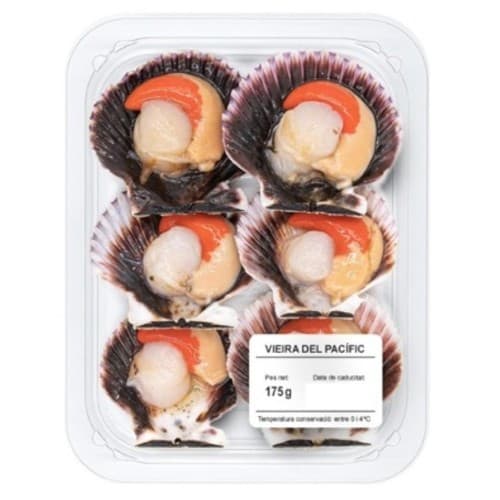 €7.99
€7.99Pacific Scallop
ud · Bonpreu
 €5.85
€5.85Scallop Half Shell
EUROPACIFICO · kg · Bonpreu
Good to know
- Species
- Placopecten magellanicus (Atlantic); Japanese (Patinopecten yessoensis) and Patagonian (Zygochlamys patagonica) are used interchangeably
- Anatomy sold
- The adductor muscle only; roe (coral) may be left attached on whole, or 'coral-on,' scallops
- Sizing
- U/8–U/12 (jumbo/portion), U/16–U/20 (standard), U/30 (small); the number = under that count per pound
- Yield
- Roughly 45–55% after pulling the tough rectangular side muscle (the 'foot') and any skirt
- Pack types
- Dry-packed (no additives) vs. wet-packed (sodium tripolyphosphate, milky, weeps in the pan)
- Storage
- Dry-packed: 3–5 days at 32–38°F; wet-packed: 1–2 days, rinse before use; IQF-at-sea is the gold standard for frozen
- Cook time
- About 90 seconds per side for a 1.5 in (4 cm) scallop over high heat, plus a 1–2 minute rest off-heat
- Difficulty
- Low effort, high precision — surface dryness and heat control matter more than technique
Substitutes
- Bay scallops — Smaller, sweeter, more delicate; cut cook time in half or just warm through — best in pasta, chowder, or raw preparations.
- Calico scallops — Smallest of the three; assertive oceanic flavor, good for sauces, stews, and crudo when in season.
- Japanese hotate (yezo scallop) — Larger, cleaner-flavored; near-perfect substitute for searing or sushi if Atlantic sea scallops aren't available.
- Lion's paw or pink scallops — Found in Latin American and Caribbean markets; firmer texture, similar handling.
- Halibut or monkfish cheeks — Not a flavor match, but the texture and protein density work in a pan-seared main where scallops are unavailable.
Pairs with
Also called
sea scallops · diver scallop · jumbo scallop · Placopecten magellanicus