Heat & Safety
Smoking Wood Chunks
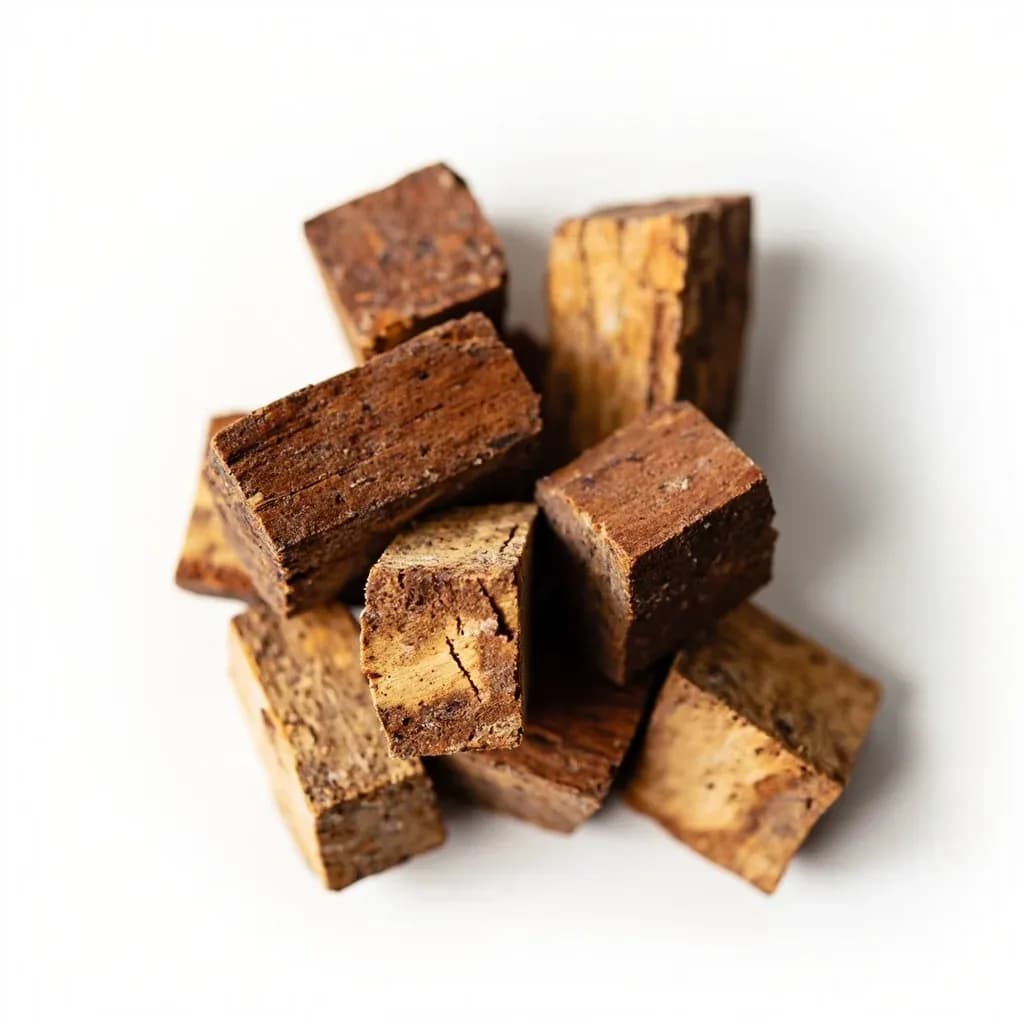
Fist-sized flavor-wood blocks that smolder for long, low-and-slow smoking.
Smoking wood chunks are large pieces of hardwood that burn slowly and steadily, making them suited to long barbecue cooks like brisket and pork shoulder. They are nestled among charcoal or placed in a smoker to release smoke over several hours. Their size means they last longer than chips without needing constant replenishing.
Smoking wood chunks are the flavoring workhorse of the backyard smokehouse: fist-sized blocks of untreated hardwood, usually 2 to 4 inches across, that you add to a separate heat source rather than burn as fuel. Their size is the point. They smolder steadily for an hour or two, releasing a steady stream of volatile compounds — phenols, carbonyls, and organic acids — that the surface of the food absorbs and that read, on the palate, as smoke. Smaller chips vanish in fifteen or twenty minutes; full splits or logs double as fuel and demand a stick-burner. Chunks split the difference, lighting easily on top of hot coals or inside a smoke box, then quietly doing their work while the fire does its own.
What separates good smoking from bitter, acrid smoking is incomplete combustion. When wood burns hot and well-ventilated, it gives off a thin, almost invisible blue smoke and a clean, sweet-savory flavor. When it smothers, smolders too cool, or is overloaded, the smoke turns thick and white, and the food comes out tasting of creosote and ash. Wood chunks are designed to ride that line: dense enough to last, porous enough to ignite, and big enough to be added once per hour rather than tended constantly.
Because the food absorbs smoke more readily when cold than when hot, the choice of wood and the amount you use both depend on the cook. A 14-hour brisket at 250°F and a 30-minute cold smoke of cream cheese share the same fuel in principle, but not in practice. The mild-to-bold spectrum of hardwoods — fruit and nut woods on the gentle end, oak and hickory in the middle, mesquite and walnut on the strong end — is what allows a cook to match flavor to protein, time, and temperature.
Alternatives
Types & varieties
Strong, bacon- and ham-like. The classic choice for ribs, pork shoulder, and bacon.
Very strong, earthy, slightly bitter in excess. Traditional for Texas-style brisket; use sparingly.
Medium, neutral, slightly toasty. The most versatile all-purpose hardwood; a strong base for blending.
Mild, sweet, faintly fruity. Pairs well with poultry, pork loin, ham, and delicate fish.
Mild, sweet, fruity. Imparts a reddish-mahogany surface color on meat; blends easily.
Mild, sweet, lightly smoky. Good with pork, poultry, cheese, and vegetables.
Mild, nutty, buttery. A gentler cousin of hickory; classic for poultry and pork.
Delicate and light. The traditional wood for Pacific Northwest–style hot- and cold-smoked salmon.
Mild and sweet with subtle stone-fruit aroma. Boutique choice for poultry and pork.
Mild, sweet, lightly fruity. Similar in character to apple and cherry.
Mild and aromatic. Often blended; common in Mediterranean and cheese smoking.
Strong and slightly bitter; use in small amounts, never with delicate foods.
How Chunks Actually Deliver Smoke
A wood chunk does not flame — it smolders, and the flavor is a function of temperature, oxygen, and surface area. Drop a chunk on a bed of glowing coals at 500°F and the outside chars while the inside is still wet; the volatile compounds you want arrive in a thick, heavy plume, much of it creosote and tars that taste acrid. Give that same chunk an open firebox, plenty of draft, and a steady 250°F, and it will pyrolyze slowly and evenly, releasing the lighter acids and carbonyls that read as sweet, savory, and round. This is why the same wood can ruin a piece of fish at one temperature and flatter a brisket at another — it is rarely the wood that is wrong, it is the fire.
The Mild-to-Bold Spectrum
Flavor woods are usually organized along an intensity scale, and learning the spectrum is the single biggest upgrade a smoker can make. Gentle woods — alder, apple, cherry, peach, plum — are sweet, light, and forgiving, and they suit cool fires, short cooks, and foods that take on smoke quickly: poultry, pork loin, fish, cheese. Mid-weight woods — pecan, maple, oak — bridge the two ends and are the safest all-purpose choices for an unfamiliar smoker. Bold woods — hickory, mesquite, walnut — are dense with strong phenols; they shine on long, low cooks of beef and rich pork, and they turn bitter fast on delicate proteins.
- Mild: alder, apple, cherry, peach, plum, grapevine
- Medium: pecan, maple, oak
- Bold: hickory, mesquite, walnut
- Start with a 50/50 blend of one mild and one medium wood if you are unsure
Chunk vs. Chip vs. Log
Wood size is a tool, not a preference. Chips are thin shavings that flare and disappear in 10–20 minutes, useful for a quick hit of smoke on a gas grill or a brief hot cook. Chunks are 2–4 inches across and last an hour or two, the practical choice for most kettle, bullet, kamado, and cabinet smokers. Logs and split billets are 6 inches and up, and they are fuel as much as flavor, suited to offset stick-burners that need a continuous, self-feeding fire. Mismatching the size to the equipment is one of the most common reasons a cook ends up with either no smoke flavor or an ashy, bitter bark.
Common Smoke Problems and What They Mean
Most smoking failures trace back to one of three things: too much wood, too little air, or wood that is not what you think it is. Diagnose by looking at the smoke and tasting the bark.
- Thick white smoke and a bitter, sooty bark — too much wood, or wood added too soon before the fire is established
- Smoke that disappears within twenty minutes of starting — chunks were too small, or the fire was too hot and burned them through
- No smoke at all and a pale, neutral bark — wood was damp, or it was never actually in contact with the heat
- Chemical, plastic, or paint smell — the wood was treated, and it should be discarded along with the food
Common uses
Tips & pitfalls
- Use only untreated hardwood. Softwoods (pine, fir, spruce, cedar, cypress) contain resins that create acrid, harsh, and potentially harmful smoke.
- Never use construction lumber, pallets, painted wood, particleboard, or anything with glue, varnish, stain, or pressure treatment — the chemicals transfer to food.
- Aim for thin, almost-invisible blue smoke. Heavy white smoke means too much wood is smoldering and will leave a bitter, ashy flavor.
- Soaking wood chunks is largely a myth: it does not meaningfully extend smoke time, can smother the fire, and produces steam that mutes flavor and creates dirty ash.
- Add chunks directly to hot coals or to a dedicated smoke box. Chunks do not need to be wrapped in foil the way small chips often are.
- Match wood intensity to the protein: bold woods (hickory, mesquite, walnut) suit beef and rich pork cuts; mild woods (apple, cherry, alder, maple, pecan) suit poultry, fish, pork loin, and cheese.
- Start with roughly 1–2 handfuls of chunks per hour of cook time, then adjust by sight and smell of the smoke; the bark and smoke color are better gauges than the clock.
- Store wood in a dry, ventilated area off the ground. Damp wood smolders, smokes poorly, and can develop mold.
Good to know
- Material
- Untreated hardwood — fruit, nut, and aromatic hardwoods; never softwood or treated lumber
- Typical Size
- Roughly 2 to 4 inches (5–10 cm) per piece
- Burn Time
- About 1–2 hours per chunk, depending on size, airflow, and fire temperature
- Storage
- Dry, sealed container; stored off the ground in a ventilated area
- Best For
- Low-and-slow smoking at 225–275°F (107–135°C)
- Role
- Flavoring added to a separate heat source — not a primary fuel
- Smoke Target
- Thin, almost invisible blue smoke; heavy white smoke indicates overuse
- Compatible Equipment
- Charcoal kettles, bullet and cabinet smokers, offset smokers, gas grills with a smoke box, kamado grills
Also called
Wood Chunks · BBQ Wood Chunks · Smoking Chunks
Related

Paper Towels
Disposable sheets for spills, drying, and patting dry

Kitchen Towels
Reusable cloths for drying, gripping, and wiping

Oven Mitts
Heatproof gloves to handle hot pans and trays safely

Disposable Gloves
Single-use gloves for safe, mess-free handling

Cleaning Cloths
Reusable cloths for wiping counters and spills

Tortilla Warmer
Insulated holder that keeps tortillas warm and soft

Trivet
Heatproof stand that shields surfaces from hot pots

Ice Bath Setup
Bowl of ice water that halts cooking and sets color