Appliances & Heat
Open Wood Fire
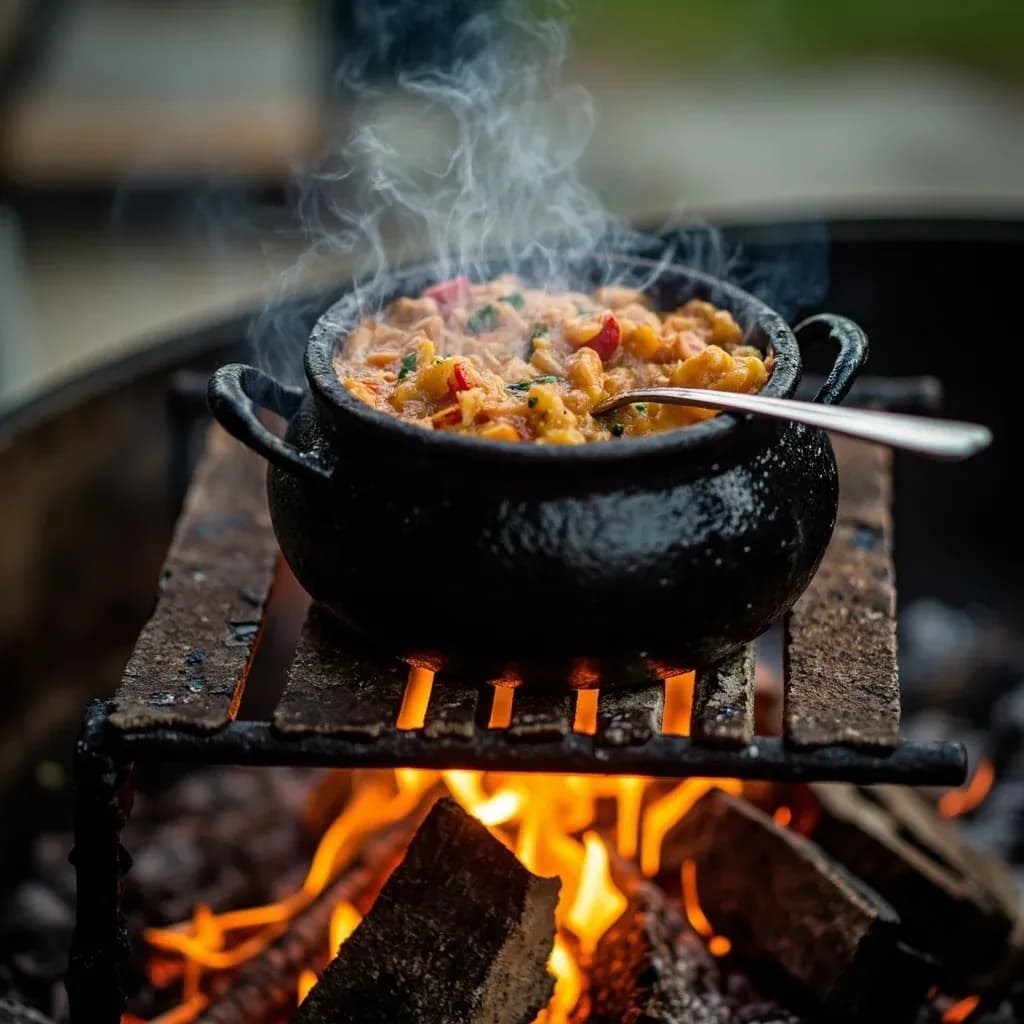
A free-burning wood fire, often outdoors, used to cook directly over the flames and coals.
An open wood fire is the most elemental cooking heat source: logs burned on the ground or in a fire pit, with food set on a grate, skewer, or pot above the flames and embers. It is used worldwide for grilling, boiling, and slow roasting, and the woodsmoke imparts a distinctive flavor. Skilled cooks read the coals rather than a dial to manage heat.
An open wood fire is the original kitchen range: a bed of burning hardwood logs and the embers they produce, used as a direct heat source for grilling, roasting, baking, stewing, and smoking. Unlike a gas burner or an electric grill, it is a living, breathing heat source that the cook manages by eye, ear, and feel — adding wood, banking coals, and shifting food between hotter and cooler zones the way a hearth cook once did with a pot hook and a foot bellows. That directness is exactly what gives an open fire its value: real wood smoke, radiant heat from glowing coals, and the high, somewhat uneven temperatures of a hardwood fire produce browning and flavor that no manufactured heat source can fully replicate.
The four things a cook actually manages are flame, coals, radiant heat, and smoke. Open flame is usually too fierce and sooty for direct cooking; most food is placed over a deep bed of glowing coals (roughly 600–1100 °F / 315–595 °C), or beside them, shielded by a stone or iron baffle. Smoke is flavor when it is thin, blue, and smells clean — the signature of well-seasoned hardwood burning hot — and is off-flavor when it is thick, white, and acrid, which signals green wood, resinous softwood, or a starved fire. Learning to read those signals is the whole craft.
Because the fire is built from scratch and burns down, the cook's rhythm is different from the turn-a-dial logic of a modern stove. A usable coal bed takes 30–60 minutes to develop, so the fire is typically lit before the food is prepped, not after. From that point the cook works in zones — a hot center for searing, cooler edges for slower cooking or finishing — and uses cast iron, spits, grates, and stones as the interface between fuel and food.
Alternatives
Types & varieties
Prehistoric and still common in rural cuisines; three stones support a pot over a wood fire built between them.
Indoor open fire with a chimney; cooked with cranes, pot hooks, trammels, spits, and Dutch ovens set in the ashes with coals piled on the lid.
Simple ground or ringed outdoor fire; food is cooked on a grate, in a Dutch oven, or on a spit.
Argentine, Uruguayan, and Chilean tradition; a cross or V-shaped grate over a long-burning fire of quebracho, algarrobo, or oak, used for slow grilling and whole-animal roasting.
Brazilian skewered meat grilled over open wood or wood-charcoal fires, often on a rotisserie or espada skewer driven by hand or motor.
Californian tradition (with a parallel in Brazilian churrascarias) featuring an adjustable triangular grate raised and lowered over a wood fire for precise heat control.
Open-wood or wood-charcoal grilling tradition with grid cooking directly over the coals.
Sunken indoor hearth with a square or rectangular frame; fish, tofu, and vegetables grilled on a hōsai grate, or pots hung from a jizaikagi hook.
Wrapped food (pig, lamb, fish in banana leaves, root vegetables) buried with hot stones and coals for slow, smoky cooking — luau, hog roast, Māori hāngi, Chilean curanto, New England clambake.
Cylindrical clay oven sunk into the ground, fired with wood or charcoal; food is skewered or slapped onto the inside walls for fast, radiant cooking.
Anatomy of the Fire
An open wood fire is really four overlapping heat sources, and the cook who knows which one is doing the work has already won half the battle. The most useful distinction is between flame and coals: flame is the visible, luminous combustion of wood gases and is too fierce and sooty to cook over directly in most cases; coals are the residual, glowing charcoal left after the gases have burned off, and they give a clean, steady, radiant heat that is ideal for grilling, roasting, and Dutch-oven work. Beyond those two, every fire also gives off radiant heat from nearby stone or iron (a hearth wall, a fireback, a pizza stone) and produces smoke, which flavors food only when it is thin and blue.
- Flame: visible fire from burning wood gases; up to ~2000 °F / 1090 °C, but generally too fierce and sooty for direct cooking — useful only for fast toast, char, or starting the fire.
- Coals: glowing embers of nearly pure carbon; 600–1100 °F, and the right place for almost all open-fire cooking. A thin white-ash coating on the coals is the visual cue that they are ready.
- Radiant heat: infrared from the coal bed and from any nearby stone, brick, or iron surface; cooks food from the side and from below, and is what makes hearth ovens and tandoors possible.
- Smoke: thin, blue, and clean-smelling = flavor. Thick, white, and acrid = off-flavor and a sign of green wood, softwood, or a starved fire.
Wood and Smoke
Wood choice is the single biggest flavor decision in open-fire cooking, and the central rule is simple: burn only seasoned hardwood. Softwoods (pine, fir, spruce, fresh cedar) are full of resins that vaporize into acrid, black smoke and will ruin food in a single breath. Treated, painted, glued, or pallet wood is worse — the fumes are genuinely toxic. Within the hardwoods, smoke flavor varies dramatically by species, and matching wood to food is where experienced pit cooks earn their reputation.
- Oak: the benchmark hardwood smoke — balanced, medium-strong, and the default for American barbecue and most long cooks.
- Hickory: stronger and bacon-like; classic with pork ribs and shoulders, easy to overdo on delicate foods.
- Mesquite: very strong, almost medicinal; excellent in Tex-Mex and Argentinian cooking but should be used sparingly or blended with a milder wood.
- Fruitwoods (apple, cherry, peach): sweet and mild; ideal for poultry, pork, and salmon.
- Alder: very mild; the traditional Pacific Northwest wood for salmon.
- Maple, pecan, beech, ash: mild to medium, versatile everyday hardwoods.
- Almond, olive, grapevine: aromatic and traditional in Mediterranean and Levantine cooking.
- Seasoning: split and air-dry wood 6–12 months under cover. Properly dry wood hisses and pops on the coals, burns hot, and produces a thin blue smoke.
Building and Managing the Fire
Open-fire cooking is staged cooking. The fire is built first and the food goes on after the structure has done its work, not the other way around. The standard progression — tinder, then pencil-width kindling, then wrist-thick sticks, then forearm-sized splits — gives each layer time to catch and to dry out the layer above it. Rushing the build with a big log on a small flame is the most common beginner mistake and produces a fire that smokes for an hour instead of cooking.
- Stage the build: tinder (dry grass, shavings, waxed canvas) → pencil-width kindling → wrist-thick sticks → forearm-sized splits. Let each layer catch before adding the next.
- Use structure to control airflow: a teepee burns fast and hot from the top down (good for getting coals going), a log-cabin burns steadily and produces a flat coal bed (good for grilling), a lean-to keeps kindling dry in wind.
- Wait for the flame to die back to a deep, ash-covered coal bed before placing most food. Flame-toasting deposits soot and creates harsh char; coals give clean radiant heat.
- Create heat zones by banking coals to one side — a two-zone or offset fire — with a hot center for searing and a cooler side for slower cooking or holding.
- For long cooks (spit-roasting, whole-animal roasting), build a larger fire than you think you need and let it burn down to a deep coal bed; a small fire fed constantly is far harder to manage than a big one burning steadily.
- Manage the fire from outside: a long poker or stick lets you spread, bank, or revive coals without reaching into the heat. Never stir a fire with your hand or with a knife.
- Readiness cues: coals are ready when their surfaces are coated in a thin white ash and they radiate steady heat, not when the last flame has died.
Common uses
Tips & pitfalls
- Use only well-seasoned hardwoods; softwoods (pine, fir, spruce, fresh cedar) throw resinous, acrid smoke that blackens and bitter-tones food.
- Never burn treated, painted, glued, or pallet wood, and never driftwood — the fumes are toxic and will taint the food no matter how long the cook.
- Wait for the flame to die back to a deep, ash-coated coal bed before placing most food. Cooking over flame deposits soot; cooking over coals gives clean radiant heat.
- Match wood to food: oak and hickory for red meat and pork; fruitwoods (apple, cherry, peach) for poultry and pork; alder for salmon; mesquite sparingly, because its smoke is strong enough to dominate a dish.
- Establish heat zones by banking coals to one side (an offset fire) so you have a hot sear zone and a cooler finishing or holding zone in the same cook.
- Oil the grates, skewers, and food — never the fire. Grease flicked into coals flares, smokes, and flavors everything on the grate.
- Never use liquid accelerants (lighter fluid, gasoline, kerosene): chemical residues flavor the food and the fumes are dangerous, and there is no kitchen technique where the risk is worth it.
- Use cast iron as the default cookware — it tolerates the high, uneven heat of an open fire far better than nonstick or thin stainless, and its mass holds steady temperature over a coal bed.
- Cook by feel, sight, smell, and an instant-read thermometer rather than by time alone; wood-fire timing is less predictable than a gas dial, and food should be moved between zones to control its rate of cooking.
- Have water, sand, or a shovel on hand for safety, and never leave an open wood fire unattended.
- After the cook, let the fire burn down to ash, douse with water, and stir the remains; never bury live coals in sand where they can smolder unseen for hours.
- Consider a windbreak on exposed sites — wind can starve a fire of oxygen or push flames into food.
- For delicate fish, use a clean, well-oiled grate or a soaked cedar plank to keep fillets intact over the heat.
Good to know
- Heat source
- Seasoned hardwood logs and the glowing coals they produce
- Coal-bed temperature
- Roughly 600–1100 °F (315–595 °C); well-established hardwood coals commonly 700–900 °F
- Flame temperature
- Up to ~2000 °F (1090 °C), but flame is generally too fierce and sooty for direct cooking
- Build time
- 30–60 minutes from lighting to a usable bed of glowing coals
- Preferred fuel
- Seasoned hardwoods — oak, hickory, maple, beech, ash, mesquite, almond, and fruitwoods such as apple, cherry, and peach
- Fuels to avoid
- Resinous softwoods (pine, fir, spruce, fresh cedar); treated, painted, glued, or pallet wood; driftwood; green wood
- Wood seasoning
- 6–12 months of air-drying for clean, hot burn and thin blue smoke
- Origin
- Among humanity's oldest cooking methods; controlled fire use dates back hundreds of thousands of years; open-hearth cooking dominated domestic kitchens in Europe and Asia until the 18th–19th centuries
- Setting
- Both indoor (historic hearth) and outdoor (campfire, fire pit, parilla)
- Primary cookware
- Cast iron (skillet, Dutch oven, griddle), spits, grates, skewers, three-legged cauldrons, hot stones, cedar planks
- Skill level
- Moderate to high — fire-building, heat management, and timing are manual and read by eye and feel
- Flavor profile
- Wood smoke and Maillard browning; flavor varies significantly by wood species used
Also called
Open Fire · Fireside · Molelo · Outdoor Wood Hearth · Firewood Hearth
Related

Stovetop
The everyday burners where most cooking actually happens

Oven
Enclosed dry heat for roasting, baking, and braising

Grill
Live-fire or gas grates for char, smoke, and high heat

Smoker
Low, slow heat and wood smoke for barbecue and brisket

Air Fryer
Countertop convection that crisps with little or no oil

Slow Cooker
Set-and-forget low heat for stews, beans, and braises

Pressure Cooker
Sealed steam pressure that cooks tough food in a fraction of the time

Rice Cooker
Foolproof, perfectly steamed rice every single time