 Mediterranean
Medium · Hot
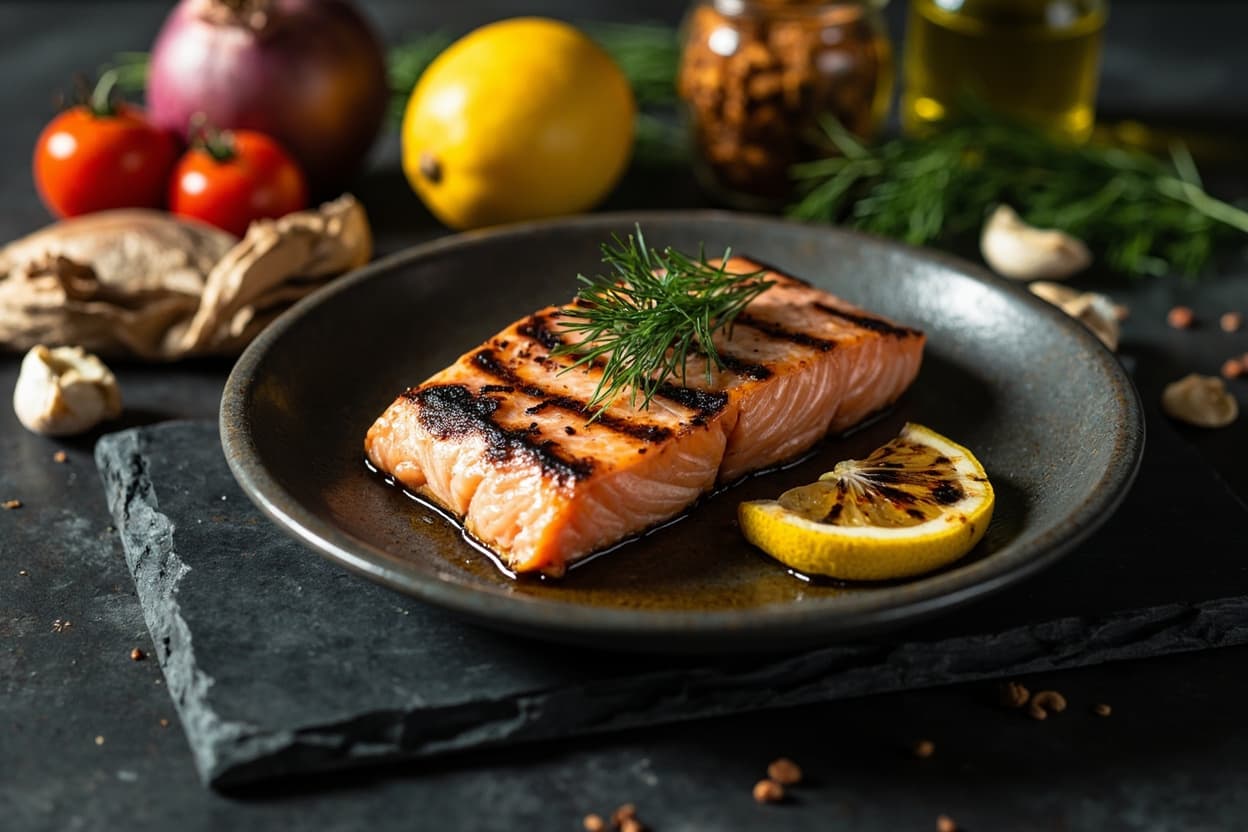
Grilled Salmon with Charred Lemon and Dill
Salmon has enough fat to protect itself on a hot grill — press down gently at the start so the skin makes full contact, then leave it alone until the flesh has turned opaque halfway up the fillet. Lemon halves go cut-side down on the same grate, caramelizing until their juice is sweet and slightly smoky. Dill and garlic stirred through olive oil rest on the fish the moment it comes off the heat.

Prep
20 min
Cook
15 min
Rest
2 min
Total
37 min
Method
Prepare the Salmon
1
Remove salmon fillets from the fridge 20 minutes before cooking. Pat each fillet dry with paper towels — moisture is the enemy of char. Drizzle 2 tbsp olive oil over the flesh side, then rub in the minced garlic, 1 tsp salt, and black pepper. Let it sit at room temperature while you build the fire.
Build the Fire
2
Get your grill ripping hot. You want a dense coal bed with white-hot embers and a clean, steady flame. The grill grates should be smoking. This is not a gentle warmth — it is heat you can feel radiating back at you. Brush the grill grates clean with a wire brush and oil them lightly.
Char the Lemon
3
Slice one whole lemon into 4 rounds, about 1/2 inch thick. Brush both sides with 1 tsp olive oil. Place directly over the hottest part of the coals. Char without moving for 2–3 minutes per side until the flesh caramelizes to a deep golden-brown with blackened edges. Remove and set aside. The lemon will perfume the grill and release its juice as it chars — do not skip this.
Grill the Salmon
4
Place salmon fillets skin-side down over the coals. Do not touch them for 3 minutes. Listen: if you hear a sustained sizzle and see smoke curling, that is the skin crisping and the fat rendering. If it sounds wet, the skin is not yet making contact — give it another minute. Flip once when the flesh near the skin is opaque halfway up. Grill the second side for 2 minutes only. Insert a calibrated meat thermometer into the thickest part of the fillet — the salmon must reach 145°F (63°C) to be safe. The salmon should have a deep mahogany char on the outside. Move to a cutting board skin-side down.
5
Place salmon fillets skin-side down over the coals. Do not touch them for 3 minutes. Listen: if you hear a sustained sizzle and see smoke curling, that is the skin crisping and the fat rendering. If it sounds wet, the skin is not yet making contact — give it another minute. Flip once when the flesh near the skin is opaque halfway up (use a thin spatula to check the edge). Grill the second side for 2–3 minutes, until the internal temperature reads 145°F (63°C) at the thickest point. The salmon should have a deep mahogany char on the outside and reach safe minimum internal temperature. Move to a cutting board skin-side down.
Make the Dill Finishing Oil
Rest and Plate
7
Let the salmon rest skin-side down for 2 minutes. Do not cover it. Resting lets the carryover heat finish the center and the skin to stay crisp. Place each fillet on a plate. Arrange two charred lemon rounds beside each fillet. Spoon the dill finishing oil generously over the flesh, letting it pool around the fish. Finish with one final pinch of flaky salt over the top. Eat immediately.
D
Nutri-Score
Needs balance
A–E · lower is better · score 11
Calories
500
per serving
High in salt · 1459mgHigh in protein · 31gLow sugar · 2g
Protein
31g
Carbs
6g
Fat
38g
Sat. fat
6g
Fiber
2g
Sugar
2g
Sodium
1459mg
Gluten FreeDairy FreePescatarianWhole30Heart HealthyAnti InflammatoryBlood Pressure ConsciousHigh ProteinOmega 3 RichLow Carb
Nutri-Score is a general nutritional-balance guide, not medical or dietary advice.
D
Environmental impact
High impact
A–E · lower is better · includes estimates
kg CO2e
2.5
per serving
DCarbonAEU all-round· carbon sets the grade
Water
1.1m³
Land
51Pt
Runoff
0.2g P
salmon fillets, skin-on drives 94% of this recipe’s estimated footprint.
Carbon from Poore & Nemecek 2018; water, land & runoff from Agribalyse — modelled averages for comparing recipes, not a measurement of your groceries.
Flavor Profile
7
Umami
3
Sweet
5
Salty
5
Sour
2
Bitter
1
Spicy
Textures
CrispyTenderRich
Aromas
SmokyHerbalCitrusPungent
Kitchen Equipment
Techniques
Finishing
Safety & Storage
Cooking Temperature
Salmon must reach an internal temperature of 145°F (63°C) to ensure safety. Do not rely solely on visual cues like translucency - use a calibrated meat thermometer inserted into the thickest part of the fillet to confirm safe doneness.
Cross Contamination
Raw salmon juices can contaminate other foods. Use separate cutting boards, plates, and utensils for raw salmon. Wash hands thoroughly with soap and water after handling raw fish before touching any other ingredients or surfaces.
Storage
Keep raw salmon refrigerated at or below 40°F (4°C) until ready to cook. Do not leave salmon at room temperature for more than 2 hours total (including the 20-minute sit-out period in the recipe).
High Risk Population
Pregnant women, young children, elderly individuals, and immunocompromised persons should only consume salmon cooked to the full 145°F internal temperature. Avoid any consumption of raw or undercooked salmon for these groups.
Equipment Safety
Use long-handled tongs to place and flip salmon - do not lean over hot coals without protection. Allow grill grates to cool before wire-brushing cleanup. Keep a fire extinguisher or water source nearby when managing live coals.
Handling
Avoid touching your face, eyes, or mouth while handling raw salmon. Patting salmon dry with paper towels helps achieve char but keep raw fish handling to a minimum and dispose of used towels immediately.
Pro Tips
Technique
When you place the salmon skin-side down, resist every urge to touch it for three full minutes. That sustained sizzle you hear? That's the skin crisping into crackle. If you lift it early, it sticks and tears — patience is the only real tool you need here.
Substitution
No dill? Fresh thyme or tarragon work beautifully against the char and lemon. I won't lie — dill is my preference for that grassy bite against the smoke — but a woody herb can honor this dish just as well.
From the chef
My family called the lemon the secret witness. We learned this at the asador when I was barely tall enough to reach the grill — the smoke from a charring citrus wheel does something to a protein that no marinade can. This salmon is my ode to that lesson: the lemon burns away its sharp edge, becomes something smoky and almost caramelized, and when its juice hits the garlicky oil on the hot fish, the whole plate comes alive. Simple fire, simple acid, no hiding.
TagsFire Cooked
AllergensFish
Source: generated · May 30, 2026