 Japanese
Medium · Warm
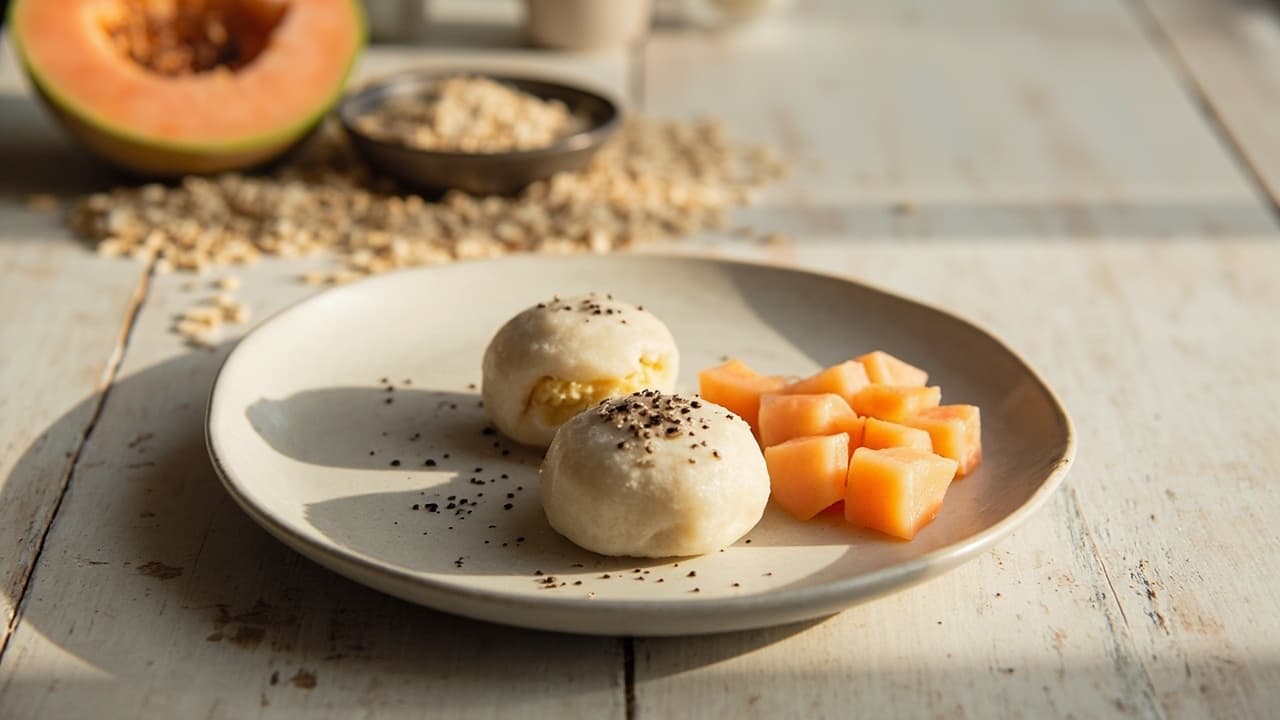
Summer Cantaloupe Chia Mochi
Delicate oat-rice dough envelopes a silky chia-cantaloupe filling, finished with fresh summer melon cubes. A light, seasonal confection that honors the fruit's gentle sweetness.

Prep
15 min
Cook
30 min
Total
45 min
Method
1
Combine chia seeds and 120 ml whole milk in a small bowl. Stir well and refrigerate for 30 minutes until seeds have fully swollen and the mixture has a gel-like consistency.
2
Grind rolled oats and white rice separately into fine powders using a blender or spice grinder.
3
Toast the ground oat powder in a dry saucepan over medium heat for 2-3 minutes, stirring constantly, until fragrant and lightly golden.
4
Whisk in the remaining 180 ml whole milk and white sugar. Cook over medium-low heat, stirring continuously, for 5-6 minutes until the mixture thickens into a smooth, pliable dough that pulls away from the pan edges.
5
Transfer dough to a lightly oiled surface. Cover with damp cloth and rest for 10 minutes.
6
Blend the soaked chia mixture with 200 g cantaloupe puree until smooth and uniform.
7
Divide the rested dough into 8 equal portions. On a lightly oiled surface, roll each portion into a thin flat disc about 3 inches in diameter.
8
Spoon 1-2 teaspoons of chia-cantaloupe filling onto the center of each disc. Gather the edges and pinch firmly to seal, forming a small parcel. Place seam-side down on a plate.
9
Dice the remaining 100 g cantaloupe into small cubes. Serve the mochi immediately, garnished with fresh cantaloupe cubes alongside.
A
Nutri-Score
Excellent balance
A–E · lower is better · score -2
Calories
260
per serving
Source of protein · 9gLow saturated fat · 2gLow salt · 51mg
Protein
9g
Carbs
44g
Fat
6g
Sat. fat
2g
Fiber
6g
Sugar
16g
Sodium
51mg
Gluten FreeVegetarianAnti InflammatoryHeart HealthyLow SodiumBalanced MacrosHigh Fiber
Nutri-Score is a general nutritional-balance guide, not medical or dietary advice.
B
Environmental impact
Low impact
A–E · lower is better · includes estimates
kg CO2e
0.5
per serving
BCarbonAEU all-round· carbon sets the grade
Water
0.4m³
Land
19Pt
Runoff
0.07g P
Whole Milk drives 32% of this recipe’s estimated footprint.
Carbon from Poore & Nemecek 2018; water, land & runoff from Agribalyse — modelled averages for comparing recipes, not a measurement of your groceries.
Flavor Profile
5
Umami
7
Sweet
1
Salty
2
Sour
1
Bitter
0
Spicy
Textures
PliableSilkySmoothTender
Aromas
FruityHerbalNutty
Kitchen Equipment
Primary Tool
SaucepanSafety & Storage
Cooking Temperature
Cook oat-rice dough mixture to 160°F minimum when thickening with milk to ensure dairy safety.
Allergen Warning
Contains milk. Not suitable for those with lactose intolerance, milk allergy, or dairy-free dietary requirements.
Cross Contamination
Oats processed in facilities handling wheat, barley, or rye may contain gluten cross-contact. Use certified gluten-free oats if preparing for celiac or gluten-sensitive individuals.
Storage
Serve mochi immediately after assembly. Fresh cantaloupe cubes and chia filling should not sit at room temperature for more than 2 hours.
High Risk Population
Raw cantaloupe consumed fresh may pose listeria risk for pregnant women, elderly, or immunocompromised individuals. Consider briefly blanching cantaloupe if serving to high-risk populations.
Handling
Keep dough covered with damp cloth during rest period to prevent drying. Lightly oil hands and work surface when shaping mochi parcels to prevent sticking.
Shelf Life
Best consumed within 4 hours of preparation. Refrigerated storage not recommended as texture will harden and become undesirable.
Pro Tips
Technique
The resting period for the dough is not mere waiting—it is essential. A damp cloth over the surface prevents drying while allowing the gluten to relax, transforming the mixture into something supple and cooperative. Rushing this step will reveal itself in cracking skins and imperfect seals.
Substitution
If shiratamako is available, it may replace the ground oat-rice combination for a more traditional mochi texture, though the oat-rice blend offers a gentler sweetness that complements the cantaloupe without competing for attention.
From the chef
During my years in Kyoto, my sensei taught me that every wagashi is a conversation between maker and season. This summer mochi embodies that lesson—cantaloupe's fleeting sweetness, softened by chia's quiet earthiness, wrapped in an oat-rice skin that honors restraint over excess. Each parcel is a small meditation on summer's brief abundance, meant to be eaten with mindfulness and gratitude.
TagsJapaneseWagashiMochiSeasonalSummerFruitCantaloupeChiaDairyLightGluten FreeVegetarian
AllergensMilkGluten
Source: generated · June 13, 2026