 British
Easy · Hot
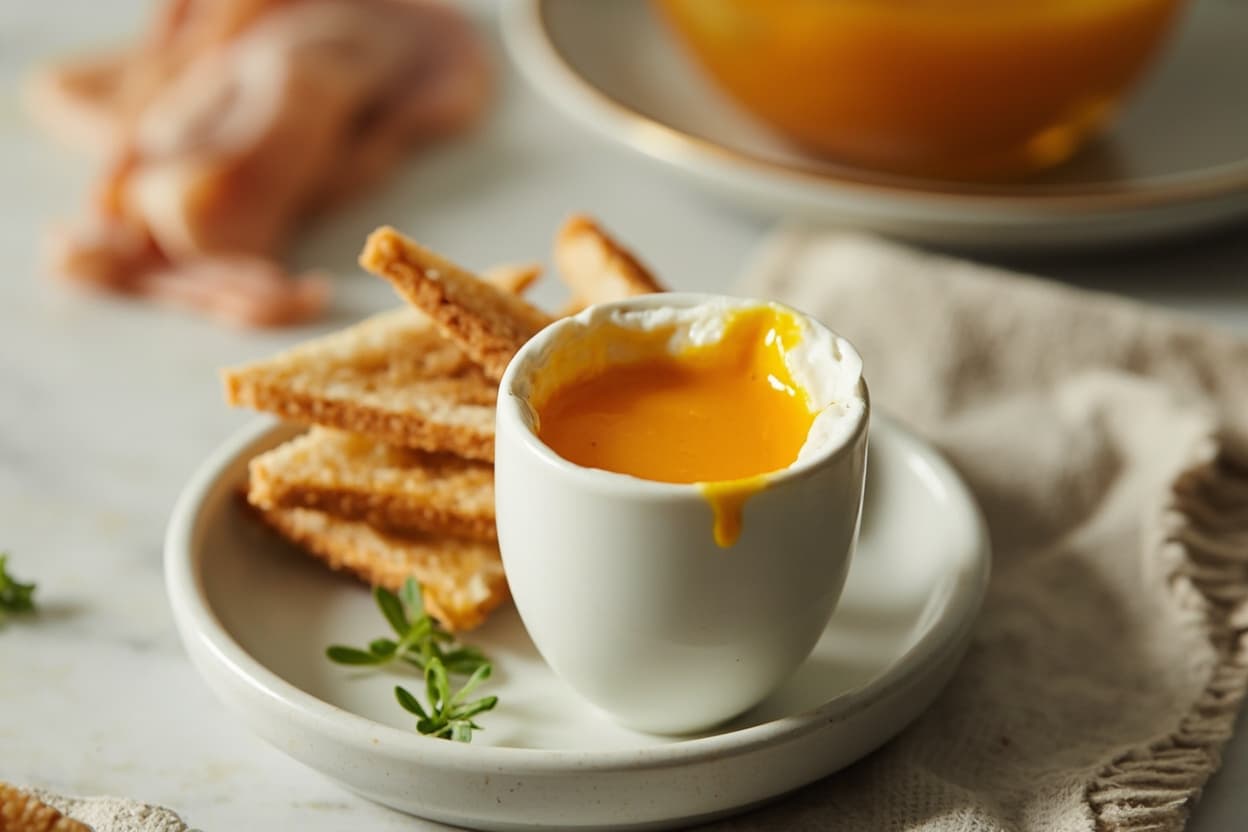
Perfect Soft-Boiled Egg with Crisp Soldiers
Two jammy-yolked eggs in their cups, accompanied by golden fingers of buttered toast. No towers. No rent. Just breakfast.

Prep
5 min
Cook
6 min
Total
11 min
Method
Set Up
1
Fill a medium saucepan with water and add the white vinegar. Bring to a rolling boil over high heat.
Cook the Eggs
3
4
Set your timer for exactly 6 minutes. Anything more and you'll have chalky yolks. Anything less and you'll have pools.
Make the Soldiers
5
While the eggs cook, cut each bread slice into 4 fingers—straight, uniform strips about 1cm wide.
6
Toast the soldiers in a dry frying pan over medium heat, turning once, until golden on both sides. Or use your toaster if you must, though a pan gives you better color control.
Finish and Serve
8
When the timer sounds, remove the eggs immediately with a slotted spoon and place in egg cups.
9
Blot the bottom of each egg dry with a cloth or paper towel so it sits steady in its cup.
10
Using a sharp knife, crack the top quarter of each shell firmly and remove the cap. Serve the soldiers alongside for dipping. Eat immediately.
D
Nutri-Score
Needs balance
A–E · lower is better · score 13
Calories
304
per serving
High in saturated fat · 11gSource of protein · 15gLow sugar · 2g
Protein
15g
Carbs
11g
Fat
22g
Sat. fat
11g
Fiber
1g
Sugar
2g
Sodium
395mg
Not VeganNot Gluten FreeContains DairyBalanced Macro Ratio
Nutri-Score is a general nutritional-balance guide, not medical or dietary advice.
C
Environmental impact
Moderate impact
A–E · lower is better · includes estimates
kg CO2e
0.6
per serving
CCarbonAEU all-round· carbon sets the grade
Water
0.1m³
Land
24Pt
Runoff
0.06g P
Eggs, refrigerator cold drives 73% of this recipe’s estimated footprint.
Carbon from Poore & Nemecek 2018; water, land & runoff from Agribalyse — modelled averages for comparing recipes, not a measurement of your groceries.
Flavor Profile
7
Umami
4
Sweet
5
Salty
3
Sour
2
Bitter
0
Spicy
Textures
CrispyTenderRunny
Aromas
ButteryToastedSavoryBready
Kitchen Equipment
Primary Tool
SaucepanCounter FootprintSmall
Safety & Storage
High Risk Population
Soft-boiled eggs with runny yolks pose a risk to vulnerable populations including pregnant individuals, young children, elderly persons, and immunocompromised individuals. Consider fully cooking eggs for these groups.
Cooking Temperature
Bring water to a rolling boil before lowering eggs in cups. Maintain active boiling throughout the 6-minute cook time to ensure proper egg white coagulation.
Handling
Crack eggs into individual cups or ramekins before adding to boiling water to maintain control and prevent shell fragments from entering the cooking water.
Cross Contamination
Use separate utensils and surfaces for raw egg handling. Clean and sanitize any equipment that contacts raw eggs before using for other food preparation.
Storage
Keep eggs refrigerated at 40°F (4°C) or below until ready to use. Butter should be stored at refrigerated temperatures until brought to room temperature for service.
Shelf Life
Soft-boiled eggs must be consumed immediately after cooking. Do not hold or store cooked eggs as they cannot be safely reheated and provide an ideal growth environment for harmful bacteria when held in the temperature danger zone.
Blot cooked eggs dry before placing in egg cups to ensure stable positioning and prevent slipping. Serve and eat immediately to maintain food safety and optimal texture.
Pro Tips
Technique
Crack your eggs into small cups first—this is not extra work, it is control. Sliding an egg from a cup into boiling water is the difference between a neat parcel and a wispy disaster. The vinegar is doing essential labor here; do not skip it.
Substitution
No white bread? Sourdough works, though the soldiers will be more robust. What you want is bread that toasts to a firm golden finger capable of standing up to a runny yolk without crumbling into apologetic toast-dust.
From the chef
There is a certain kind of restaurant that will serve you a soft-boiled egg in a tower of microgreens, surrounded by three sauces, with a bread basket on standby. This is not that. This is an egg in a cup, toast in fingers, and the quiet dignity of knowing exactly what you are eating. No velvet ropes. No queue. Just breakfast.
TagsClassicBreakfastQuickEasyEggsToast
AllergensEggsMilkWheatGluten
Source: generated · June 9, 2026