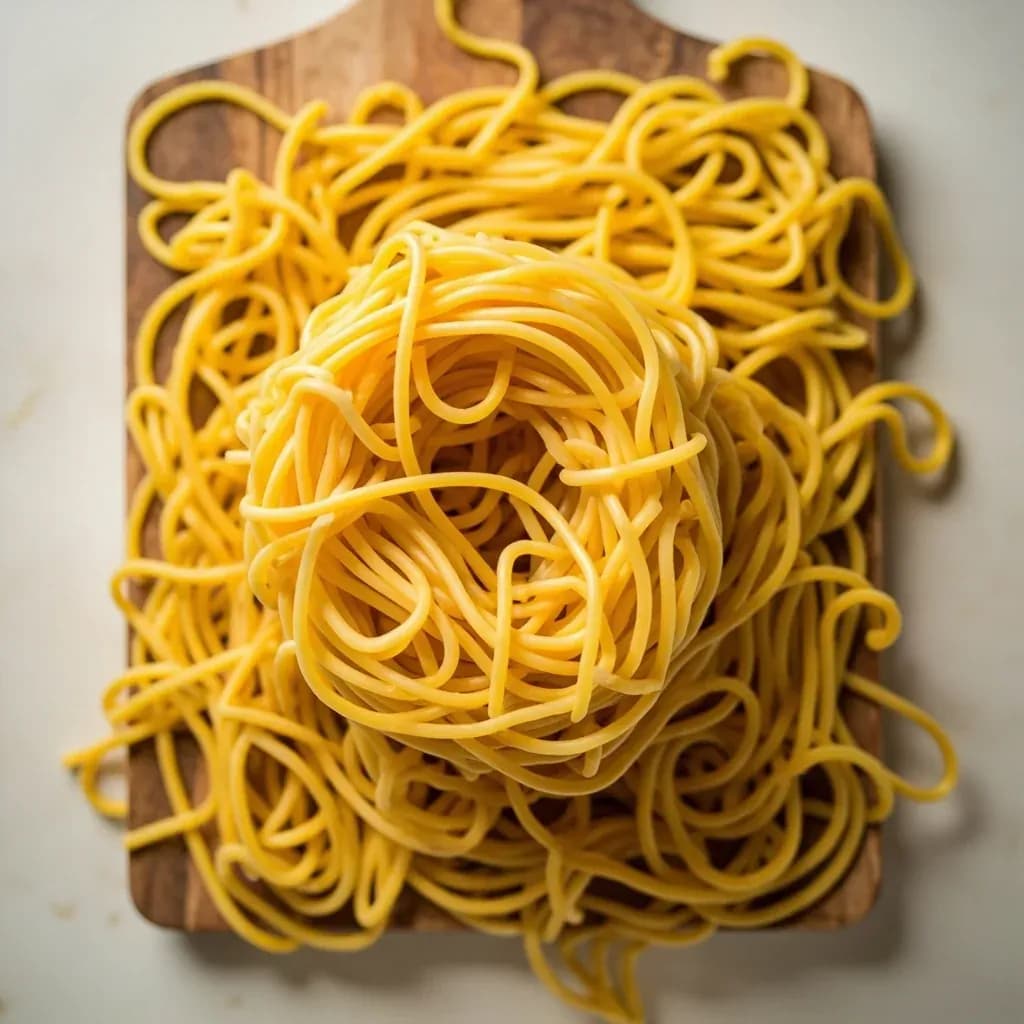
Transform & Preserve
Alkaline Treatment (Kansui)
Adding alkaline salts to dough so noodles gain springy bite, yellow color, and aroma.
Alkaline treatment uses kansui, a solution of sodium and potassium carbonate, in noodle dough to raise its pH. The higher pH tightens the gluten for a firm, springy chew, turns the dough yellow, and develops the distinctive ramen aroma. Baked baking soda is a common home substitute when kansui is unavailable.
Alkaline treatment — kansui (鹼水) in Japanese and Mandarin — is the practice of incorporating carbonate salts into noodle or pastry dough so the finished product develops a springy bite, a pale-to-deep yellow color, and a faint mineral aroma no other single ingredient can replicate. Traditionally, cooks leached carbonate-rich ash from burned hardwoods, straw, or specific plants (quinoa husk, sunflower stalks, certain desert shrubs) in water; today, the same effect is achieved with a measured blend of potassium and sodium carbonates dissolved into the formula water. Lifting dough pH into the 9–11 range, the alkali firms the gluten network, slows staling, and produces a noodle that holds its shape through boiling, rinsing, stir-frying, or a long soak in hot broth.
The technique is the defining differentiator between an East Asian alkaline noodle and a plain salt-and-water wheat noodle such as Italian pasta. The yellow hue of a bowl of ramen or a plate of Cantonese wonton mee is not from egg or saffron — it is the direct result of carbonates reacting with wheat pigments and promoting browning during cooking. The characteristic 'curry-like' or 'woody' aroma, the chew, the resilience when reheated, and the longer shelf life all trace back to this single, carefully measured addition. Authentic Cantonese wonton noodles and Hong Kong wonton mee must contain lye water; without it, the noodles read as soft, white, and unmistakably wrong to anyone raised on the tradition.
In practical terms, alkaline dough behaves differently from neutral dough at every stage: it requires less hydration, mixes more stiffly, rests more productively, and cooks more quickly. It browns faster in oil, rinses clean of surface starch, and carries broth flavor with unusual clarity. Treating it as a different category from Italian-style egg or semolina pasta — rather than a tweak to a familiar recipe — is the single biggest mental shift a cook must make when working with kansui for the first time.
- Difficulty
- Medium
Types & varieties
A measured blend of potassium and sodium carbonates sold in packets or jars; dissolved at the time of use. The standard form for ramen and most Cantonese noodles.
Commercial liquid containing potassium carbonate plus added sodium bicarbonate; used for Cantonese mooncake crust to deepen golden browning.
Carbonate-only liquid without bicarbonate; gentler alkalinity, used in classic wonton noodles and certain Hakka and Henan preparations.
Sodium bicarbonate heated at 120–150°C / 250–300°F for about an hour to convert it to sodium carbonate. A reliable home preparation of the active agent.
Traditional leachate from hardwood ash; contains potassium carbonate plus trace minerals that contribute a faintly earthy, complex aroma.
How to do it
- 1
Choose your alkali form
For ramen, Cantonese egg noodles, and Henan/Shanxi-style noodles, use a potassium/sodium carbonate blend — commercial powdered kansui or homemade baked baking soda. For Cantonese mooncake crust, use bottled 'yellow lye water' (carbonates plus bicarbonate) to drive deeper browning. Avoid pure baking soda: it gives off-flavors and a dull color.
- 2
Dissolve in warm water
Weigh 1–3% alkali by flour weight (1% for a soft yellow noodle, 3% for the springy Peking/Henan bite) into a small bowl. Add warm water (~40°C / 105°F) equal to roughly 10–20% of the formula's total water. Stir until fully dissolved; any undissolved grit will leave dark specks in the finished dough.
- 3
Combine with flour and remaining water
Place flour and ~1% salt in a bowl or stand mixer. Pour in the dissolved alkali solution and the remaining water — typically 32–38% total hydration for ramen, 30–34% for Cantonese wonton noodles. Mix on low until the dough comes together in a shaggy mass.
- 4
Knead to a stiff, smooth dough
Knead 8–12 minutes in a mixer, or 15–20 minutes by hand. The dough will feel noticeably stiffer than a neutral pasta dough at the same hydration; that firmness is correct. When pressed, the surface should look slightly yellow and feel almost waxy.
- 5
Rest, tightly covered
Wrap in plastic and rest 30–60 minutes at room temperature, or overnight at 4°C. A refrigerated rest deepens the yellow color and firms the texture further. Do not skip this step: alkaline dough needs time for the pH to act on the gluten.
- 6
Sheet and cut
Roll or machine-sheet the rested dough through progressively thinner settings, letting it rest a few minutes between passes if it springs back. For ramen, target a final thickness of about 1.0–1.2 mm before cutting. For Cantonese wonton noodles, cut thin (≈1 mm × 1 mm) on a bamboo pole or pasta machine.
- 7
Cook in vigorously boiling water
Drop noodles into a large pot of rapidly boiling, unsalted water, stirring gently at the start to prevent sticking. Ramen: 60–90 seconds fresh, 2–3 minutes from frozen. Wonton noodles: 45–60 seconds. The noodles should be just tender with a resilient core.
- 8
Rinse, shock, and serve
Drain and rinse briefly under cool running water to remove surface starch and excess alkali. For ramen, transfer directly into hot broth without rinsing so the surface starch helps the broth cling. For cold dishes or stir-fries, rinse and optionally shock in ice water to set the bite.
The Chemistry of the Bite
Three things happen when alkali meets flour, and together they explain every sensory difference between an alkaline noodle and a plain one.
- Gluten firms: at pH 9–11, gluten proteins form a tighter, more cross-linked network, giving the noodle its characteristic snap, elasticity, and resistance to overcooking. Dough feels stiffer during mixing than a neutral pasta dough at the same hydration — that firmness is correct, not a sign of over-flouring.
- Color develops: alkaline conditions reveal the natural yellow flavone pigments already present in wheat, producing a pale-to-deep yellow hue even in egg-free dough. The same environment accelerates Maillard browning during cooking, so alkaline noodles color faster than neutral ones when pan-fried or deep-fried.
- Aroma emerges: a distinctive mineral, slightly soapy, sometimes 'curry-like' or 'woody' aroma that is unique to alkaline noodles. It is most pronounced in potassium-carbonate-heavy blends; sodium carbonate alone tastes flatter and more chemical.
- Shelf life extends: the elevated pH inhibits mold and many spoilage bacteria, so dried alkaline noodles keep noticeably longer than neutral wheat noodles, an advantage that drove the technique's spread along trade and migration routes.
Common uses
Tips & pitfalls
- Always dissolve carbonates in warm water (~40°C / 105°F); they will not fully dissolve in cold water and you will end up with gritty, speckled dough.
- Add kansui gradually — 1% of flour weight for a soft yellow noodle, up to 3% for the springy 'Peking/Henan' bite. Going past ~4% produces a soapy, unpleasant flavor.
- Choose potassium-rich kansui over pure sodium carbonate if you want the characteristic ramen aroma; sodium carbonate alone tastes flatter and more chemical.
- Rest the dough 30–60 minutes (or overnight, refrigerated) after kneading — alkalinity continues to relax the gluten and deepen the yellow color over time.
- If substituting with baking soda, bake it first at 120–150°C / 250–300°F for about an hour to convert bicarbonate to carbonate; otherwise the dough takes on a sour, metallic note.
- Use glass, stainless steel, or food-grade plastic bowls and utensils for prolonged contact with strong kansui solutions.
- Do not confuse culinary 'lye water' (alkaline carbonate solution) with sodium hydroxide lye (NaOH). NaOH is caustic at kitchen strengths and is not the same ingredient.
- Alkaline noodles brown much faster in oil than neutral noodles — drop the fryer or pan temperature by roughly 10°C to prevent scorching the surface before the inside cooks through.
- Store opened liquid kansui tightly capped; CO2 from air gradually converts carbonates to bicarbonates, lowering pH and weakening the effect over months.
Good to know
- Traditional name
- Kansui (鹼水) in Japanese; jiǎn shuǐ (鹼水) in Mandarin; gaan seoi (Cantonese).
- Traditional source
- Lye-leached water from the ash of burned hardwoods, straw, or carbonate-rich plants such as quinoa husk or sunflower stalks.
- Modern composition
- Typically a blend of potassium carbonate (~70–80%) and sodium carbonate (~15–25%), sometimes with a small amount of sodium bicarbonate; final solution pH around 11.
- Dough pH
- Roughly 9–11, depending on dosage and flour absorption.
- Typical dosage
- 1–3% of flour weight for noodles (1% mild, 3% firm/elastic); 2–3% of dough weight for wonton wrappers; 2–5% for Cantonese mooncake crust.
- Solubility
- Carbonates dissolve only sparingly in cold water; warm water (~40°C / 105°F) is required for a clear solution.
- Origin
- China, most often credited to Henan and Shanxi noodle traditions; adopted into Japanese ramen during the Meiji era (late 19th–early 20th c.).
- Shelf-life benefit
- High pH inhibits mold and bacterial growth, giving dried alkaline noodles a markedly longer shelf life than neutral wheat noodles.
- Storage (powder)
- Indefinite in a sealed, dry container; protect from moisture and CO2, which can convert carbonates to bicarbonate over time.
- Storage (liquid)
- Sealed dark bottle keeps 6–12 months; the yellow tint of bottled 'yellow lye water' may fade with air exposure without loss of potency.
Also called
Kansui Treatment · Lye Water Treatment
Related

Confit
Cook slowly submerged in fat for silky tenderness and keeping

Cure
Draw out moisture with salt and time to preserve and concentrate

Pickle
Steep in acidic brine for bright, tangy, crunchy preservation

Ferment
Let friendly microbes transform food into tangy, complex flavor

Marinate
Soak in a seasoned mix to flavor and tenderize before cooking

Brine
Soak in salt water so meat stays juicy and seasoned throughout

Dehydrate
Slowly dry out moisture to concentrate flavor and extend shelf life

Cold-Smoke
Perfume cured food with smoke without cooking it through