Heat & Fire
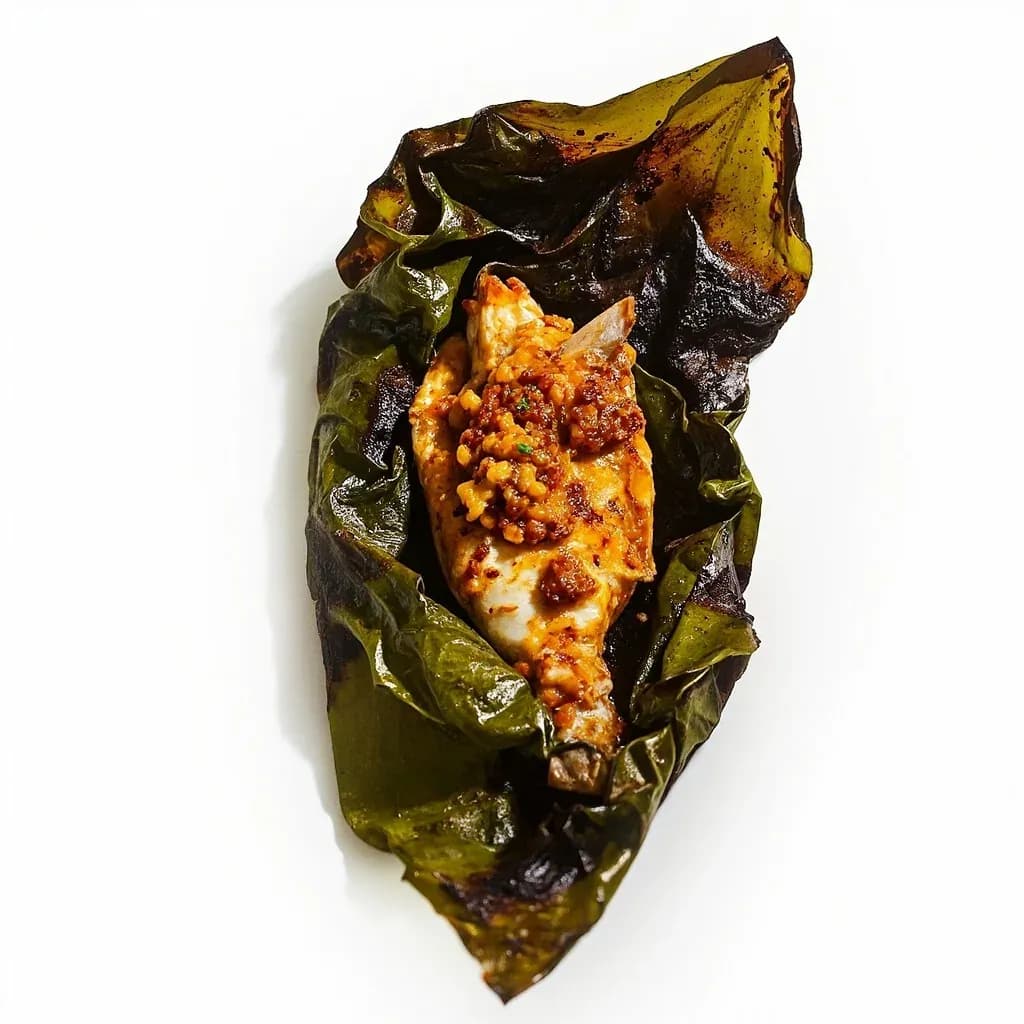
Banana-Leaf Wrapped Grilling (Pepes/Tum)
Wrapping spiced fish or meat in banana leaves and grilling so it steams and smokes inside the parcel.
This technique encloses seasoned fish, meat, or vegetables with spice paste in banana leaves, then grills or steams the parcel so the contents cook gently in their own juices while taking on a grassy aroma and light char. Indonesian pepes and Lao or Thai tum mok are classic examples. The leaf protects the delicate filling from direct flame and is unwrapped at the table to release fragrant steam.
Banana-leaf grilling is the practice of enclosing marinated fish, meat, or vegetables in a tight banana-leaf parcel and cooking it directly over coals. The wrapper does the work that a lid, foil, and a roasting pan would do in a Western kitchen: it traps the food's own steam so the interior cooks gently, while the grill's smoke and conducted heat work on the outside. The result is a hybrid cook — softer than direct grilling, smokier than steaming — that delivers a moist, fragrant filling under a leaf that has blistered and blackened in places.
The technique matters most for foods that are fragile, lean, or wet. A delicate carp fillet that would disintegrate on the grate, a loose fish paste with nothing to hold it together, or a chicken breast that dries out in minutes can all be wrapped, set on the coals, and walked away from. The leaf also gives the food something no other wrapper can: a faint, grassy, faintly resinous aromatic — the smell of cut grass and tea — that comes from the waxes and oils in the leaf's cuticle as it heats. Foil and parchment can mimic the moisture retention, but they cannot replicate that smell.
Across the cuisines where this method lives — Sundanese pepes, Balinese tum, Malay otak-otak, Kerala pollichathu, Visayan pinais, and Mexican pescado en hoja de plátano — the wrapper is the technique. The fillings change with the pantry; the logic stays the same. Once you understand that a banana-leaf parcel is essentially a small, self-basting steamer that happens to be sitting on a grill, you can adapt the method to almost anything that benefits from gentle, smoky, hands-off cooking.
- Difficulty
- Medium
Types & varieties
Sundanese (West Java). Spice-coated fish or chicken wrapped in banana leaf and grilled over coals — the reference form. Often sold in splayed bamboo baskets (tambul/besek) as street food.
Vegetarian Sundanese parcels replacing the protein with mushrooms, tofu, or tempeh; same spice paste, shorter grill time.
Balinese banana-leaf parcel, usually steamed with herbs (ayam tum, ikan tum). Grilled variants over coconut-husk coals are common in warung; parcels are tighter and flatter than Sundanese pepes.
Malaysia, Riau, Singapore. Fish paste (often mackerel or sardine) bound with coconut milk and spices, piped onto a doubled banana-leaf strip, folded into a flat packet, and grilled. Eaten with peanut sauce.
Kerala, India. Whole pearl spot fish rubbed with masala, wrapped in banana leaf, then pan-griddled in coconut oil — Kerala's signature leaf-wrapped fish.
Kerala, India. Generic version: any firm-fleshed fish wrapped with onion-tomato masala and pan-grilled in leaf.
Gujarat, India. Fish or rice coated in a tamarind-jaggery-coconut paste, wrapped in leaf, and grilled on a tawa or pan.
Visayan and Tagalog (Philippines). Marinated fish or pork with coconut milk and calamansi, folded in banana leaf, grilled on a grill or pan.
Thai. Cured fish or chicken curry steamed in banana-leaf cups; usually steamed, but the same leaf-wrap-and-grill method is used for 'bai toey' street snacks.
Caribbean and Mexican adaptation. Whole fish with sofrito or achiote paste, wrapped in leaf and grilled or baked — a descendant of the SE Asian technique via colonial trade routes.
How to do it
- 1
Prepare the banana leaves
Cut fresh or thawed leaves into 25–35 cm squares, trimming out the thick central rib. Wipe both sides with a damp cloth. Pass each square briefly over a gas flame or a hot dry skillet for 2–3 seconds per side until the color brightens and the leaf becomes pliable. Stack the wilted squares under a clean towel so they stay flexible while you work.
- 2
Make the spice paste (bumbu)
Grind shallots, garlic, candlenuts (or macadamias), coriander seed, turmeric, galangal, fresh chilies, and a small knob of shrimp paste to a coarse paste in a mortar or small food processor. Season with salt, a pinch of sugar, and a squeeze of lime, then fold in finely sliced lemongrass and shredded kaffir lime leaves. For otak-otak–style paste parcels, loosen with a splash of coconut milk until the mixture holds together but is not runny.
- 3
Coat the protein
Score whole small fish (200–400 g) deeply on both sides, or portion fillets. Rub the spice paste thoroughly into the cuts and cavity so it reaches the bone, then marinate 15–30 minutes at room temperature or up to 2 hours refrigerated. For paste-style parcels, fold the protein directly into the bumbu until it forms a thick, cohesive mass that holds its shape on a spoon.
- 4
Wrap the parcels
Lay a leaf square shiny-side up. For whole fish or fillets: place the coated fish in the center, tuck aromatics around it, fold the bottom edge up over the fish, fold the sides in like an envelope, and roll forward into a tight flat packet. For paste: spoon a 2–3 cm thick log of fish paste along the center of a long leaf strip and fold the leaf over it like a booklet. Secure each parcel with 2–3 bands — top, middle, and bottom — using either folded banana-leaf strips or twine that has been soaked in water.
- 5
Heat the grill
Light a charcoal chimney starter 25–30 minutes before cooking. Spread the coals in a single layer and let them burn down to grey ash. Target a medium fire: hold your hand about 10 cm above the grate and you should be able to keep it there for roughly 4–5 seconds. Brush the grate clean and oil it lightly with a folded paper towel.
- 6
Grill the parcels
Lay parcels seam-side down on the grate. Grill uncovered for 8–12 minutes (small fish, fillets, or paste) or 15–25 minutes (whole fish or chicken thighs), turning every 3–4 minutes with tongs or a wide spatula so all sides blister and char lightly. Brush the exterior with coconut oil once or twice during cooking to slow scorching and add a gloss.
- 7
Test for doneness
The leaf should be blistered and partly blackened, and the parcel should feel firm and resilient when pressed with tongs, not squishy. For whole fish or chicken, push an instant-read thermometer through the leaf into the thickest part: 60 °C / 140 °F for fish, 75 °C / 165 °F for chicken. A properly cooked parcel will give a faint, satisfying sizzle when nudged.
- 8
Rest and serve
Transfer parcels to a warm plate and let rest 2–3 minutes so the juices redistribute. Open at the table by snipping the ties and peeling back the leaf — expect a fragrant puff of steam and the full aroma of the leaf and spice paste. Serve in the opened leaf, with steamed rice, sambal, kecap manis, or peanut sauce alongside.
Working with Banana Leaf
The leaf is the technique's most demanding ingredient — not because it is fragile, but because it has to be in the right condition when it meets the protein. Fresh leaves are brittle and will crack along the veins the moment you try to fold them. The fix is a quick pass over a flame or hot dry skillet, two or three seconds per side, until the green brightens and the leaf relaxes. Wilted this way, the same leaf will fold like cloth and hold a tight seam without tearing. Wipe leaves clean with a damp cloth rather than rinsing: water trapped in the leaf's channels steams unevenly and can split the seam mid-grill. Cut the thick central rib out before wrapping; it does not wilt and will not lie flat.
- Fresh leaves keep about 1 week refrigerated, wrapped in plastic. Blanched and frozen leaves keep 6+ months and should be wiped, not rinsed, before use.
- Cut 25–35 cm squares for single-serving parcels; longer strips work for folded otak-otak logs.
- Always wilt the leaf before folding — the only common reason a parcel falls apart on the grill is an un-wilted, cracked leaf.
- For very wet fillings (coconut-milk-heavy paste, juicy tomatoes), double-wrap with two squares offset by 90° to catch any leaks.
Choosing the Right Protein
The leaf rewards foods that the grill punishes. Lean white fish, oily small fish, fish paste, tofu, tempeh, and boneless chicken thighs are ideal because they need protection from direct heat and have enough moisture of their own to generate the steam that does the gentle work. Very large, dense pieces — a thick steak or a whole chicken — work less well: the parcel sits on the coals long enough for the outside to overcook before the center is done. Score whole fish deeply so the paste and steam reach the bone; cut fillets into portions so they cook in the same window as the leaf. Marinate 15–30 minutes for whole fish, 10–15 for fillets and paste, to let the salt and acid begin to season the flesh before it meets the heat.
- Best: whole small fish (200–400 g), fish fillets, fish paste, chicken thighs, tofu, tempeh, mushroom mix.
- Use with caution: very large whole fish, thick steaks, and any piece that needs a long cook — finish in the oven if the leaf starts to scorch before the center is done.
- Always score whole fish on both sides before marinating, even for a 15-minute rest.
Common uses
Tips & pitfalls
- Wilt the leaf over a flame or hot dry pan for 2–3 seconds per side before wrapping. A brittle, fresh leaf will crack the moment you fold it; a wilted one folds like cloth and holds its seam.
- Never soak leaves in water — wipe them with a damp cloth instead. Waterlogged leaves steam unevenly and split at the seams during grilling.
- Double-wrap very wet fillings (coconut-milk-heavy otak-otak, juicy tomatoes) in two offset leaf squares to catch any leaks before they hit the coals.
- Tie with soaked twine or with strips folded from spare banana leaf — both avoid the burning-through problem of dry string.
- Grill over medium, well-established coals — flames licking the leaf will scorch it black and turn the spice paste bitter. Grey-ashed coals, not flaming ones, are the target.
- Brush the outside of the parcel with a thin film of coconut oil or neutral oil to slow charring and add a gloss.
- Turn parcels every 3–4 minutes for even charring; some blackening of the leaf is flavor, not failure.
- Don't open the parcel to 'check' it. Every opening bleeds steam and lengthens the cook. Trust the time and the firmness of the parcel instead.
- Rest finished parcels 2–3 minutes off the heat so the juices redistribute; open them at the table for the full aroma.
- Thick parcels that char on the outside before the inside is done can finish in a 200 °C / 400 °F oven for 5–8 minutes — the leaf will not burn further in dry oven heat.
- Raw wrapped parcels freeze well for up to 2 months; grill straight from frozen, adding 4–5 minutes to the cook time.
Good to know
- Origin
- Island Southeast Asia; the term 'pepes' is Sundanese (West Java, Indonesia), and the parcel-grilling technique is shared across Indonesia, Malaysia, the southern Philippines, and South India.
- Wrapper
- Banana leaf (Musa spp.), typically cut into 20–35 cm squares. The leaf is never eaten — it is a cooking vessel and flavoring wrapper.
- Heat source
- Charcoal or wood-fire grill; medium coals (about 175–200 °C / 350–400 °F at the grate). High heat scorches the leaf before the food cooks.
- Cook time
- Roughly 8–15 minutes for small fish or fish-paste parcels; 15–25 minutes for whole small fish (200–400 g) or chicken thighs.
- Core technique
- A tight wrap that traps steam while the exterior picks up smoke. Inside cooks by a hybrid of steam, smoke, and conducted heat.
- Sign of doneness
- The parcel feels firm when pressed, the leaf chars and blisters, and opening releases a soft 'huff' of fragrant steam.
- Common proteins
- Carp (ikan mas), mackerel (kembung/tongkol), tilapia, sardines, chicken, tofu, tempeh, and fish paste (otak-otak style).
- Difficulty
- Moderate. Wrapping neatly is the main skill; the leaf forgives overcooking better than a naked grate.
Also called
Pepes · Tum · Banana Leaf Steaming
Related

Sear
Blast the surface hot for a deep-browned, savory crust

Sauté
Cook quickly in a little fat over lively heat, tossing as you go

Stir-Fry
Toss bite-sized pieces over roaring heat for fast, smoky cooking

Pan-Fry
Crisp food in a shallow layer of hot fat, turning once or twice

Deep-Fry
Submerge in hot oil for an all-over crackling crust

Roast
Cook uncovered in dry oven heat for browned edges and tender centers

Bake
Cook with steady, surrounding oven heat — the soul of bread and pastry

Broil
Hit food from directly above with fierce overhead heat