Prep & Assembly
Barding
Wrapping lean meat in fat such as bacon to keep it moist during roasting.
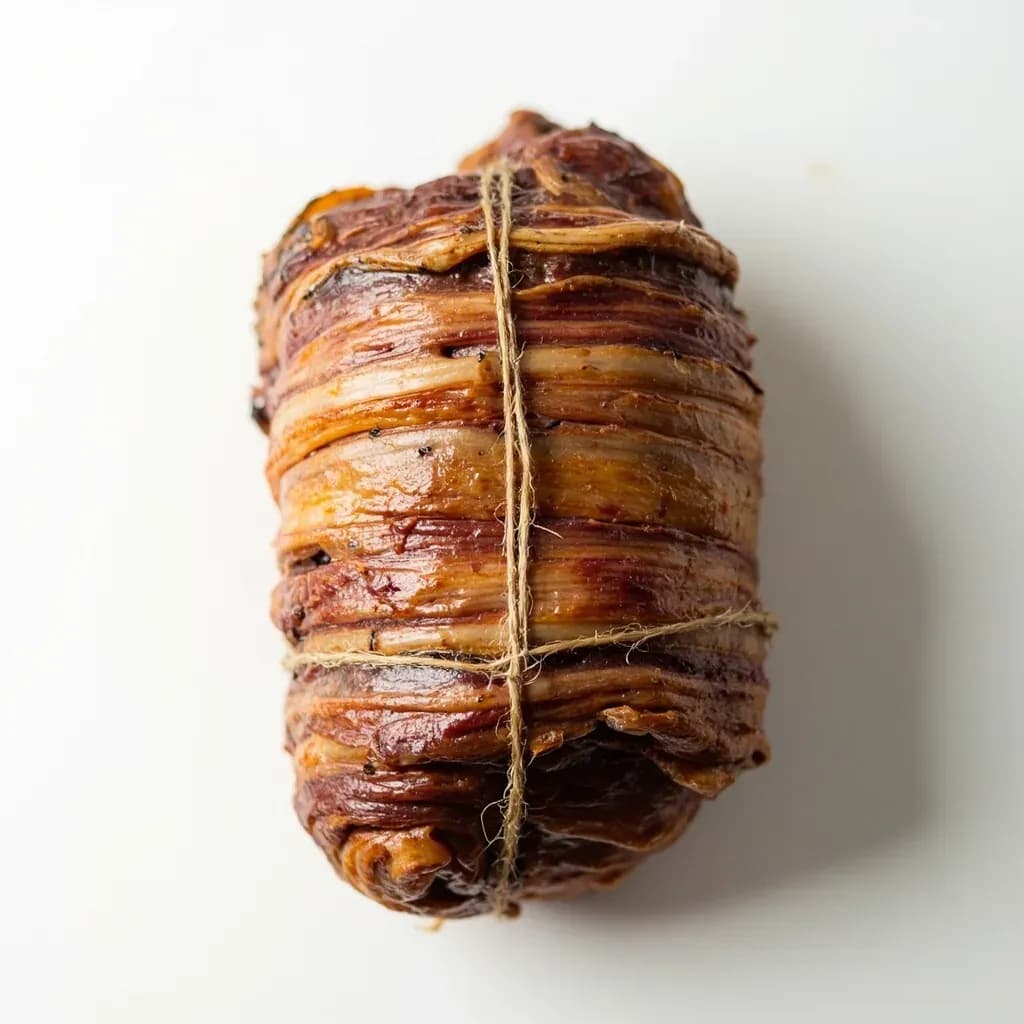
Barding drapes or wraps lean cuts and game in a layer of fat, classically thin sheets of pork fatback or bacon, before roasting. As the meat cooks the fat melts and bastes it, protecting the surface from drying out and adding richness. It differs from larding, which threads fat through the interior of the meat rather than over its surface.
Barding is the classical technique of draping thin sheets of fat over the outside of a lean piece of meat — or bird or fish — before cooking, so the fat slowly renders during roasting or grilling and self-bastes the food from the outside. The principle is simple: the leaner the protein, the more it suffers from prolonged heat, so a sacrificial layer of pork fat, bacon, or caul fat acts as both an insulator and a continuous source of moisture. The fat melts at a lower temperature than the meat's connective tissue tightens, which means it bastes the surface just as the muscle fibers begin to squeeze out their own juices.
The technique is closely associated with French classical cuisine — codified by Carême in the early 19th century and passed down through Escoffier — but it has medieval roots and appears in many traditions where hunters had to make the most of lean venison, hare, and wild fowl. In a modern kitchen, barding is most often called on when a recipe has no marinade, brine, or sauce to compensate for dryness, and when the cook wants a clean, unadorned finished plate.
It is worth separating barding from its frequent companion, larding. Barding wraps the exterior; larding threads strips of fat deep into the interior of a roast with a needle. They look similar, they share the same end goal, and the great classical kitchens routinely used both together on the leanest meats, but they are not interchangeable steps.
- Difficulty
- Medium
Types & varieties
The classic choice; neutral flavor, high fat content, slices cleanly when chilled
Adds smoke and salt; popular for game birds and roast turkey
Lacy netting of pig omentum; drapes over meat without tying and self-conforms
Cured and salted; very traditional, used for venison and game
Meatier than fatback; adds richness and a thin layer of cooked pork
Hard beef or mutton fat; occasionally used for very traditional British game preparations
How to do it
- 1
Chill the fat
Place the chosen fat (fatback, bacon, or other) in the freezer for 10–20 minutes until firm but not frozen solid. Cold fat slices cleanly without tearing or sticking to the blade.
- 2
Prepare the meat
Pat the meat dry and season lightly. If barding a bird, truss it first so it holds a compact shape. For roasts, bring the meat to a uniform shape so the fat lays flat.
- 3
Slice the fat
Using a long, sharp knife, cut the fat into thin, even sheets roughly 3–5 mm thick and large enough to cover the surfaces you want to protect. Keep slices as rectangular as possible for easier wrapping.
- 4
Wrap the meat
Lay the slices of fat over the leanest surfaces (breast meat on birds, the back and sides of a venison saddle, etc.), overlapping them slightly like shingles so no meat is exposed.
- 5
Secure the barding
Tie at 2–3 cm intervals with butcher's twine, or pin with short wooden or metal skewers. If using caul fat, simply drape it on; the natural mesh holds it in place without tying.
- 6
Cook as directed
Roast, grill, or braise according to your recipe. The fat will slowly render, basting the meat and shielding it from direct heat. Baste the outside occasionally with the rendered fat for even protection.
- 7
Optional: remove near the end
For the final 15–20 minutes, strip off the barding and raise the heat if possible so the meat's surface can brown and develop a crust or crisp skin.
- 8
Rest and serve
Rest the meat for at least 10–15 minutes (longer for large roasts) so the juices redistribute. Discard the rendered fat, or strain and reserve it for another use.
Barding vs. larding
The two are often discussed as if they were the same technique, but they work on different parts of the meat. Barding protects the exterior, guarding the surface from direct radiant heat and continuously basting the outside as it renders. Larding goes the other way: a larding needle pierces the meat and pulls a strip of fat (a lardon) deep into the lean muscle, moistening the interior from within. On a very lean saddle of venison or a large dry turkey, the classical kitchen would routinely do both — lard the breast and legs, then bard the outside — because either alone leaves one zone of the meat unprotected. For most home cooks, barding is the easier and more forgiving of the two, since it requires only a sharp knife and twine rather than the special needle and practiced hand larding demands.
Choosing the right fat
The fat you choose sets the flavor of the finished dish as much as the barding itself, so pick with the recipe in mind.
- Fatback is the neutral, all-purpose choice: pure pork fat, no cure, no smoke, no saltiness. Use it when you want moisture without altering the flavor of the meat.
- Bacon brings salt and smoke. It is convenient — almost every kitchen has it — but it will season the surface of whatever it wraps, so match the cure to the dish (a smoky applewood bacon suits turkey, a milder bacon is better with delicate fish).
- Caul fat is the elegant option: the lacy, web-like membrane (omentum) from the pig's abdominal cavity. It drapes like a net, needs no tying, and renders into a thin, almost invisible layer of fat. Butchers who make pâtés and crepinettes will usually have it on request.
- Salt pork is traditional with game, where a pronounced cure was historically welcome. Soak it briefly and rinse if you are concerned about oversalting the finished dish.
- Suet is reserved for the most traditional British game roasts. It has a higher melting point than pork fat, so it stays intact longer in a hot oven — useful when you want the fat to protect rather than render quickly.
Common uses
Tips & pitfalls
- Chill the fat thoroughly (firm but not rock-hard) so it cuts into clean, even slices without crumbling
- Slice the fat with a long, sharp knife dipped in hot water and wiped dry between cuts
- Wrap the meat snugly; loose fat shrinks away and fails to baste properly
- Tie with butcher's twine at 2–3 cm intervals, or pin with small metal skewers
- Season the outside of the fat lightly; salt helps draw out moisture and aids browning
- Consider removing the barding in the final 15–20 minutes of cooking so the surface can brown and crisp
- Reserve the rendered fat from the pan for roasting vegetables or making a jus
- Do not confuse barding (outside wrapping) with larding (interior insertion through a needle)
- Avoid over-barding; too much fat overwhelms the meat's own flavor and can make the dish greasy
- For poultry, tuck a little of the fat under the skin of the breast as well for extra insurance
Good to know
- Origin
- Classical French cuisine, with roots in medieval and Renaissance European cooking
- Etymology
- From French 'barde', meaning a thin slice of fat (typically pork) used to wrap food
- Related technique
- Larding (inserting fat into the interior of meat with a larding needle)
- Primary materials
- Pork fatback, bacon, salt pork, caul fat (crépine), thin slices of pork belly
- Best applied to
- Lean meats with little intramuscular fat: game birds, venison, rabbit, turkey breast, lean fish
- Documented by
- Antoine Carême and Auguste Escoffier in the 19th and early 20th centuries
- Active time
- Roughly 5–15 minutes to wrap and tie; cooking time is dictated by the dish itself
- Skill level
- Beginner to intermediate; requires confident knife work for thin, even slices of fat
- Fat temperature
- Should be kept very cold (ideally just out of the freezer for 10–15 minutes) so it slices cleanly without tearing
- Slice thickness
- Around 3–5 mm (about ⅛ inch); thick enough to render and self-baste, thin enough to melt through
Also called
Fat-Wrapping
Related

Whisk
Beat ingredients smooth and aerated with a looping wire motion

Sift
Pass dry ingredients through mesh to aerate and remove lumps

Strain
Pour through mesh to separate solids from liquid for a smooth result

Filter
Pass liquid through fine material to clarify out the smallest particles

Rice
Press cooked potatoes through small holes for fluffy, lump-free texture

Mash
Crush soft cooked food into a rustic, creamy purée

Grind
Crush food into a coarse to fine texture, from spices to meat

Grate
Shred food into fine bits against a sharp-toothed surface