Heat & Fire
Pot-Roasting
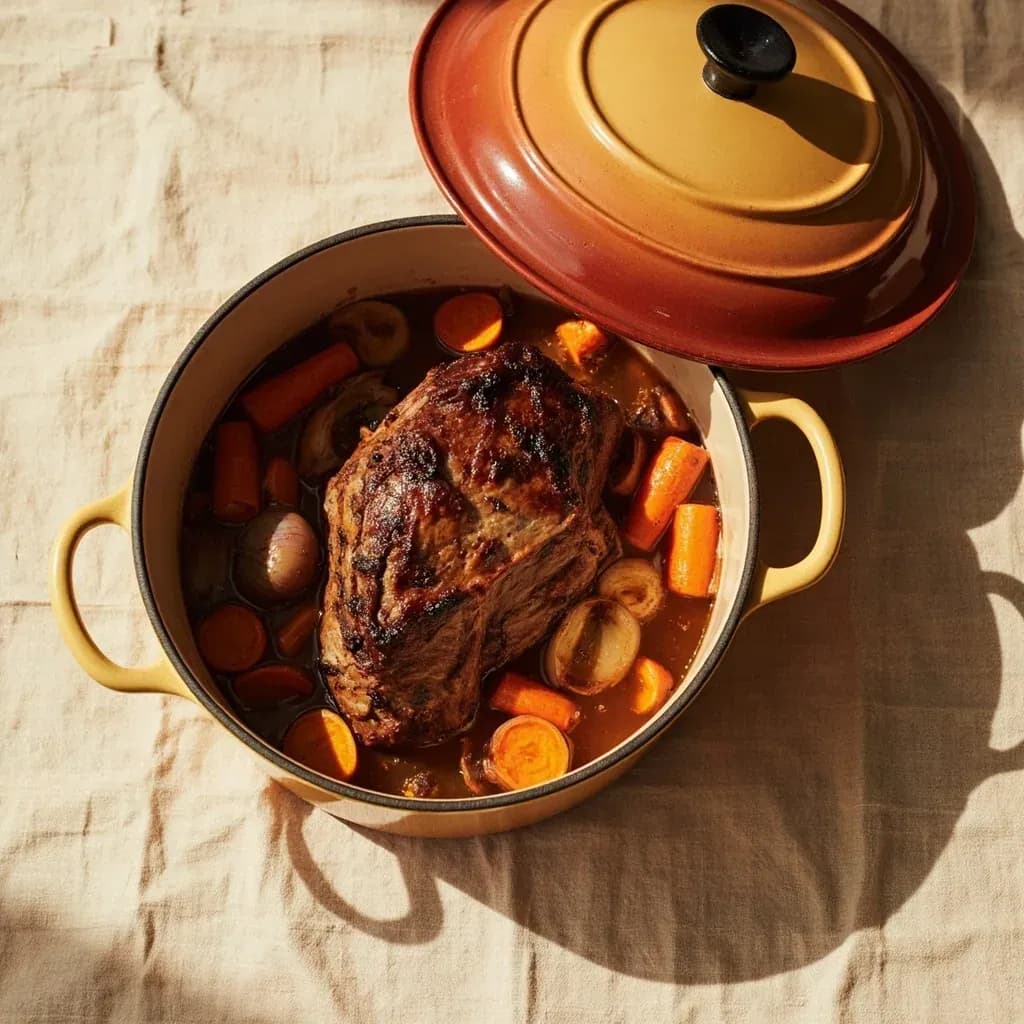
Searing a large cut, then cooking it covered in a small amount of liquid with aromatics so it self-bastes and turns fork-tender.
Pot-roasting is the home cook's quiet superpower. It takes cuts that are too tough, too fatty, or too sinewy for grilling or pan-searing — beef chuck, brisket, pork shoulder, lamb shoulder — and turns them into something that yields to a fork, draped in a glossy sauce built from the same pot. The technique is essentially a braise applied to a single large piece of meat rather than smaller pieces, with the cooking liquid held shallow so that the exposed upper half of the roast continues to benefit from the sear and the aromatic steam that rises from below.
The method does several things at once: a hot Maillard crust for flavor, a long gentle simmer to dissolve collagen into gelatin, and a self-basting environment inside a covered pot. The result is a roast that is simultaneously deeply browned and meltingly tender, with a built-in sauce and enough leftover potential to feed you for days.
Because the method is forgiving — small variations in time, temperature, and liquid are absorbed by the long cook — it rewards planning over precision. Salt the meat the night before, brown it well, keep the liquid low, and let a low oven do the rest. The technique anchors the American Sunday-supper tradition and appears across Europe as a regional classic: German sauerbraten, French bœuf à la mode, Italian brasato al Barolo, and the Jewish onion-buried pot roast among them.
- Difficulty
- Easy
Types & varieties
Beef chuck with onion, carrot, celery, and beef stock, often finished with tomato paste or a splash of red wine; the U.S. default.
German pot roast marinated 3–7 days in vinegar, onion, juniper, and peppercorns, then pot-roasted; served with gingersnap-thickened gravy and potato dumplings.
Piedmontese classic: beef braised in Barolo or other red wine with soffritto, bay, and sometimes a touch of milk.
French pot roast larded and cooked in red wine with carrots, onion, and aromatics; Provençal daube adds orange peel, tomato, and sometimes marc.
Beef chuck cooked buried under a generous quantity of sliced onions that melt down into a sweet, glossy pan sauce.
Modern American (late 20th century) — beef chuck with pepperoncini, ranch seasoning, and butter; frequently made in a slow cooker.
Boston butt or shoulder, often braised with sauerkraut, apples, cider, or caraway; common in German, Austrian, and Eastern European cuisines.
Boned or bone-in shoulder with garlic, rosemary, white wine, and tomato; a Mediterranean tradition.
How to do it
- 1
Choose the cut
Select a well-marbled cut with plenty of connective tissue: beef chuck (first-cut or shoulder), brisket, bottom round, pork shoulder/butt, or lamb shoulder. Tie loosely with kitchen twine if the shape is uneven so it holds together. Pull from the fridge 45–60 minutes before cooking to take the chill off.
- 2
Season
Pat the meat thoroughly dry with paper towels. Season generously on all sides — including the ends — with kosher salt and freshly ground black pepper. For best results, salt 12–24 hours ahead and refrigerate uncovered so the surface dries out further.
- 3
Sear
Heat 2–3 tablespoons of neutral oil in a Dutch oven over medium-high until just smoking. Place the roast in and leave it undisturbed 3–4 minutes per flat side to build a deep brown crust. Sear the two ends as well. Remove and reserve on a plate.
- 4
Sweat the aromatics
Lower the heat to medium. Add diced onion, carrot, and celery to the pot and cook 5–7 minutes in the rendered fat and fond until softened and lightly caramelized. Stir in minced garlic, tomato paste (if using), and any dried spices — peppercorns, juniper, paprika — and cook 1 minute more.
- 5
Deglaze
Pour in 1–2 cups of red wine, stock, beer, or water and scrape the bottom of the pot with a wooden spoon to release every bit of fond. Reduce by about half so the wine cooks off its raw edge.
- 6
Build the braise
Nestle the seared roast back into the pot. Add enough stock, wine, beer, or water to come about 1/3 to 1/2 of the way up the sides of the meat — never more than halfway. Tuck in fresh thyme, rosemary, and 1–2 bay leaves.
- 7
Cook low and covered
Bring to a bare simmer on the stovetop, then cover and transfer to a 275–325°F (135–165°C) oven. Cook undisturbed 3–4 hours for a 3–4 lb chuck, turning the meat once about halfway through. Alternatively, hold on the stovetop at the gentlest possible simmer.
- 8
Test for doneness
The roast is ready when a fork or skewer slides into the thickest part with almost no resistance, the meat reads 195–205°F (90–96°C) on an instant-read thermometer, and the roast looks slack rather than taut when nudged.
- 9
Rest
Transfer the roast to a warm board or platter, tent loosely with foil, and rest at least 15–20 minutes. It will firm up slightly and reabsorb juices.
- 10
Finish the sauce
Skim fat from the braising liquid (or chill briefly so the fat rises and hardens for easy removal). Strain or blend the vegetables back into the liquid, then simmer to reduce to a spoon-coating consistency. Adjust with salt and a splash of red-wine vinegar, lemon, or Dijon to brighten.
- 11
Slice and serve
Identify the grain of the meat — on chuck it changes direction along the length — and slice across it into roughly 1/2-inch (1 cm) thick pieces, or pull apart into chunks if shredding. Spoon the sauce over and serve with boiled potatoes, buttered egg noodles, polenta, or crusty bread.
Why tough cuts work here
The cuts prized for pot-roasting are loaded with connective tissue — collagen, elastin, and silverskin — that makes them chewy if cooked quickly to medium-rare. Held at a low, steady simmer in moist heat, that collagen slowly hydrolyzes into gelatin, the same substance that gives stock its body. Gelatin coats the muscle fibers, lubricates them, and turns what was a rubbery bite into a soft, almost silken texture. The Maillard crust built during the sear contributes a second layer of flavor that poaching or stewing would wash away.
- Salt well in advance (12–24 hours) — salt begins dissolving proteins and lets seasoning penetrate past the surface.
- Aim past well-done on the thermometer: 195–205°F is the window where connective tissue has fully softened.
- Hold the liquid at a bare simmer; a rolling boil tightens muscle proteins and toughens the meat.
- Rest the roast before slicing so the gelatin re-sets rather than running onto the board.
Common uses
Tips & pitfalls
- Salt the roast 12–24 hours ahead if possible; dry-brining deepens seasoning and helps a better crust form.
- Pat the meat dry before searing — surface moisture is the main enemy of browning.
- Use a heavy pot that holds heat evenly; cast iron or enameled cast iron is the standard.
- Don't crowd the pot — sear the roast with space around it so steam can escape and crust can form.
- Keep the liquid low: 1/3 to 1/2 up the sides of the meat. Submerging the crust wastes the sear and yields boiled flavor.
- Hold a bare simmer, never a boil — agitation tightens proteins. A 275–325°F oven gives the most even, hands-off heat.
- Test doneness with a fork or skewer as well as a thermometer; it should slide in with almost no resistance.
- Slice across the grain. The grain on a chuck changes direction along the roast, so turn the meat and recheck before each slice.
- Defat and reduce the braising liquid for a glossy sauce, then finish with a splash of acid to brighten it.
- Pot roast is reliably better the next day — refrigerate the meat in its liquid and reheat gently.
Good to know
- Category
- Combination cooking — a braise applied to one large piece of meat
- Best cuts
- Beef chuck (first-cut/shoulder), brisket, bottom round; pork shoulder (Boston butt); lamb shoulder
- Target internal temperature
- 195–205°F (90–96°C) — well past medium to fully break down collagen
- Oven temperature
- 275–325°F (135–165°C)
- Typical time
- 3–4 hours for a 3–4 lb (1.4–1.8 kg) chuck; longer for larger or bone-in cuts
- Liquid level
- About 1/3 to 1/2 up the sides of the meat — it should braise, not poach
- Key equipment
- Dutch oven or heavy lidded pot — cast iron, enameled cast iron, or heavy stainless
- Origin
- European; the term 'pot-roast' appears in 18th-century English cookery texts; closely tied to Dutch-oven cookery
- Difficulty
- Beginner-friendly and very forgiving
Also called
pot roast · dutch-oven roast · braised roast
