Transform & Preserve
Dry Brining
Salting meat in advance so it draws in seasoning and retains moisture without a liquid bath.
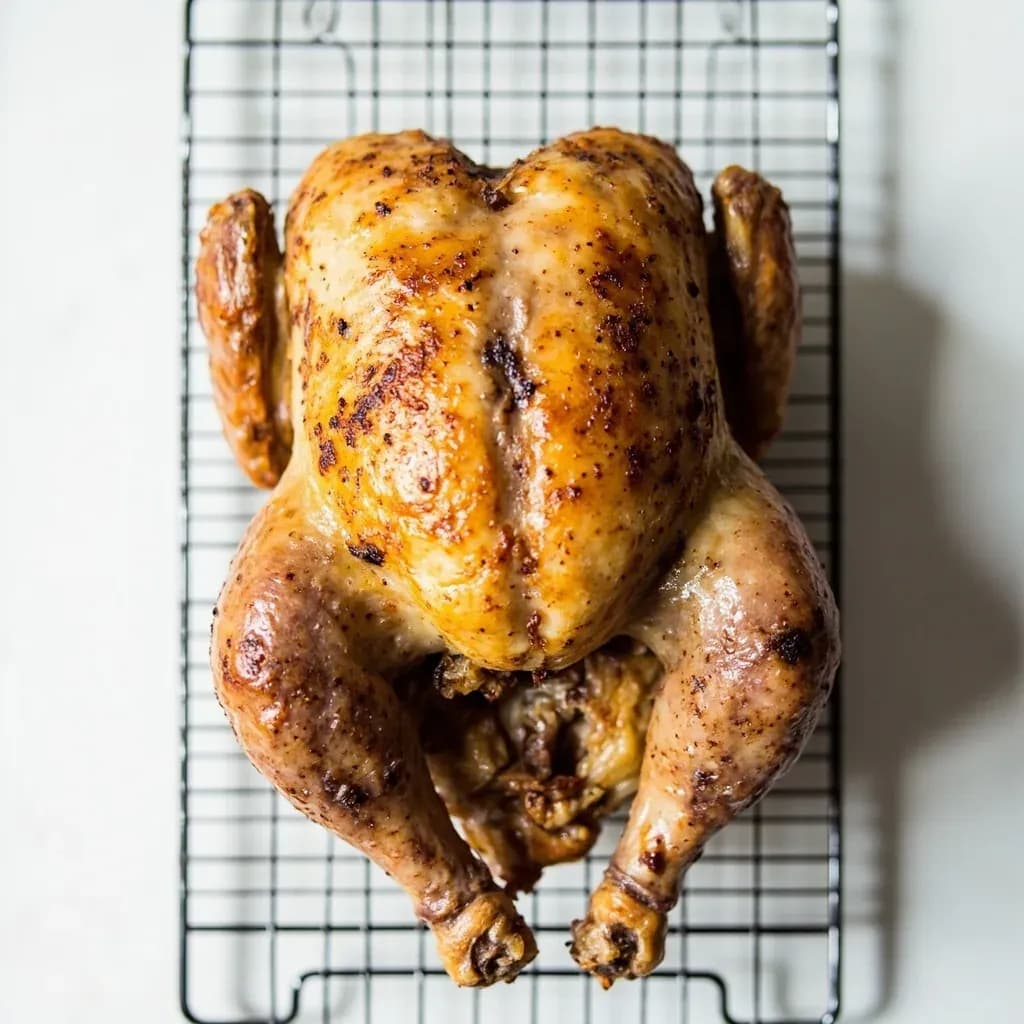
Dry brining rubs salt directly onto meat or poultry and rests it, uncovered, for hours or days before cooking. The salt first draws out moisture, dissolves into a concentrated brine, then is reabsorbed, seasoning the interior and helping the protein hold juices while crisping the surface. It is simpler and less diluting than wet brining and is a favorite for roast chicken, turkey, and steaks.
Dry brining is the practice of salting raw meat — poultry, pork, beef, lamb, or game — and resting it uncovered in the refrigerator for hours or a few days before cooking. The salt first pulls moisture out of the muscle by osmosis; that liquid dissolves the surface salt and is then reabsorbed into the meat, carrying seasoning deep below the surface. The result is a piece of protein that is evenly seasoned from edge to edge and noticeably juicier in the finished dish.
The moisture-retention effect does not come from added water — none is added. Salt dissolves a portion of the surface myosin, a muscle protein, which gels as the meat heats and physically traps liquid that would otherwise weep into the pan. Because the surface dries out during the uncovered rest, dry-brined birds and roasts also brown faster and develop crackling skin. The technique itself is ancient, but its modern articulation — and the name 'dry brine' — was popularized in U.S. home cooking for Thanksgiving turkey and in food-science writing by Harold McGee and Kenji López-Alt. It is distinct from a dry rub, which is calibrated for surface flavor and bark, and from a wet brine, which adds moisture along with seasoning.
- Difficulty
- Easy
Types & varieties
Just kosher salt; the baseline technique for steak, pork, and poultry
Sugar added at roughly 1:4 to 1:2 ratio to the salt; common for pork, duck, and turkey to balance salt and encourage browning
Salt mixed with dried herbs, cracked pepper, garlic powder, smoked paprika, or other dry spices; avoids the wet paste that fresh aromatics would create
A hybrid where thick dairy is rubbed on after a salt-only dry brine to tenderize and flavor poultry
Butcher and regional variations such as coriander-and-black-pepper salt for pork belly, or Sichuan-spice salt for duck
How to do it
- 1
Choose and measure the salt
Use kosher salt — Diamond Crystal is the common reference; if using Morton, use roughly half the volume. Calculate about ½ to 1 teaspoon per pound of meat, or about 0.5% of the meat's weight for a moderate brine, up to about 0.75% for very thick roasts or whole birds. If using sugar or dry aromatics, mix them with the salt first.
- 2
Pat the meat dry
Blot the surface thoroughly with paper towels. A dry surface helps the salt adhere and begins the surface-drying that will later help browning.
- 3
Season evenly on all sides
Sprinkle or rub the salt uniformly over the top, bottom, and sides. For whole birds, gently lift the skin over the breast and thighs and work some salt directly onto the meat underneath.
- 4
Set up for air circulation
Place the meat skin-side up on a wire rack set inside a rimmed sheet pan. The rack keeps the underside from sitting in released liquid, which would steam the skin instead of drying it.
- 5
Refrigerate uncovered
Chill for the appropriate time: small cuts 1–4 hours, steaks 1–24 hours, chicken parts up to about 24 hours, whole chicken 12–48 hours, turkey 1–3 days. Do not cover with plastic — you want the surface to dry.
- 6
Check and dry before cooking
Remove from the fridge. If any undissolved salt crystals remain on the surface, brush or wipe them off; the salt underneath has already penetrated. Pat the surface again with paper towels. The skin should feel tacky-dry, not wet.
- 7
Cook without adding more salt early
Sear, roast, grill, or smoke the meat as your recipe directs. Taste before adding finishing salt to pan sauces or compound butters — the meat is already seasoned throughout.
Salt brands and measurement
Dry brining is unusually sensitive to the type of salt you use, because the dose is small and the difference between brands is large. Diamond Crystal kosher salt — the light, flakey kind sold in the blue carton — is the standard reference in most modern recipes, and Morton kosher salt is roughly twice as dense by volume. A teaspoon of Morton will season a steak as if it were two teaspoons of Diamond Crystal, which is the single most common silent over-salting mistake in the technique. Fine table salt and iodized salt are denser still and should be cut to about half the volume of Diamond Crystal. When in doubt, weigh the salt: 0.5% of the meat's weight in any fine-grained salt is a reliable starting point that translates across brands. Coarse sea salt can be substituted roughly volume-for-volume for Diamond Crystal, but weighing is the only way to be certain.
Common uses
Tips & pitfalls
- Weigh the meat and the salt when you can; volume measures with kosher salt vary enormously between brands
- If you only have table salt, use about half the volume you would use of Diamond Crystal kosher, and season conservatively
- Always place the meat on a wire rack over a sheet pan — a flat plate traps the released liquid and steams the skin instead of drying it
- For whole birds, work salt under the breast and thigh skin so it seasons the lean breast meat, not just the skin
- Pat the surface dry with paper towels just before cooking; any dampness will suppress browning
- If white salt crystals still sit on the surface after long brining, brush or wipe them off before cooking — the salt underneath has already penetrated
- Combine with reverse-searing: dry-brine, then slow-roast or sous-vide to a few degrees below target, and finish with a hard sear for crust
- For turkey, hold off on stuffing the cavity with bread dressing until after brining, since salt absorption from inside the cavity is uneven
- Do not add extra salt in a finishing rub or pan sauce without tasting — the meat is already seasoned through
- Resist the urge to rinse; rinsing washes flavor off the surface and defeats the browning benefit
Good to know
- Also known as
- Pre-salting; salt curing (in a loose sense); sometimes called a 'dry cure' when applied to whole-muscle meats
- Core mechanism
- Salt draws moisture out by osmosis, dissolves in it, and is reabsorbed; it also dissolves surface myosin, which gels during cooking to trap additional moisture
- Typical salt ratio
- Roughly 0.25–0.75% of meat weight, or about ½–1 teaspoon kosher salt per pound; thicker and leaner cuts lean toward the higher end
- Recommended salt
- Coarse kosher salt; fine table or iodized salt is denser by volume and over-salts easily
- Morton vs. Diamond Crystal
- Morton kosher salt is roughly twice as dense by volume as Diamond Crystal, so the same measure of each seasons very differently
- Surface requirement
- Uncovered on a wire rack over a sheet pan so air circulates and the skin or exterior dries
- Timing
- Roughly 1 hour per inch of thickness for small cuts; whole chicken 12–48 hours; whole turkey 1–3 days; safe upper limit about 2 days for chicken parts, 3 days for whole chicken, 3–4 days for turkey
- Not the same as
- A dry rub — rubs are calibrated for surface flavor and crust, while a dry brine is dosed by weight and time to season deeply and hold water
Also called
Pre-Salting · Salting
Dishes that rely on it






Related

Confit
Cook slowly submerged in fat for silky tenderness and keeping

Cure
Draw out moisture with salt and time to preserve and concentrate

Pickle
Steep in acidic brine for bright, tangy, crunchy preservation

Ferment
Let friendly microbes transform food into tangy, complex flavor

Marinate
Soak in a seasoned mix to flavor and tenderize before cooking

Brine
Soak in salt water so meat stays juicy and seasoned throughout

Dehydrate
Slowly dry out moisture to concentrate flavor and extend shelf life

Cold-Smoke
Perfume cured food with smoke without cooking it through